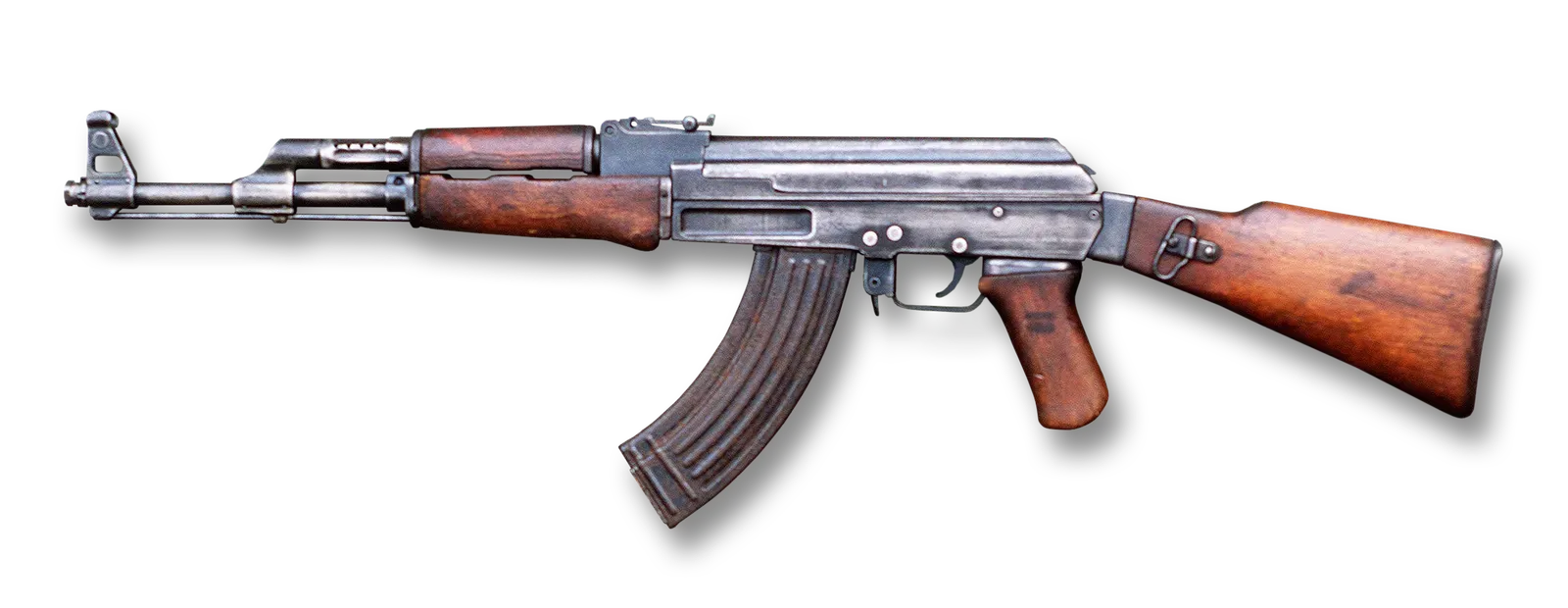
Type “6 July 1947” into a search engine and it will tell you, with total confidence, that this is the day the AK-47 went into production in the Soviet Union. Wired ran the line in 2009. Sputnik ran it again in 2017, calling it a seventieth birthday. It is one of the most repeated “this day in history” facts attached to any weapon ever built. It is also not true. The Soviet trial records tell a slower, messier story, and the rifle that would eventually be called the AK-47 did not exist yet on that date - not as a finished design, and not for another four months.
What did exist, and what was actually undergoing testing in the first days of July 1947, was an earlier and inferior prototype. From 30 June to 12 July that year, a commission chaired by one N. S. Okhotnikov ran comparative field trials on five competing automatic rifles, including Kalashnikov’s. The verdict, recorded afterwards, was blunt: none of the entries met the Red Army’s technical requirements, and none could be recommended for production. Three designers, Kalashnikov among them, were told to go back and fix their weapons. The gun now celebrated every 6 July on aggregator websites was, on the actual 6 July in question, a documented failure sent back for rework.
Kalashnikov did more than fix it. Working with a fellow designer, Alexander Zaytsev, at the Kovrov arms plant, he tore up his own layout and started again. The result, completed in November 1947, replaced the earlier design’s separate upper and lower receivers with a single unit, swapped a short-stroke gas piston for a long-stroke one bolted straight to the bolt carrier, and merged the safety and fire selector into one lever on the side of the receiver - the large, unmistakable paddle that anyone who has ever handled the rifle will recognise. This was the weapon that first earned the name AK-47. It was not yet two months old on the day the internet insists it went into production.
It still had two more years to survive. Kalashnikov’s redesign beat rival entries from designers Bulkin and Dementyev in trials at the Shchurovo proving ground over the New Year of 1947 into 1948, and the commission’s own reasoning, as later recorded, amounted to this: a reliable rifle with merely adequate accuracy available immediately beat a more accurate one available eventually. A first batch of a hundred rifles was assembled at factory No. 524 in Izhevsk by May 1948 for troop trials. Formal adoption did not come until 18 June 1949, by a Council of Ministers decree that gave the weapon its lasting bureaucratic name: the 7.62mm Kalashnikov assault rifle, model of the year 1947. The number frozen into that name describes a design that, in the very year it credits, had already failed once and been rebuilt from nothing. Mass production at Izhevsk followed the decree, not the design.
It is also worth clearing up who actually built it, since a persistent rumour credits Hugo Schmeisser, the German engineer behind the wartime StG 44, with secretly designing the Kalashnikov. Schmeisser was in the Soviet Union at the time, one of roughly fifteen German engineers relocated to Izhevsk between 1946 and 1951 as part of postwar reparations. But he worked in a separate bureau, had no clearance for what was then a classified programme, and Kalashnikov did his design work eighty kilometres away in Kovrov. The resemblance between the two rifles is real enough at a glance - stamped receiver, curved magazine, similar silhouette - but the mechanisms inside are different, and the myth says more about Cold War assumptions that a Soviet peasant’s son could not have designed a serious weapon than about the historical record.
That peasant’s son had a specific grievance driving him. Kalashnikov was a tank commander, wounded near Bryansk in October 1941 during one of the Wehrmacht’s early routs of the Red Army. Recovering in hospital, he listened to fellow soldiers complain that German infantry carried automatic weapons while Soviet units often shared a single bolt-action Mosin rifle between three men. He decided, without any formal engineering training, to build something better. It took him six years, several failed prototypes, and one badly timed set of trials in the first week of July 1947 to get there.
What he eventually delivered was built on a philosophy almost opposite to Western small-arms design of the period: generous clearances between moving parts, a heavy bolt carrier, and tolerances loose enough that sand, mud, and sub-zero grease could accumulate inside the action without stopping it from cycling. The American rival that would meet it in combat, Eugene Stoner’s M16, was engineered the other way - tighter, lighter, more accurate, and considerably less forgiving. Early M16s issued in Vietnam in 1965 and 1966 suffered well-documented jamming failures, traced to a change in propellant and the initial absence of a chrome-lined chamber, and a 1967 congressional subcommittee investigated soldiers found dead beside rifles they had been unable to clear. The AK-47 carried by the other side that same year rarely had that problem. Two Cold War engineering philosophies met each other in the same jungle, and only one of them was designed to be neglected.
From there the numbers do the rest of the talking. Licensed and unlicensed production spread the design through the Warsaw Pact and beyond - China’s Type 56, Poland’s, East Germany’s, Yugoslavia’s Zastava - until estimates of Kalashnikov-pattern rifles in circulation ranged from 70 million to over 100 million, somewhere around one in five or six of all firearms on Earth. It was cheap enough to end up priced, in parts of Somalia, Congo, and Kenya, between thirty and a few hundred dollars, or bartered directly for livestock and grain where cash was scarce. It was light and simple enough that a child could be taught to strip, load, and fire one in under an hour, which is precisely why children were.
The rifle became something more than hardware. It sits today on the flag and coat of arms of Mozambique, the only firearm depicted on any national flag currently flown, chosen deliberately to mark a war of independence fought largely with captured and Soviet-supplied Kalashnikovs. It appears on the coats of arms of Zimbabwe and East Timor, on the former flag of Burkina Faso, and on the emblems of Hezbollah, FARC, and a long list of other armed movements that never had a state to put it on a flag for. No other weapon in history has been adopted as a national and revolutionary symbol quite so widely, by governments and insurgents alike, often on opposite sides of the same war.
Kalashnikov himself never entirely made peace with what he had built. In 2002, visiting a weapons museum in Germany, he told the tabloid Bild that he would have preferred to invent something people could use to help themselves, “for example a lawnmower” - a remark made slightly ridiculous by the fact that he had, in fact, already built himself one, welding a milk cart and washing-machine parts together to cut the grass at his dacha outside Izhevsk. The joke thinned considerably ten years later. In a letter written in 2012 and published only after his death, he told the head of the Russian Orthodox Church that his “spiritual pain is unbearable,” and asked whether he, an Orthodox believer, bore responsibility for the deaths caused by a rifle he had spent sixty years watching multiply beyond anyone’s control. He died in December 2013, aged ninety-four, with President Putin at the funeral.
No archive will tell you the exact day mass production of the AK-47 began, because no such day exists in the tidy form the anniversary trade prefers. The rifle failed a trial the week it is supposed to have been born, and was rebuilt from scratch before it earned its own name. What is not in dispute is what happened once the paperwork caught up: a weapon designed to be neglected, in the hands of a hundred million people who neglected it accordingly, on every continent except Antarctica. Kalashnikov wanted to be remembered for a lawnmower. He built one. Nobody remembers that either.