The Butterfly Effect
A murder in Taiwan. A pandemic in China. A war in Europe. One chain of events.
The Butterfly Effect is now available on Kindle. Join the mailing list for news about books, essays, blogs, and occasional notes.
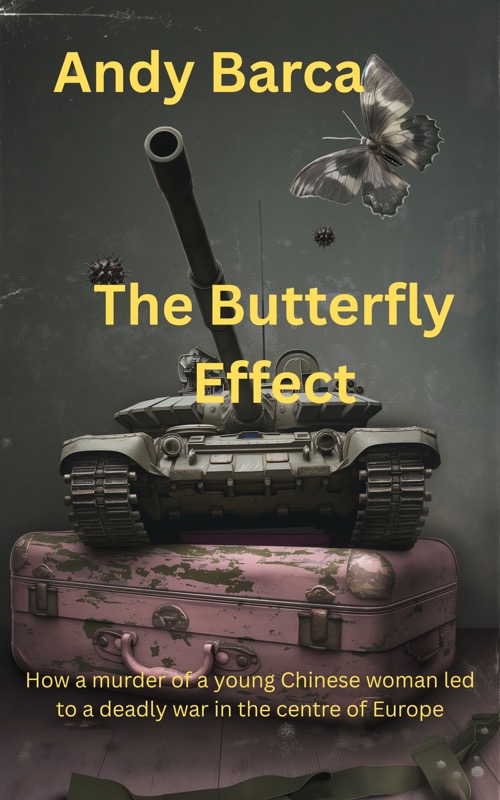
In 2018, a seemingly isolated murder in an Asian metropolis set off a cascade that would reach the heart of a continent. The Butterfly Effect traces the links: mass demonstrations in a global financial hub, a novel virus' outbreak leveraged for political gain, and the increasingly insulated decisions of an aging autocrat. This is chaos theory in action—how one crime of passion ripples through political systems and public health crises to reshape regional security.
Documented with precision and told with the drive of a thriller, the book reveals the fragile architecture of our world — and how vulnerable it remains to the next small perturbation.
A murder in Taiwan. A pandemic in China. A war in Europe. One unexpected chain of events, that affected all of us.
In February 2018, a Hong Kong man murdered his girlfriend in Taiwan and stuffed her body in a pink suitcase. That seemingly isolated crime triggered a cascade of geopolitical consequences that would ultimately contribute to hundreds of thousands of deaths in a European war.
The Butterfly Effect traces this chain of causation with forensic precision. From mass demonstrations on the streets of an Asian financial hub, to a novel virus' outbreak leveraged for political gain, to the growing isolation of an elderly autocrat amidst lockdowns — the chain is followed link by link.
This is not conspiracy theory. It is chaos theory in action: how interconnected systems amplify small perturbations into catastrophic outcomes. Through specific dates, documented events, and observable human decisions, the narrative reveals the fragile architecture of our globalized world—where a crime of passion in one city can ripple through political systems, public health crises, and authoritarian calculations to reshape the security of an entire continent.
What you'll get is a bracing, tightly argued narrative that pulls together events most commentators treat as unrelated, showing how they collide to shape our present. By threading COVID‑19 and the Ukraine war through an unexpected causal lens, the book turns abstract geopolitics into concrete human stories with clear, traceable links. It moves with the drive of true crime, political thriller, and contemporary history at once—while reaching back to older historical shocks and inflection points to make sense of the moment we are living through now.
Written with documentary objectivity and narrative economy, The Butterfly Effect offers both the satisfaction of understanding how we arrived at this moment and the unsettling recognition of how vulnerable our world remains to the next unexpected perturbation.
Sample
Get a taste of the book's style and argument with this excerpt.
In the early morning of February 24, 2022, residents of villages northwest of Kyiv heard a sound that froze them where they stood. A deep rhythmic thudding, growing louder, coming from the north. The rotor wash of heavy helicopters — not one or two, but many — flying lower than anyone had ever seen military aircraft fly. The machines burst over the tree line, so close that windows rattled in their frames. Dogs cowered. Children pointed. Old men who remembered Soviet times felt something cold settle in their stomachs.
The Mi-8 helicopters crossed the Kyiv reservoir flying low and fast, skimming the grey February water at treetop height to avoid Ukrainian radar. Inside each helicopter sat twenty men from Russia’s 45th Guards Spetsnaz Brigade — the elite of the elite, trained for exactly this kind of operation.
Their target was Antonov Airport, known locally as Hostomel. The facility sat twenty-five kilometres northwest of Kyiv, its single runway long enough to land the massive An-124 transport aircraft that gave the airport its name. If Russia could seize and hold Hostomel, they could fly in thousands of troops directly to the outskirts of the Ukrainian capital. The war would be over in days. The government would fall. A puppet regime would be installed. The West would protest impotently, as before, and then move on.
That was the plan.
The helicopters touched down on the frozen grass beside the runway. Commandos poured out and sprinted toward the control tower and terminal buildings. Some Ukrainian National Guard units were present — a skeleton force, not prepared for an assault of this magnitude. The Spetsnaz moved with practiced efficiency. Small arms fire crackled across the airfield. Grenades detonated against defensive positions. Within hours, the Russians controlled the airport.
But control and consolidation are different things.
Ukrainian forces regrouped faster than Russian planners anticipated. Reinforcements arrived from Kyiv. Artillery units found their range. By afternoon, shells were landing on the runway. The An-124 transports loaded with paratroopers sat on airfields in Belarus, waiting for the signal that never came. The runway wasn’t secure. Landing heavy aircraft under artillery fire would be suicide.
Through the night, fighting continued. Ukrainian special forces counterattacked. The Spetsnaz, cut off from resupply and reinforcement, held their perimeter but couldn’t expand it. More Ukrainian units arrived. The battle for the airport became a battle for survival.
By morning on February 25, the Russians withdrew. They left behind destroyed helicopters, abandoned equipment, and dead soldiers. The airport itself was wrecked — cratered runway, burning buildings, scattered debris. Neither side could use it now. But the strategic failure belonged to Russia. The air bridge to Kyiv would not materialise. The quick decapitation strike had failed.
The war would not be over in days.
While vital, Hostomel was just one of many moving parts in the larger plan. As the Spetsnaz fought and died at the airfield, the main body of the Russian invasion force was crossing the Ukrainian border along a front stretching over a thousand kilometres.
From Belarus in the north, armoured columns pushed toward Kyiv along multiple axes. From Crimea in the south, troops advanced toward Kherson and the water supply that sustained the peninsula. From the east, forces struck toward Kharkiv, Ukraine’s second-largest city, just forty kilometres from the Russian border. Tens of thousands of Russian soldiers entered Ukraine that first day, and more followed. They expected to face a demoralized enemy, a population ready to welcome liberation, a government that would flee.
They found none of these things.
Russian military planners had made assumptions. They assumed the Ukrainian army was the same demoralized, corrupt force they’d brushed aside in Crimea eight years earlier. They assumed Russian-speaking Ukrainians in the east would welcome their “liberation.” They assumed Zelensky — a comedian turned politician with no military experience — would flee at the first sound of artillery. They assumed Western nations would do what they always did: issue condemnations, impose symbolic sanctions, and ultimately accept the new reality.
Every assumption proved wrong. How wrong, and why, is a story we will return to later in this book.
Ukrainian soldiers fought. Civilians formed territorial defence units. The government stayed in Kyiv. President Zelensky, offered evacuation by the Americans, reportedly replied: “I need ammunition, not a ride.”
The war that was supposed to last three days stretched into weeks, then months, then years. It is still ongoing at the time of writing this book. Tens of thousands died. Millions fled their homes. Cities were reduced to rubble. The largest conventional war in Europe since 1945 had begun.
Among the soldiers who fought that day — Russian conscripts, Ukrainian reservists, Spetsnaz commandos, territorial defence volunteers — how many knew the name Chan Tong-kai?
Probably none.
Perhaps one soldier, somewhere in that vast theater of war, had seen the name in a newspaper four years earlier. A minor story from Hong Kong, quickly forgotten. Perhaps a university student mobilized into a territorial defence unit had studied East Asian politics and encountered the case in passing. Even so, they would not have connected it to the shells falling around them, the tanks rolling through their villages, the helicopters descending on their airfields.
And even if someone had heard the name, they could not have pronounced it correctly. Chan Tong-kai is Cantonese, one of the world’s most difficult languages for foreigners to learn and to pronounce correctly. Russian and Ukrainian soldiers were not, in general, gifted linguists. So the name meant nothing to them. A string of foreign syllables, if they ever saw it at all.
Yet this person — this name no one on the battlefield would recognize — set in motion the chain of events that brought armies to Ukraine. Not through intention. Not through conspiracy. Through a single act of violence in a hotel room on the other side of the world, four years earlier, whose consequences rippled outward through systems and decisions and accidents until they crashed against the borders of Europe.
In February 2018, a young woman named Poon Hiu-wing died in Taipei. Her boyfriend, Chan Tong-kai, killed her during an argument. He stuffed her body into a pink suitcase and dumped it in the bushes near a suburban train station.
The crime was tragic, but not something to grab the headlines. One death among the thousands that occur worldwide each day from intimate partner violence. One victim out of many, soon forgotten.
Except it wasn’t forgotten. Because of where it happened, and who was involved, and what geopolitical peculiarities it exposed — the killing of Poon Hiu-wing became a pebble dropped into still water. The ripples spread. They reached Hong Kong, then moved quickly to Beijing, and eventually spread across the globe, reshaping the lives of hundreds of millions of people.
The ripples reached Hostomel, where helicopters descended through morning fog and commandos died on a frozen airfield.
This book traces those ripples.
Not through speculation. Not through conspiracy theory. Through documented events, dated decisions, observable consequences. Each link in the chain is established before moving to the next. The connections are real. They can be verified.
The blood spilled in Taipei in 2018 was regrettable but minor — one victim, one killer, one tragedy. The blood that would flow from that single death filled rivers on the other side of the world.
This is how it happened.
Where to buy
Also available on all other Amazon country-specific sites.
A Note from the Author
The idea for this book arrived in July 2022, while I was glued to the news from Ukraine. Like so many others, I had watched the Russian invasion unfold in disbelief. Just a year earlier, a similar build-up on the border had come to nothing. This time it was real, and it made no sense to me.
At first I was simply appalled. Then the question took hold: why? What sequence of choices and accidents had brought us here? I have always been a keen reader of history — ancient and modern — and it was not long before a plausible, if crude, chain of events began to form in my mind, linking places and crises that most commentators treated as unrelated.
That chain started life not as a book but as a single page of thirteen bullet points, typed out one evening and then left to stew. I returned to them again and again, turning each point over in my mind, testing it against the record. Somewhere along the way the list became an outline, the outline became a draft, and the draft became the text you hold today.
The journey from those thirteen points to a finished manuscript was longer and harder than I ever anticipated. I had never attempted anything of this scale, and there were stretches where the research alone felt bottomless. I started writing the main text more than once, only to abandon it as I realised it was not working. But I didn't give up. The story wanted to be written, to get out, and it kept pulling me forward — each link in the chain demanded the next.
I am proud of the result, and genuinely glad it is now in your hands. If it provokes a thought, a disagreement, or even a conversation during a lunch break, I shall consider the effort well spent. I would be delighted to hear from you — comments, questions, challenges, all welcome. Do get in touch any time you like.