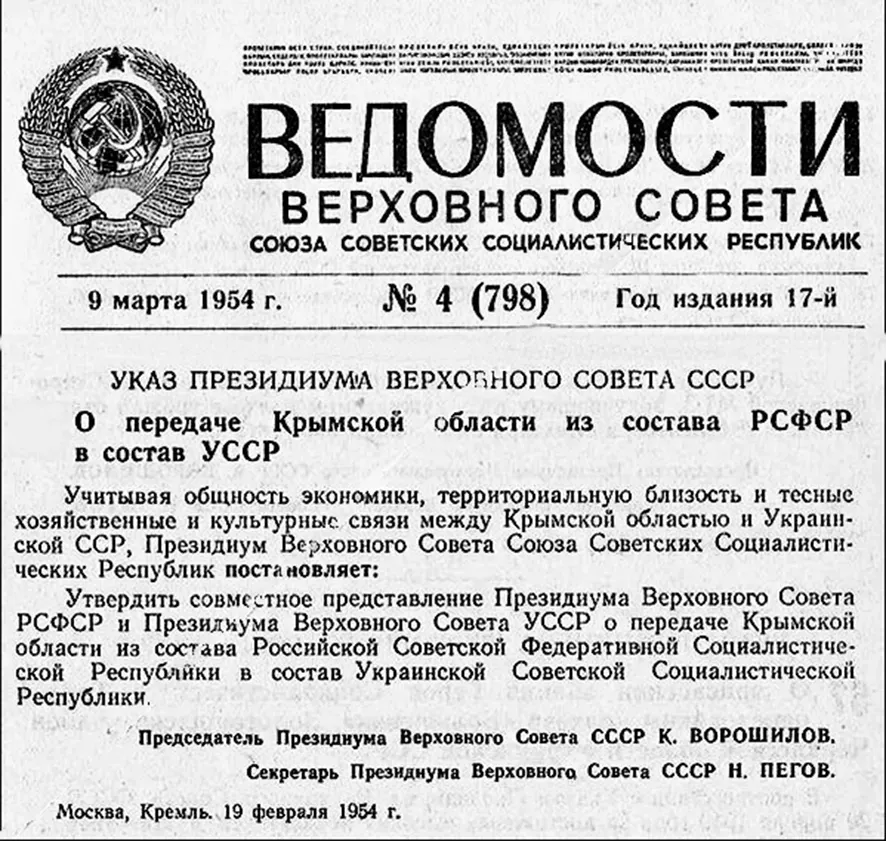
On 19 February 1954, the Presidium of the Supreme Soviet of the USSR convened to consider an administrative proposal. The Crimean Oblast — a peninsula jutting into the Black Sea, populated mostly by Russians, home to the naval base at Sevastopol — would be transferred from the Russian Soviet Federative Socialist Republic to the Ukrainian Soviet Socialist Republic. The official justification was ceremonial: the 300th anniversary of the Pereyaslav Agreement, the 1654 treaty in which the Cossack Hetmanate had bound itself to the Tsardom of Russia. The practical argument was geographic: Crimea’s economy was linked to Ukraine by road, rail, and water supply; administering it from Moscow made little sense. Nikita Khrushchev, recently installed as party first secretary and deeply connected to Ukraine through his years running the Ukrainian party apparatus, backed the move. The session lasted about fifteen minutes. The vote was unanimous.
It was, everyone agreed, a technicality.
Within the logic of 1954, this is defensible. The USSR was a single state. The distinction between the Russian Soviet Federative Socialist Republic (RSFSR) and the Ukrainian Soviet Socialist Republic was, for most practical purposes, the same as the distinction between counties in England — real on paper, mostly irrelevant to daily life. Citizens of both republics held the same passports, answered to the same leadership, and could not meaningfully refuse. No one asked them anyway. The internal border was an administrative line, not a border in any sense that mattered. Moving Crimea from one republic to another was roughly like reassigning a district from one regional authority to another: an act with no obvious geopolitical weight, no sovereignty implications, no real-world stakes.
The assumption embedded in that logic — so obvious it did not need stating — was that the Soviet Union would always exist.
It lasted thirty-seven more years. When the USSR dissolved in December 1991, its internal borders became international ones overnight. The line that had separated the Russian SFSR from the Ukrainian SSR became the border between the Russian Federation and the new state of Ukraine. Crimea, with its Russian-speaking majority, its history as a Russian imperial prize, and its hosting of the Russian Black Sea Fleet at Sevastopol under a lease arrangement, was now — legally, inarguably, tauntingly — Ukrainian territory.
The arrangement was unstable from the start. Russia’s hold on Sevastopol, the port through which it projected naval power into the Mediterranean, now depended on a lease with a foreign government. The ethnic composition of the peninsula meant that local politics never fully aligned with Kyiv. And Russian nationalist sentiment, always ambivalent about the 1954 transfer, became more vocal every decade. The question of Crimea sat under the surface of Ukrainian-Russian relations like a fault line, occasionally trembling, never fully quiet.
In February 2014, after the Euromaidan revolution toppled the unpopular Ukrainian president Victor Yanukovych and installed a government oriented toward the EU and NATO, Russia made its move. Soldiers in unmarked uniforms — “little green men,” in the diplomatic euphemism of the time, soldiers the Kremlin denied were its own — appeared at airports and government buildings across Crimea. A referendum, organised in sixteen days and held under armed occupation, produced a 97% vote to join Russia. The Kremlin announced it was correcting a historical injustice. The 1954 transfer, officials said, had been unconstitutional under Soviet law — a legal fiction that the new Russia was simply unwinding. Putin called it a theft.
The legal argument was thin. Soviet constitutional procedures had not been followed correctly in 1954 — probably — but Soviet constitutional procedures had rarely been followed correctly for anything, and Russia had accepted the transfer without protest for thirty-seven years of independent existence. What the argument actually was, stripped of the legal dressing, was simpler: Crimea is Russian because it has always been Russian, the 1954 decision was illegitimate, and Russia has the right to take it back. International law said otherwise. The UN General Assembly passed a resolution declaring the referendum invalid. Russia’s Security Council veto blocked any enforcement.
Crimea spent the next decade as Russia’s most visible territorial acquisition — and its most useful military platform. When Russia launched its full-scale invasion of Ukraine in February 2022, the peninsula served as a primary staging ground, its ports and airfields providing the infrastructure for the assault on southern Ukraine. The administrative transfer of 1954, seventy years on, had become a military launchpad.
This is the pattern. A bureaucratic decision, made in minutes, in the belief that its consequences are contained — and then the context it was made in collapses, and the consequences escape. The people in that room in 1954 were not reckless. They were operating on a reasonable assumption. The assumption failed on a generational timescale, which is not the timescale on which bureaucratic decisions are made. By the time the fault line cracked open, no one who had signed the transfer order was alive to answer for it.
The other thing worth noting is how readily a purely administrative act becomes historical grievance. The 1954 decision was not widely remembered or politically salient for most of the Soviet period. It took a specific confluence — Soviet collapse, Ukrainian independence, NATO expansion, Russian revanchism under Putin — to turn a bureaucratic footnote into a casus belli. History does not automatically make use of its old grievances. But it keeps them on file, and under the right conditions, it reaches for them.
That pattern — the administrative line that becomes, decades later, a fuse — is one of many I trace across a longer arc in The Butterfly Effect. The Crimean transfer is not an isolated case. It is one link in a chain of decisions, each of which seemed contained at the time, each of which turned out not to be.