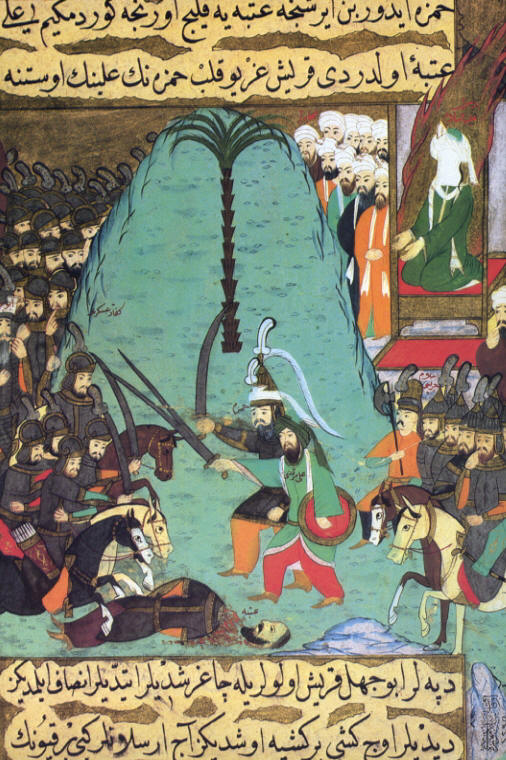
On 13 March 624, a small nacent Muslim force of 313 men — two horses between them, 70 camels shared among more than 300 — met a Qurayshi army of roughly 1,000 men, 100 horses, and considerable expectation of an easy afternoon, in a valley called Badr, about 130 kilometres south-west of Medina. The Muslims had not come for a battle. They had come to raid a merchant caravan worth 50,000 dinars. The caravan was long gone. The battle happened anyway. By early afternoon it was over, the Qurayshi dead were being thrown into a dry well, and the course of Arabian history had turned in a direction nobody had entirely planned.
This is how most decisive events begin: as something else entirely.
Two years before Badr, in 622 CE, Muhammad and his followers had left Mecca — fled, really, under sustained pressure from the Quraysh, who were the ruling tribe and found the new religion inconvenient. The Quraysh had confiscated the property the migrants left behind. They were not just theological opponents; they were creditors who owed a debt and did not intend to pay it. Medina, some 400 kilometres to the north, offered the community shelter and a degree of political authority. Muhammad was invited in to settle a long-standing dispute between the city’s tribal factions and emerged as a genuine leader, with a base, a growing number of followers, and the beginnings of something that looked like a state.
The instrument of economic retaliation was the caravan raid. The Quraysh of Mecca were merchants. Their wealth flowed along two main routes: north to Syria and the Levant, south to Yemen. Intercepting their caravans was both payback for the confiscations and, if it worked, a deterrent against any future Qurayshi attack on Medina. Between 623 and early 624, Muhammad mounted five or six attempts to intercept Qurayshi trade. None succeeded. The Quraysh were well-connected along the routes and could be warned.
In early 624, a particularly large caravan was returning from the Levant — possibly from Gaza — carrying merchandise worth 50,000 dinars, guarded by 70 men, and led by Abu Sufyan ibn Harb. The caravan had grouped smaller convoys together for safety. Every major Meccan financier had a stake in it. Muhammad gathered around 313 men and moved to intercept.
Abu Sufyan was one of the most capable operators in Mecca, and he found out about the Muslim plan in time to do something about it. He rerouted the caravan toward the Red Sea coast, away from the direct route and away from the Muslim force advancing from Medina. Then he sent a messenger to Mecca, a man named Damdam, who arrived at the Kaaba in a state of theatrical distress — camel’s nose and ears cut off, saddle turned upside down, shirt torn — and cried out that the caravan was under threat and that Mecca needed to send an army.
The Quraysh responded. All the major clans except the Banu Adi assembled an army of around 1,000 men, 100 horses, and enough provisions for a substantial campaign. By the time this force was marching toward Badr, Abu Sufyan had already sent word that the caravan was safe — he had got it clear of the danger. The army received this news at a waypoint called al-Juhfah. Much of it wanted to go home.
What followed shows how battles that nobody intends come to be fought. Abu Jahl — Amr ibn Hisham, chief of the Banu Makhzum and the most energetically anti-Muslim figure in Mecca — refused to turn back. The point, as he saw it, was no longer the caravan. The point was to march to Badr and hold a feast there, visible to the surrounding tribes, demonstrating that the Quraysh were not intimidated by a band of exiles in Medina. The Banu Zahrah, some 300 men, disagreed and went home. Muhammad’s own clan, the Banu Hashim, tried to leave and were threatened by Abu Jahl into staying. The army that continued to Badr was smaller than it had been, composed partly of men who had just been talked out of leaving, led by a man whose primary motive was prestige. It walked into a trap it had marched there on purpose to avoid.
When the Muslim army arrived at Badr before the Meccans, a companion named al-Hubab ibn al-Mundhir made the most important tactical suggestion of the engagement: do not camp at the first well you find. Move to the well closest to the Qurayshi approach, and destroy or block the others. Muhammad had been about to encamp at a different spot; he asked al-Hubab whether the choice was divine instruction or his own opinion. It was his own opinion, Muhammad said. Al-Hubab proposed the change. Muhammad accepted. By midnight, the Muslims had the primary water source, and every other well between their position and the Meccan route had been put out of action. In desert warfare, controlling water is not a tactical advantage. It is the tactical situation. The Quraysh arrived thirsty, in disorganised haste, and found themselves looking up at men who had had a good night’s sleep near the only working well for miles.
The battle opened, as was customary, with single combat. Al-Aswad ibn Abd al-Asad charged out and swore to drink from the Muslim well or die trying. Hamza, Muhammad’s uncle, came out to meet him and obliged him on the second count. Three Qurayshi champions — Utbah ibn Rabi’ah, his brother Shaybah, and his son al-Walid — then stepped forward. Three Medinan volunteers emerged from the Muslim side, but the Qurayshis wanted to keep the dispute within the tribe and waved them back. Hamza, Ali ibn Abi Talib, and Ubaydah ibn al-Harith came out instead. Ali killed al-Walid; Hamza killed Shaybah; Ubaydah and Utbah wounded each other badly enough that Hamza had to finish the job. Ubaydah was carried back to the Muslim lines, where he later died. The score, after the duels, was three to one in Muslim favour, and the initiative was gone from the Quraysh before the main engagement started.
What followed was brief. The Meccan army charged. Muhammad prayed in a lean-to shelter until Abu Bakr reportedly told him he had implored God’s assistance enough, then gave the order to advance. The Muslim counter-charge broke the Qurayshi lines within minutes. The Meccans, already demoralised, outnumbered at the well, and facing men who had nothing to go home to, collapsed and ran. The battle lasted a few hours. It was over by early afternoon.
The figures are stark: 14 Muslims killed, roughly 70 Meccans dead, including Abu Jahl and most of the senior Qurayshi nobility. The men who had bankrolled Mecca’s resistance to Islam died in a valley they had chosen to march to because their chief thought a feast there would look impressive. Abu Jahl was found badly wounded among the bodies; two young Muslim fighters finished him off. His head was brought to Muhammad.
Around 70 Qurayshi prisoners were taken. Muhammad, against the advice of Umar, who argued for execution, chose to ransom them. Those who could not pay in money paid in a different currency: the literate prisoners were released in exchange for teaching ten Muslims each to read and write. It is not often that a ransom policy doubles as an education programme. The account has a slightly too-neat quality, but the broad outline is consistent across sources.
The political transformation was the real consequence. Marshall Hodgson, in The Venture of Islam, writes that Badr forced the other Arab tribes to “regard the Muslims as challengers and potential inheritors to the prestige and the political role of the Quraish.” Before Badr, Muhammad was the leader of a refugee community in a city that had taken him in out of factional necessity. After Badr, he was the head of a city-state with a demonstrated military capacity and the corpses of Mecca’s ruling class to prove it. Tribes that had been watching from a careful distance began to approach. His internal opponent in Medina, Abd Allah ibn Ubayy, found his own position suddenly weakened beyond recovery. The community of exiles had become something harder to ignore.
The strangest beneficiary of Badr was Abu Sufyan — the man who had not been there. He had been the one who got the caravan out. He was alive, his goods were safe, and everyone who might have outranked him in Mecca was dead in a dry well at Badr. By default, he became chief of the Quraysh. Six years later, when Muhammad marched on Mecca with an army of 10,000, it was Abu Sufyan who came out to meet him and negotiated its peaceful surrender. His son Mu’awiya, born a Qurayshi noble in the old order, survived to found the Umayyad Caliphate in 661, which would rule from Spain to Central Asia for nearly a century. The thread runs straight from Abu Jahl’s decision to hold his feast at Badr to the shape of the medieval Islamic world. History has a habit of being made by the men who chose the wrong exit.
The Quran calls the battle Yawm al-Furqan — the Day of the Criterion. Not the Day of the Victory, or the Day of the Surprise: the Day of the Criterion, the moment that separated what came before from what came after. Verse 3:123 states it plainly: “Allah had helped you at Badr, when ye were a contemptible little force.” The phrase is not modest; it is exact. Three hundred and thirteen men, two horses, a good well, and a caravan that slipped away in the night.
The name has not lost its power. Egypt called its 1973 offensive in the Yom Kippur War “Operation Badr.” Pakistan invoked it in the 1999 Kargil conflict. In August 2011, the Libyan rebel leadership announced that they had chosen the date of their assault on Tripoli to fall on the 20th of Ramadan — the anniversary, by the Islamic calendar, of Badr. Armies reach for the name when they want to say: we were outnumbered, we had God on our side, we won.
Muhammad set out for a caravan on 13 March 624. He did not get the caravan. What he got instead was a battle he had not planned, against an army that had not wanted to fight, that handed him the foundations of a state and the beginning of a fourteen-century legend. Abu Sufyan made the correct decision and went home to count his money. Abu Jahl made the fatal one and stayed for his feast. Sometimes the whole of history turns on which man leaves the room.