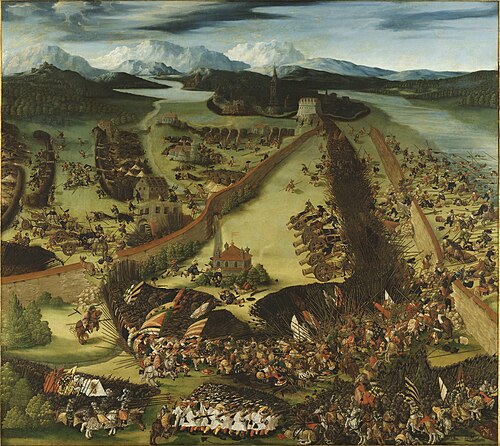
On 24 February 1525, an Imperial army under Charles de Lannoy, Viceroy of Naples, attacked the French forces besieging the city of Pavia in Lombardy. The French king, Francis I, had brought roughly twenty-six thousand men across the Alps to take the city, which had been held since October by an Imperial garrison under Antonio de Leyva. The siege was going well enough — until it wasn’t. The Imperial relief force, around twenty-three thousand strong and including some of the finest landsknecht pikemen in Europe under Georg von Frundsberg, approached from the east and breached the walls of the Mirabello park where the French were encamped. What followed was less a battle than a disintegration. Francis’s heavy cavalry — the king himself at its head — charged into the Imperial lines and was cut apart by concentrated arquebus fire, one of the first major engagements where massed firearms decided the outcome against armoured horsemen. The Swiss mercenaries in French service, seeing which way the fight was turning, withdrew without orders. By midday the French army had ceased to exist. Eight thousand French soldiers lay dead in the park. Among the captured was Francis himself, pulled from beneath his dead horse, his armour dented, his pride in worse condition. He reportedly wrote to his mother, Louise of Savoy: “Of all things, nothing remains to me but honour and my life, which is saved.” The line has come down through the centuries in its polished form — “All is lost save honour” — and may well be apocryphal in both versions. What is not apocryphal is the date. The twenty-fourth of February was Charles V’s birthday. He had been born in Ghent on that day in 1500. As gifts go, a destroyed French army and a captured king rank fairly high.
Francis was treated with the courtesy owed to a fellow anointed monarch — held first at Pizzighettone, then moved to Spain, where he occupied a tower in Madrid with servants, a view, and no liberty. The courtesy did not extend to releasing him cheaply. Negotiations dragged for nearly a year while Francis’s mother governed France as regent and held together a kingdom whose king was in enemy hands. In January 1526 the two sides signed the Treaty of Madrid. The terms were severe: Francis renounced all French claims to Italy, Naples, and Flanders; ceded the Duchy of Burgundy to the Emperor; and surrendered his two eldest sons, the Dauphin Francis and Henry, Duke of Orléans, as hostages to guarantee compliance. Francis signed. A captive king negotiates from the floor, not the table. He crossed back into France on 17 March 1526, and almost immediately declared the treaty void — signed under duress, he said, and therefore not binding. Pope Clement VII, Venice, Florence, and Milan agreed with him, forming the League of Cognac to contest Habsburg dominance in Italy. The boys stayed in Spanish custody for four years, until a new peace and a ransom of two million gold écus secured their release in 1530. Francis got his sons back. But the strategic verdict of Pavia held: the Italian peninsula belonged to the Habsburgs, and would remain so for two centuries. France’s Italian ambition — pursued by every French king since Charles VIII crossed the Alps in 1494 — was over.
The emperor who collected this birthday victory was, by any reasonable measure, the most powerful European ruler who ever lived. Charles V held his titles through a dynastic accident so improbable it could not have been engineered. Through his father, Philip the Handsome, he inherited the Burgundian Netherlands and the Habsburg claim to the Holy Roman Empire. Through his mother, Juana of Castile — alive and nominally queen, but confined to a palace in Tordesillas for nearly fifty years on grounds of insanity — he inherited Spain. And Spain in 1525 meant not merely the Iberian kingdoms of Castile and Aragon but also Naples, Sicily, Sardinia, and the vast territories of the New World, still expanding as he sat on the throne. Hernán Cortés had destroyed the Aztec Empire in Charles’s name just four years before Pavia. Francisco Pizarro would do the same to the Inca in 1533. Nobody in Madrid knew the full extent of what Charles owned across the Atlantic, because the mapping and claiming were still in progress — expeditions kept returning with reports of new rivers, new coasts, new peoples, all of it nominally belonging to a man who had never left Europe. On the continent itself, his domains stretched from the Strait of Gibraltar to the Baltic, from Castile to Bruges. Holy Roman Emperor, King of Spain, Archduke of Austria, Duke of Burgundy, King of Naples and Sicily, Lord of the Netherlands — the full list of titles ran longer than most men’s biographies. No European ruler since Charlemagne had held anything comparable, and Charlemagne never had to contend with the Ottoman Empire, the Protestant Reformation, and the administration of two hemispheres at once.
The cost of holding all this together was proportional to its scale. Charles spent his reign in near-constant motion, shuttling between Spain, Germany, Italy, and the Low Countries, waging war on every front and negotiating on every other, never quite at rest. He fought the French repeatedly and mostly won. He fought the Ottomans in the Mediterranean and in Hungary, and at best held the line. His unpaid troops sacked Rome in 1527 — a catastrophe that horrified Christendom and humiliated the Emperor, who had not ordered it but bore the blame. He fought the Protestant princes of Germany at Mühlberg in 1547 and won the battle, only to discover that defeating Lutherans on a field is not the same as settling a religious question. The Peace of Augsburg in 1555 conceded what Charles had spent decades trying to prevent: each German prince could choose the faith of his territory — cuius regio, eius religio. The religious unity of Western Christendom, the cause that mattered most to him after the survival of his dynasty, was formally dead. His body failed alongside his ambitions. Gout — a Habsburg affliction, worsened by a diet heavy on meat and beer that his doctors implored him to change and he would not — left him by his forties unable to ride a horse and often unable to walk. He was carried to Mühlberg in a litter. By fifty-five he had had enough. The abdication came in stages across the autumn and winter of 1555–1556, delivered in ceremonies in Brussels. He split the empire he had spent a lifetime holding together: his son Philip II received Spain, the Netherlands, Italy, and the Americas; his brother Ferdinand received the Holy Roman Empire and the Austrian lands. Charles retired to the monastery of Yuste in the hills of Extremadura, where he spent his final two years in something close to silence — eating, praying, and tinkering with a collection of mechanical clocks. He tried to make them run in unison. They would not — a difficulty he might have recognised from forty years of attempting the same with an empire. He died on 21 September 1558, aged fifty-eight, thirty-three years after a birthday that brought him a captured king and the mastery of a continent. The clocks at Yuste kept their own time.