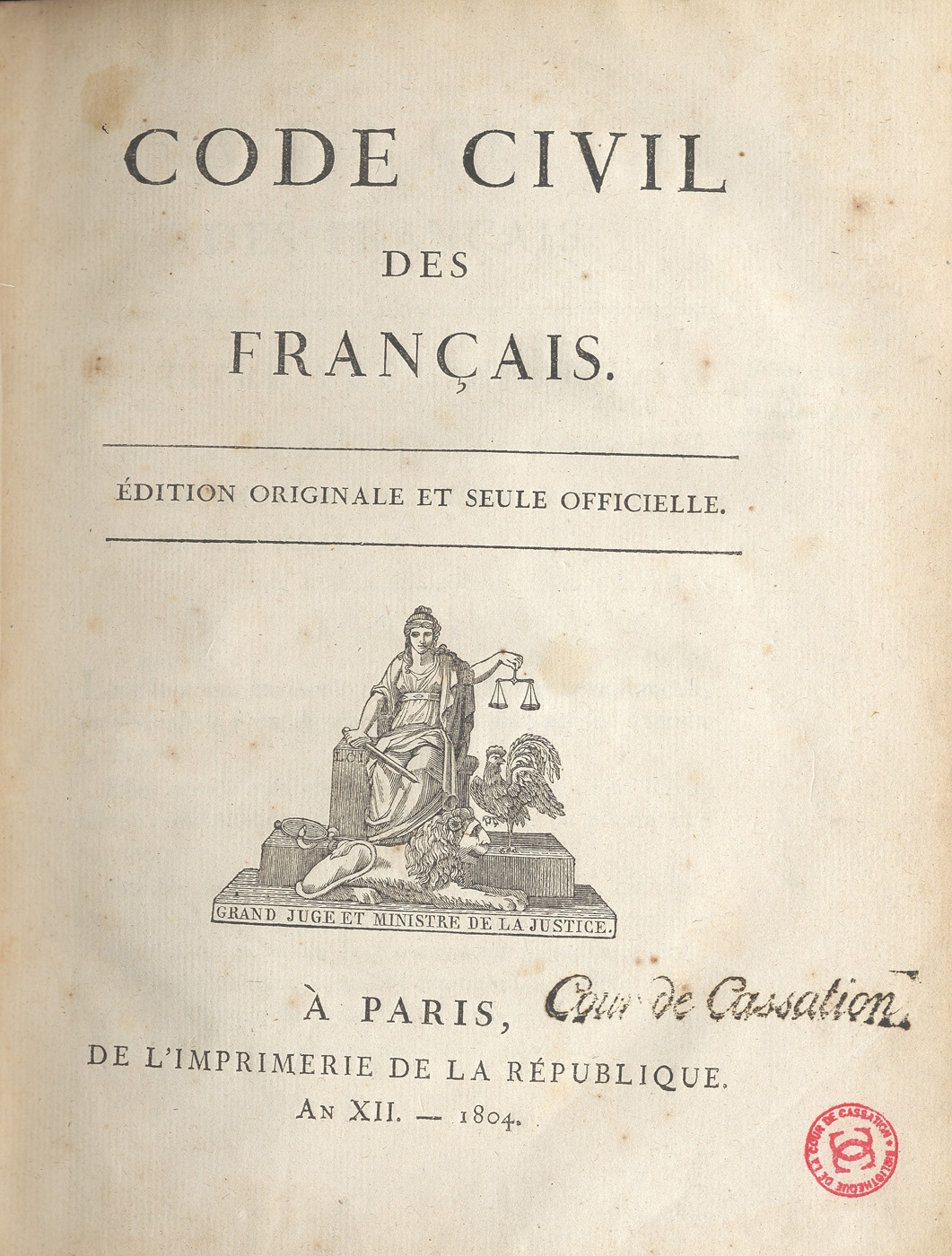
On 21 March 1804, Napoleon Bonaparte signed the Code civil des Français into law. At the time, he was First Consul of the French Republic, not yet Emperor — that came in December. His armies had already rearranged the map of Europe once and would do so several more times before Waterloo put a stop to it. But the thing he signed that March morning was not a battle order. It was 2,281 articles of civil law: inheritance, contracts, property, marriage, the legal status of persons. Mundane, meticulous, and, as it turned out, more durable than anything his armies ever built.
The problem the Code solved was real. Before 1804, France had no unified legal system. The country ran on a patchwork of more than 360 local customs — written and unwritten — feudal privileges, royal charters, and the residue of Roman law that lingered in the south while Germanic customary law dominated the north. A contract enforceable in Paris might be unenforceable in Lyon. Inheritance rules differed by region, sometimes by town. The Revolution had made things worse, not better: between 1789 and 1799, the various assemblies had issued somewhere in the region of 14,000 decrees, many of them contradicting each other, and none of them coherently organised into anything a lawyer or an ordinary citizen could use as a guide. There had been four attempts at codification under the Directory. All four were rejected. The legal chaos was not ideological; it was simply the accumulated debris of centuries of overlapping authority, and nobody had yet had both the power and the will to clear it.
Napoleon had both. He appointed a commission of four distinguished jurists — Jacques de Maleville, François Denis Tronchet, Félix Bigot de Préameneu, and Jean-Étienne-Marie Portalis — in August 1800, and they completed a working draft in four months. What followed was a grinding process of plenary sessions, legislative submissions, and political arm-twisting. When the legislature initially rejected the bill, by a vote of 142 to 139, Napoleon dissolved the assemblies’ sessions and went to the Senate to berate its members personally. He got his majority. Of the 107 plenary sessions of the drafting commission, he chaired 55 himself — not drafting, but interrogating, pressing for clarity, cutting through legal abstraction. He had no legal training and did not pretend to. He was there to ensure that what emerged was usable.
The Code that came into force on 21 March 1804 was, by any measure, a departure. It established equality before the law — no feudal titles, no class exemptions, no legal privileges attached to birth. Property rights were secular and absolute. Contracts were enforceable. The law was written in French, not Latin, and in language that a literate non-lawyer could follow. No ex post facto laws. No secret legislation. Judges were required to apply the Code and prohibited from declining cases on grounds that the law was unclear or silent; they had to interpret, but they could not legislate. The historian Robert Holtman, whose judgement on these matters carries weight, called it one of the few documents to have influenced the whole world.
It also contained provisions that modern readers will not find so admirable. Women under the Code were legal minors, subordinate to their husbands in nearly every respect: they could not enter a contract, open a bank account, pursue a profession, or appear in court without their husband’s authorisation. Divorce, which the Revolution had permitted on relatively easy terms, was abolished outright in 1804 — reinstated later, but significantly restricted. Children were subject to paternal authority in terms that owed less to Enlightenment philosophy than to Roman law. The Code was written by men, for a society in which property descended through men, and it showed. The liberty it enshrined was the liberty of male property owners. This was not incidental; it was structural.
Napoleon, for his part, was under no illusions about what he had done. “My glory,” he reportedly said on St Helena, reflecting on his career from exile, “is not to have won forty battles, for Waterloo’s defeat will destroy the memory of as many victories. But what nothing will destroy, what will live eternally, is my Civil Code.” The precise wording is disputed — everything Napoleon said on St Helena exists in multiple versions, filtered through multiple memorialists — but the sentiment is consistent with his correspondence and his known obsessions. He talked about the Code constantly in his final years. He seemed to have understood, more clearly than most conquerors do, that armies occupy territory and armies leave, whereas a legal system gets into the walls.
He was right about the spread. The Code followed French armies into Belgium, Luxembourg, the Netherlands, and swaths of western Germany. It was adopted in Italy, Spain, Portugal, and Poland. When Napoleon’s empire collapsed, most of those territories kept the Code anyway, because it was better than what they had before — clearer, more rational, more conducive to commercial activity than the feudal systems it replaced. Beyond Europe, it shaped the civil codes of Louisiana and Quebec, Haiti, Egypt, and through Egypt, most of the Arab Middle Eastern states. By 1960, more than 70 countries had either adopted it directly or modelled their civil codes closely on it. Some did so under occupation. Many did so by choice.
The French Empire Napoleon built lasted from 1804 to 1815. Eleven years. The battles are names on classroom maps: Austerlitz, Jena, Wagram, Borodino, Waterloo. France lost nearly all the territory it had conquered. The satellite kingdoms collapsed. The restored Bourbon dynasty scrubbed Napoleonic iconography from every wall it could reach. But the Civil Code stayed. The Bourbons tried to revise it, could not find anything coherent to replace it with, and left it largely intact. It remains in force in France today — heavily amended, expanded into dozens of subsidiary codes, stretched nearly beyond recognition in some areas, but continuous from 1804 to the present. Over two centuries of succession, revolution, occupation, and constitutional upheaval, and the legal architecture survives.
Napoleon wanted to be remembered for his battles. He largely is. The Code civil is the kind of achievement that tends not to make the popular imagination — there are no paintings of four jurists submitting draft articles, no opera about the plenary sessions of the drafting commission, no famous last words involving inheritance law. But the man who chaired half those sessions and bullied a legislature into submission to get this thing passed understood something that his military victories did not teach him. Conquest is temporary. Law outlasts it. He was right about that, and about very little else at the end.