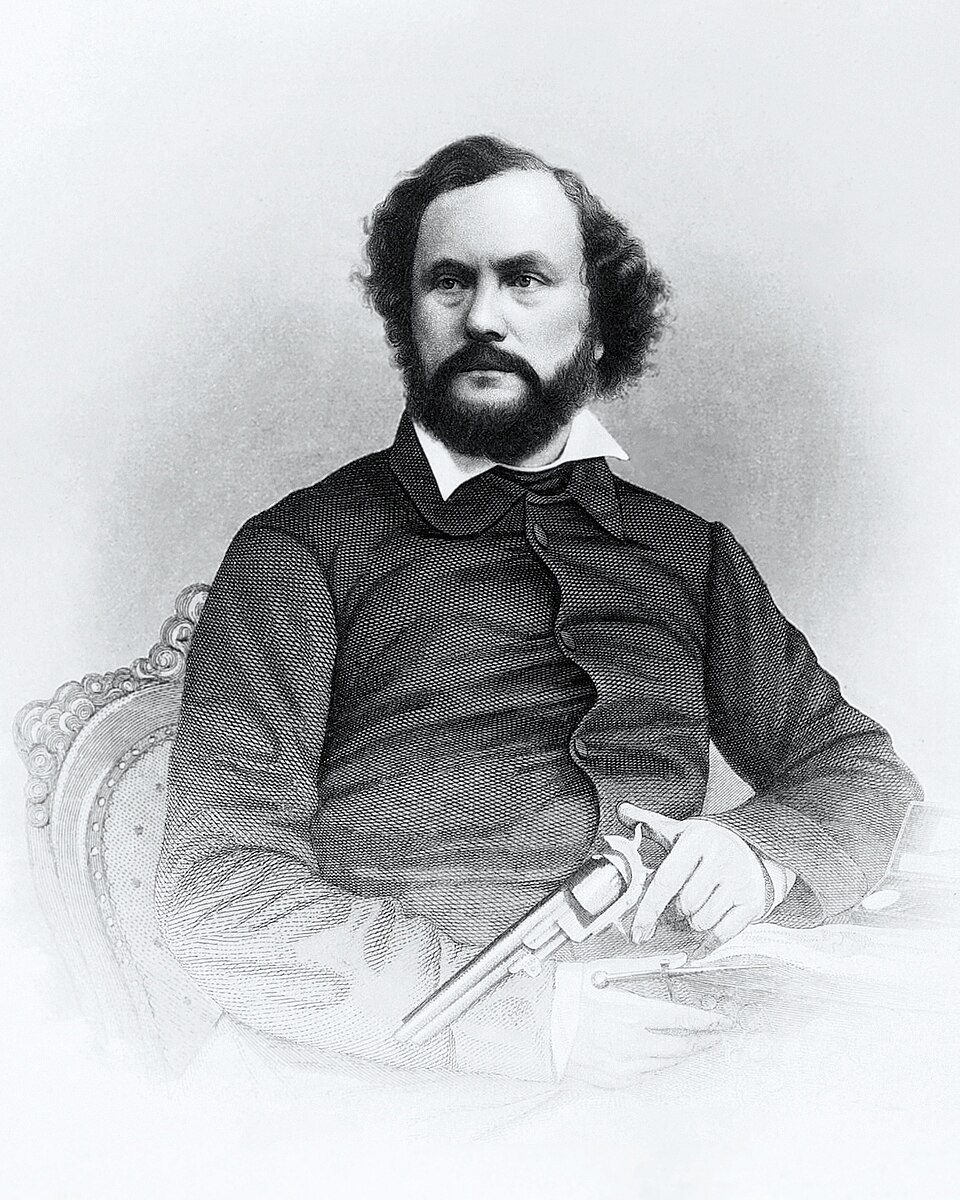
On 25 February 1836, Samuel Colt received United States Patent No. 138 for a revolving-breech pistol — a firearm with a rotating cylinder that could fire five successive shots without reloading. Colt was twenty-one years old. He had been born in Hartford, Connecticut, the son of a textile manufacturer and a mother who died of tuberculosis when he was six. One sister later killed herself; a brother was convicted of murder and died by suicide the day before his execution. The Colts were not a gentle family. Samuel’s path to the patent began at sea: in 1830, aged sixteen and sent to learn the sailor’s trade after being expelled from boarding school for setting a fire with his pyrotechnics, he sailed aboard the brig Corvo to Calcutta. On the voyage he watched the ship’s capstan — the ratchet-and-pawl mechanism that locked the drum into position — and carved a wooden model of a revolving pistol from scrap timber. The principle was simple: cocking the hammer would rotate the cylinder and lock it in alignment with a single barrel. When he returned to America, he needed money. He got it by touring the country as “the Celebrated Dr. Colt of New-York, London and Calcutta,” performing laughing-gas demonstrations with nitrous oxide in lecture halls and general stores. The medicine-show profits funded gunsmiths in Baltimore, who turned his wooden concept into metal prototypes. On the advice of a family friend who happened to run the US Patent Office, Colt filed first in Britain (October 1835) and France (November 1835) — a prior American patent would have barred foreign filing — then secured the US patent that gave him a monopoly on revolver manufacture until 1857. Within weeks he had incorporated the Patent Arms Manufacturing Company in Paterson, New Jersey, and begun producing the Colt Paterson, a five-shot .36-calibre percussion-cap revolver. Roughly 2,800 were built before the company went bankrupt in 1842. Nobody wanted them — or not enough people, anyway. It took a war to change that.
On 9 June 1844, Captain Jack Hays led fifteen Texas Rangers armed with Colt Patersons into a fight with a Comanche war party of at least eighty warriors near Walker’s Creek, north of San Antonio. The Comanches had spent generations dominating mounted combat on the southern plains. A man with a single-shot musket could fire once, then spend twenty seconds reloading — time in which a Comanche archer could loose five or six arrows. The Rangers carried two revolvers each: ten shots before any reloading at all. The fight lasted roughly three miles of running cavalry engagement and ended with twenty-three dead Comanches and one dead Ranger. A Comanche participant later said the Rangers “had a shot for every finger on the hand.” Captain Samuel Walker, who had fought alongside Hays, went looking for Colt in 1847 and found him in a New York gunsmith’s shop. Walker ordered a thousand revolvers for the Mexican-American War, with specifications: six shots instead of five, enough power to kill a horse with a single round, faster reloading. Colt hired Eli Whitney III to manufacture the new design — the Colt Walker — and used the profits to build his own factory in Hartford: Colt’s Patent Fire-Arms Manufacturing Company. The word “Colt” became a generic term for revolver. The company made Colt one of the wealthiest men in America before he died in 1862, aged forty-seven. He wrote to an English associate that “the good people of this world are very far from being satisfied with each other, and my arms are the best peacemakers.” His company later named a model the Peacemaker. The irony was not lost on everyone, but it did not slow sales.
“God created men and Sam Colt made them equal.” Nobody can trace the line to Colt himself — it surfaced decades after his death, in dime novels and newspaper columns that romanticised the frontier — but it captured something real. Before the revolver, killing at close quarters required strength, skill, or numbers. A small man with a knife faced a larger man’s reach. A woman confronting an attacker had, in most cases, no recourse that physics did not already decide against. A repeating firearm changed the arithmetic. It did not care about the size of the hand holding it. In that narrow, mechanical sense, the revolver was an equaliser. The trouble is that equality in the capacity for violence does not produce equality in anything else. What the Colt revolver equalised, in practice, was the ability of fifteen Texas Rangers to ride down eighty Comanches; the ability of settlers moving west to shoot their way through peoples who had lived on the land for centuries; the ability of any man with a grievance and a few dollars to end an argument permanently. Homicide rates across the United States rose sharply from the late 1840s through mid-century. The revolver did not cause every killing, but it lowered the threshold for all of them. A fist fight that might have ended with a black eye could now end with a burial. The “equaliser” made killing easy, portable, and routine — and once that genie was out of its cylinder, nobody could rotate it back.
The revolver is no longer the weapon of choice for most American gun violence. Semi-automatic pistols and rifles displaced it decades ago, and the AR-15 — a weapon Colt’s own company manufactured — has become the preferred instrument for the mass shootings that define the country’s particular relationship with firearms. But the cultural infrastructure Colt helped build is very much intact. The idea that a gun is a right, a tool of self-reliance, an equaliser that keeps the weak safe from the strong — that argument was forged in the 1840s and has not been settled since. In 2023, nearly 47,000 Americans died from firearms — roughly 27,000 by suicide, the rest by homicide, accident, and police shootings. Firearms are the leading cause of death for American children and teenagers. In 2024, the country recorded 499 mass shootings, defined as incidents in which four or more people were shot. I grew up in Europe, where these numbers read like dispatches from a war zone, and I still find them difficult to absorb after years of watching the pattern repeat. The country that coined “The Peacemaker” has the highest gun death rate in the developed world. Every proposal to change this meets the same argument Colt would have recognised: that an armed citizen is a free citizen, that the gun is the great leveller, that to disarm the people is to subject them. The argument has not moved in nearly two centuries. It just accumulates bodies. Colt died rich, in Hartford, in the house he built with revolver money. The conversation he started — about who gets to carry lethal force, and what kind of society that produces — is still going, with no resolution in sight and a counter that never stops climbing.