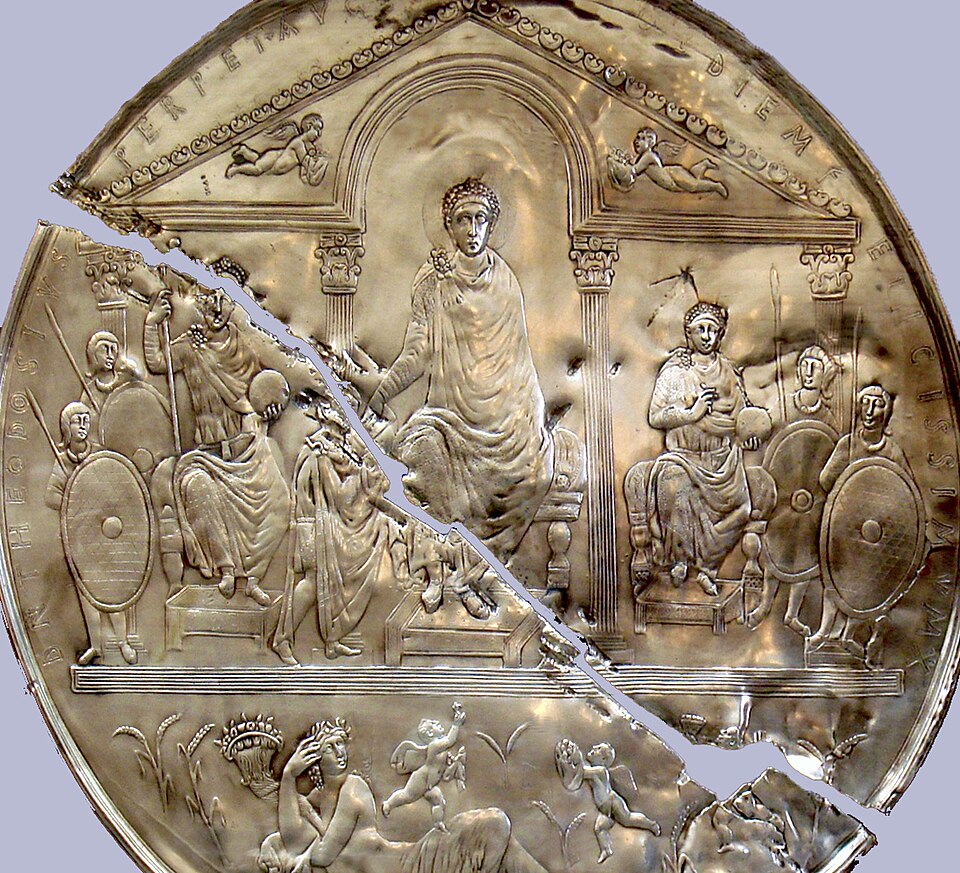
On 27 February 380, the Emperor Theodosius I issued an edict from Thessalonica that made Nicene Christianity the state religion of the Roman Empire. The text was co-signed by his western co-emperors Gratian and Valentinian II, addressed to the people of Constantinople, and blunt about what it expected. All subjects were to profess the faith “delivered to the Romans by the divine Apostle Peter” as defined by the bishops of Rome and Alexandria. Everyone else — Arians, pagans, and any other variety of believer — was classified as a follower of “foolish madmen” and warned to expect both divine judgement and imperial punishment. Christianity, in its Nicene formulation, had arrived. Not merely tolerated, not merely favoured, but mandated.
That mandate placed Christianity on a rather exclusive list. By 380, the number of religions that a state had formally imposed on its entire population could be counted on one hand — and you would not need all the fingers.
The earliest case belongs to Akhenaten, the Egyptian pharaoh who around 1348 BC abolished the traditional pantheon and replaced it with the exclusive worship of the Aten, the sun disc. He closed the old temples, chiselled the names of rival gods off monuments, and built a new capital city at Amarna to house his new order. It lasted roughly seventeen years. When Akhenaten died, his successors restored the old gods with the enthusiasm of people reopening a favourite pub after a long and unpopular renovation. Atenism did not survive its founder.
Then came Josiah, king of Judah, who in 622 BC launched a sweeping reform after his priests conveniently discovered a “book of the law” in the Jerusalem Temple — almost certainly an early version of Deuteronomy. Josiah centralised all worship at Jerusalem, demolished the rural shrines, purged foreign cults, and made a single strict form of Yahwism the only permitted religion in his kingdom. The reform was sincere and comprehensive. It also ended with Josiah’s death in battle at Megiddo in 609 BC, after which the old pluralism crept back.
Zoroastrianism had a longer run. The Sassanid Empire made it the official state religion from its founding in 224, and by the late third century the high priest Kartir was enforcing orthodoxy with the zeal of a man who believed that every non-Zoroastrian was a threat to cosmic order. Christians, Manichaeans, Buddhists, and Jews all faced periodic pressure. That regime was still running when Theodosius issued his edict — which meant that the two greatest empires of the late ancient world were now both in the business of mandating correct belief, facing each other across the Euphrates with rival orthodoxies.
Armenia deserves a mention. King Tiridates III adopted Christianity as the state religion in 301 AD, making Armenia the first officially Christian state — nearly eighty years before the Romans got around to it. The Armenian case is often treated as a footnote, partly because the kingdom was small and partly because its conversion was tangled in Persian and Roman geopolitics. But it was first, and that matters.
So when Theodosius acted in 380, he was not inventing the concept of a state-imposed religion. He was joining a club with very few members and a mixed track record. What made his edict different was scale. The Roman Empire stretched from Britain to Mesopotamia. To mandate a single creed across that territory was an act of extraordinary ambition and, in practice, a project that took decades of coercion, legislation, and targeted demolition to enforce. The edict itself was the announcement. The follow-through included the First Council of Constantinople in 381, which reaffirmed the Nicene Creed; a cascade of laws closing temples, banning sacrifices, and criminalising heresy; and the physical destruction of sites like the Serapeum of Alexandria in 391. The state did not merely endorse a faith. It dismantled the alternatives.
I think the most striking thing about the edict is not the ambition but the specificity. Theodosius did not simply declare Christianity the state religion. He declared a particular theological position — the Nicene formula of the Trinity — the only acceptable one, and named the bishops of Rome and Alexandria as the arbiters of correct belief. This was not religion versus irreligion. It was one faction of Christianity using imperial power to win an argument that had been splitting the church for over fifty years. Arianism, which held that Christ was subordinate to the Father, had been the dominant theology across much of the eastern empire for decades. Theodosius ended that debate with a legal instrument. When a government picks a winner among competing versions of the same faith, the word for that is not piety. It is policy.
Image source: Wikipedia — Missorium of Theodosius I