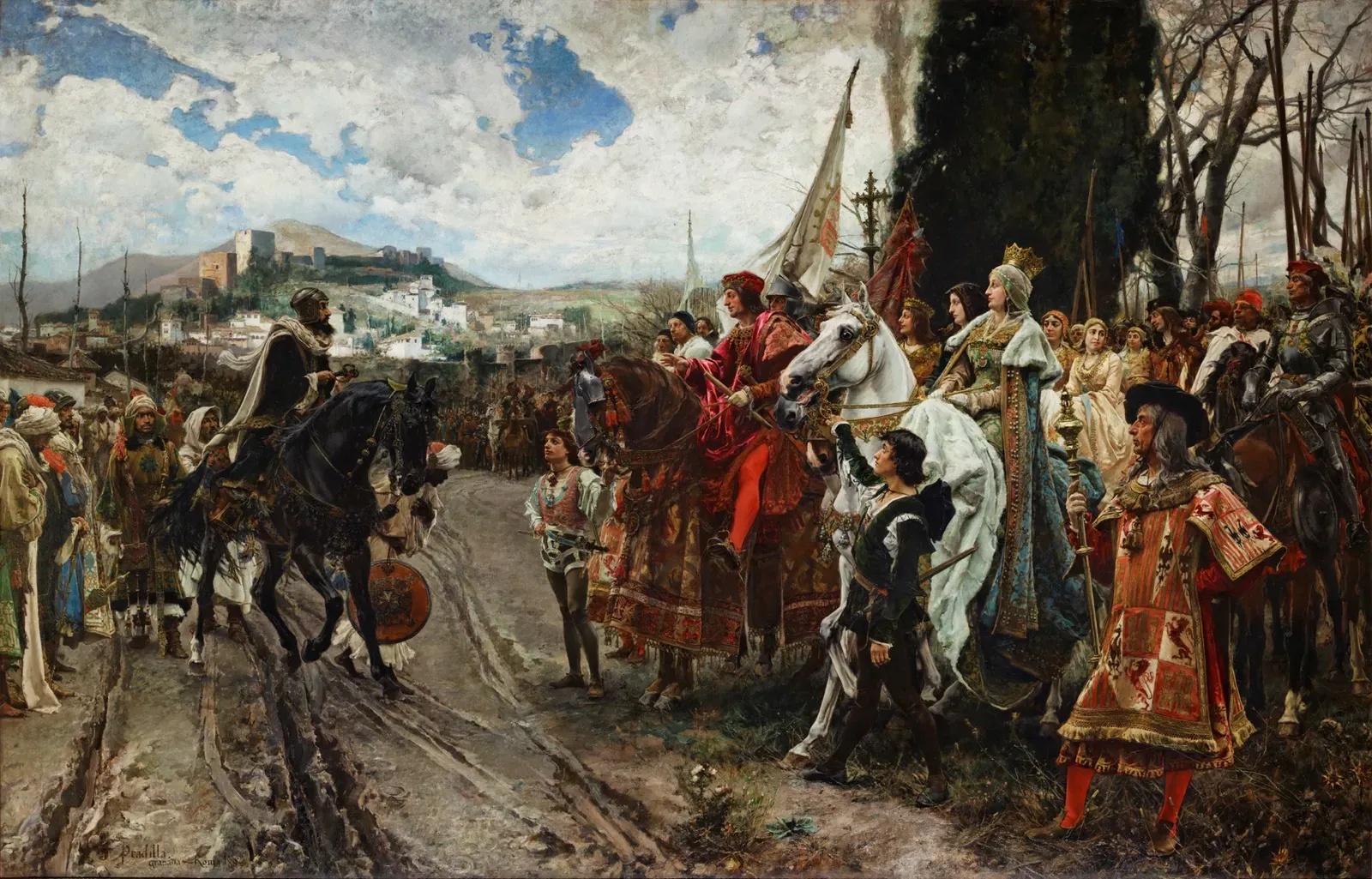
The last emir of Granada handed over the keys of the Alhambra on the morning of 2nd January 1492. Ferdinand and Isabella were waiting outside the walls. Muhammad XII — known to the Christians as Boabdil, a corruption of his Arabic name — rode out to meet them, dismounted, and surrendered the city he had been born in, twice lost to civil war before the Catholic Monarchs ever laid siege to it, and would never see again.
The pass where he turned to look back at the Alhambra is still called El último suspiro del Moro — the Moor’s Last Sigh. The story goes that he wept there, and that his mother told him: “Weep like a woman for what you could not defend as a man.” This is almost certainly apocryphal. But stories stick when they capture something true about a situation, and the truth here is that the loss of Granada really was the kind of loss that makes men weep, if not for themselves, then for what was ending.
What was ending was 781 years. Muslim armies crossed into the Iberian Peninsula in 711 and controlled most of it within a decade. By the 10th century, under the Caliphate of Córdoba, al-Andalus was among the most sophisticated civilisations in Europe — its libraries, hospitals, and astronomical observatories far outpacing what the Christian kingdoms to the north could offer. The Reconquista, the slow warfare of taking back those lands, had been pressing south for centuries while the Muslim polities fragmented, allied with their supposed enemies, fought each other, and called in North African reinforcements that often proved as threatening as the Christians they came to repel.
By 1232, all that remained was Granada. The Nasrid dynasty, founded by Muhammad I that year, sustained the emirate for another 260 years through a combination of geography, diplomacy, and tribute. The emirate occupied the mountainous south-east corner of the peninsula, difficult terrain for any invading army. The Alhambra — begun by Muhammad I on a red hill above the city — became one of the great architectural achievements of the Islamic world. This was not lost on the Castilian king Peter I, who built his own palace in Seville in explicit imitation of its style.
The emirate survived because it knew how to play its neighbours against each other. It paid tribute to Castile when it had to. It occasionally allied with Castile against other Muslim rulers. It called in Moroccan Marinid troops when the pressure was greatest, then allied with Castile when the Marinids became the bigger threat. The arrangement was never stable, but it held for two and a half centuries. What made the emirate’s fall inevitable after 1479 was the marriage of Ferdinand of Aragon and Isabella of Castile, which united the two most important Spanish crowns into a single political force. For generations, Granada had survived by playing those two kingdoms against each other. With them joined, that option disappeared.
The Granada War began in earnest in 1482. Ferdinand took Alhama, a town in the heart of the emirate, in February of that year — a major blow, cutting the road between Granada and Málaga. The campaign was slow and grinding, town by town, for ten years. The Catholic Monarchs brought in Swiss mercenaries alongside Castilian troops, and the Pope encouraged contributions from other Christian kingdoms. It was, formally, a crusade.
Granada’s resistance collapsed from within before the walls were even breached. In July 1482, Boabdil launched a coup against his own father, Abu’l Hasan, who fled to Málaga. The emirate split. Boabdil was captured by the Castilians in 1483 and released only after making major concessions — concessions that destroyed his credibility in Granada. His uncle Muhammad XIII took control after his father died in 1485 and mounted a genuinely fierce resistance, but he was steadily outmanoeuvred. By 1489 he had surrendered Almería and Guadix and fled to North Africa, selling his lands to fund his departure. By 1490, only the city of Granada itself remained.
The siege was a complete success. The Treaty of Granada was signed on 25th November 1491, setting out the terms of surrender. The Muslims who remained were guaranteed their property, their laws, their customs, and their religion. Boabdil rode out and handed over the keys on 2nd January 1492. He turned south, looked back at what he was leaving, and wept — or so the story goes.
The end of the war freed up a lot of royal resources, and as a result, Ferdinand and Isabella had a productive year in 1492. On 31st March, three months after taking possession of Granada, they signed the Alhambra Decree, ordering the expulsion of all Jews from their territories who refused to convert to Christianity. Communities that had lived on the peninsula for over a thousand years — among the most economically and intellectually significant in Europe — were given until July 31st to leave or convert. Estimates of those who left run between 100,000 and 200,000. The Ottoman Sultan Bayezid II, who welcomed many of them into his empire, reportedly remarked that Ferdinand had impoverished his own kingdoms to enrich his.
And on 3rd August, Columbus set sail.
The direct connection between the fall of Granada and the Columbus voyage is real but not quite as simple as freed-up military cash. The money for Columbus’s three ships came primarily from Luis de Santángel, a converso banker at the Aragonese court, who advanced the funds and persuaded Isabella to approve the enterprise. What the end of the Granada War provided was political attention and a sense of triumphant momentum — a monarchy that had just finished a centuries-long project, looking for the next one.
The promises made in the Treaty of Granada did not hold. By 1500, Muslims were rebelling in the Alpujarras mountains after Franciscan friars began forced conversions. The rebellion gave the Crown the excuse to formally void the treaty’s religious protections. Muslims were given the choice of conversion or exile. Those who converted — the Moriscos — lived under escalating suspicion and restriction for the next century. In 1609, Philip III ordered their complete expulsion: somewhere between 275,000 and 300,000 people, whose families had been on the peninsula for generations, removed entirely.
The Alhambra, at least, survived, up to this day. Ferdinand and Isabella moved in. Charles V began building a Renaissance palace in the middle of the complex in 1527 — an act of architectural confidence that left the Nasrid palaces intact on one side while erecting a circular Roman-style courtyard on the other. The two buildings still stand next to each other on the hill above Granada, which tells you something about how the victors understood what they had won.
Boabdil died in Morocco, probably in 1518 or 1533, depending on which account you believe. One source says he died in battle in 1536. His descendants were reportedly living in poverty in Fez a century after the surrender. The pass outside Granada still bears his sigh. The cascade he set in motion that January morning is still going.