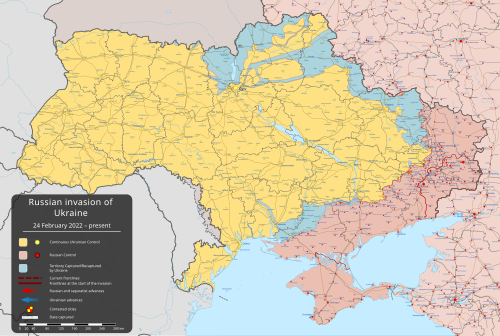
On 24 February 2022, at roughly five in the morning local time, Russian missiles struck targets across Ukraine — airfields, military installations, air defence systems, barracks — from Kharkiv to Lviv to Kyiv. Ground forces crossed the border from three directions: north through Belarus towards the capital, east into the Donbas, and south out of Crimea towards Kherson and Zaporizhzhia. Vladimir Putin, in a televised address delivered before dawn, called it a “special military operation” aimed at the “demilitarisation and denazification” of Ukraine — two words that meant whatever he needed them to mean and have since been stretched to cover the destruction of entire cities. Russian airborne troops seized Hostomel airport, twenty-five kilometres northwest of central Kyiv, on the first morning. An armoured column stretched roughly sixty kilometres along the highway from Belarus. The plan, insofar as Western intelligence later reconstructed it, was to decapitate the Ukrainian government within days, replace Volodymyr Zelensky with a compliant successor, and present the world with a fait accompli before it could organise a response. Today marks four years since that morning. The war is still going.
The quick victory never came. The airborne troops at Hostomel were reinforced too slowly and cut off. The armoured column stalled, ran short of fuel and food, and sat exposed on the road while Ukrainian drones and artillery picked it apart vehicle by vehicle. Zelensky did not flee — he stayed in Kyiv, recorded a video on his phone outside the presidential office at night, and told Ukrainians and the world that he was still there. By early April 2022, Russia had withdrawn from the entire Kyiv region, leaving behind evidence in Bucha and Irpin — bodies in the streets, civilians with bound hands shot in the back of the head — that settled any remaining ambiguity about what “denazification” meant in practice. What followed was not peace but a reorientation: Russia concentrated its forces in the east and south, and the war settled into a grinding attritional contest across the Donbas steppe and industrial belt that has now lasted four years, consumed hundreds of thousands of lives, and moved the front line back and forth across a stretch of ground whose names meant nothing to most of the world before 2022 — Severodonetsk, Lysychansk, Bakhmut, Avdiivka — and now mean rubble.
The costs go in every direction. Credible estimates place combined military casualties — killed and wounded — well above half a million, though both sides lie about their losses and the real figure is unknowable. Ukraine has lost a generation of young men, a substantial portion of its energy infrastructure to successive Russian missile and drone campaigns targeting power stations through every winter since the invasion, and roughly a fifth of its internationally recognised territory. More than six million Ukrainians have fled the country; millions more are internally displaced. Russia’s economy, propped up by energy exports and wartime production, has avoided collapse but absorbed damage that will compound for decades: hundreds of thousands of its most capable young men dead, wounded, or emigrated; foreign investment gone; technology imports squeezed by sanctions. Europe has rearmed, NATO has expanded to include Finland and Sweden, and the global energy market has been rearranged in ways that benefit almost nobody. A war in the middle of Europe in the twenty-first century, fought for objectives that recede with every month of fighting, achieving nothing that a sane accounting would call a gain for anyone involved.
What makes it worse — what pushes it from tragedy towards something closer to farce — is how it started. Not the proximate causes, which are documented enough: NATO expansion, the Maidan revolution of 2014, the annexation of Crimea, the Donbas conflict, the failure of the Minsk agreements, and Putin’s increasingly visible conviction that Ukraine is not a real country and never was. Those are the obvious threads. But pull on them and the chain leads somewhere no one expects — to a murder in an Asian city, a suitcase, an extradition bill that detonated mass protests, a novel virus, and the peculiar isolation of an ageing autocrat sealed off from the world during a pandemic. The full chain, traced link by link from a crime scene in Taipei to a column of tanks on the road to Kyiv, is the subject of The Butterfly Effect. I will not rehearse the entire argument here — the book exists precisely because the chain is too long and too specific to compress. But the core of it is this: the largest armed conflict in Europe since 1945 connects, by a series of documented and observable events, to a crime half a world away that nobody at the time considered significant beyond a single police investigation. One death in one city, and four years later hundreds of thousands of deaths across a continent. The butterfly effect is not a metaphor. It is a mechanism — and this war is its proof.
This is the fourth anniversary. There will, in all likelihood, be a fifth, but let us hope I’m wrong.