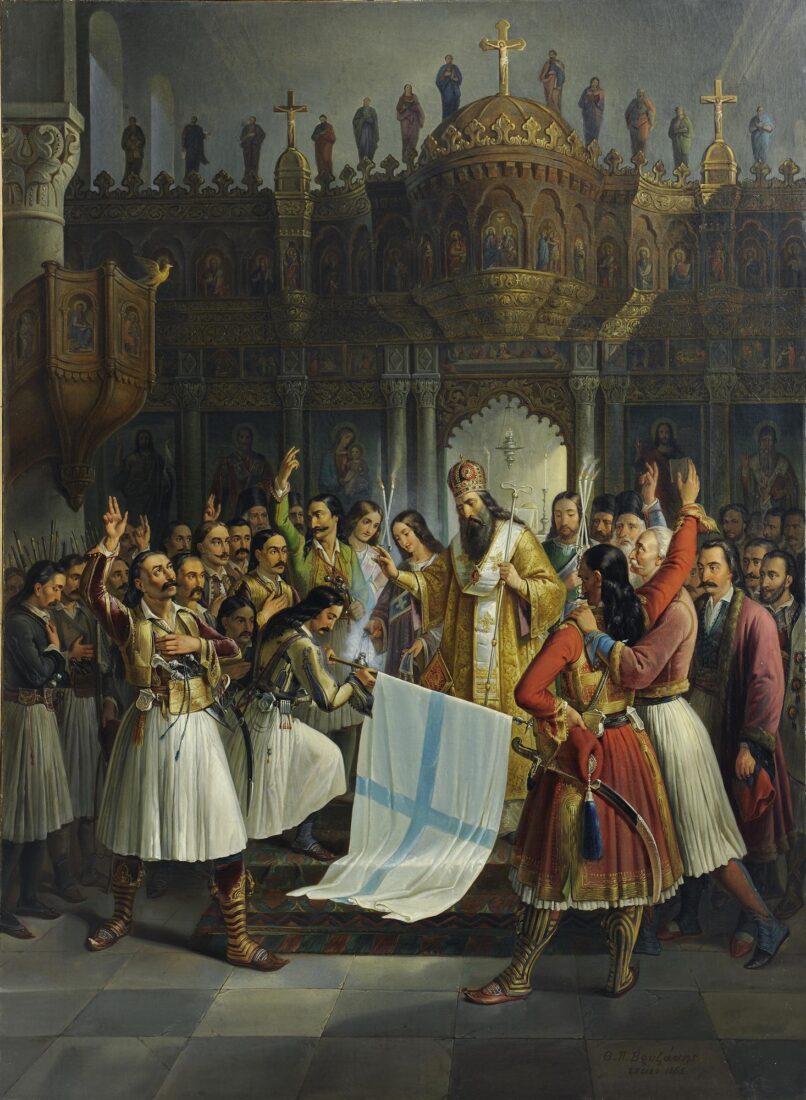
On 17th March 1821, the Maniots of the southern Peloponnese formally declared war on the Ottoman Empire. Six days later, Kalamata fell to Greek forces. By the time Bishop Germanos of Patras is said to have raised the banner of revolution at the Monastery of Agia Lavra on the 25th, the uprising was already running. Greece celebrates March 25th anyway, and rightly so - not because the date is accurate, but because it was chosen, deliberately and with care, to mean something larger than a military timetable.
The date was the work of the Filiki Eteria - the Friendly Society - a secret organisation founded in Odessa, Russia, of all places, in 1814 by three impoverished Greek merchants: Nikolaos Skoufas, Emmanuil Xanthos, and Athanasios Tsakalov. They had no army, no foreign patron willing to commit, and no track record of anything. What they had was a network, a plan, and an understanding that a revolution requires a story as much as soldiers. March 25th was the Feast of the Annunciation - the day the Archangel Gabriel told Mary that something unprecedented was about to happen. The message to the Greek peasantry was unmistakeable: God and nation were the same cause.
This was not a casual calculation. The Ottoman Empire had ruled the Greek-speaking world since the fall of Constantinople in 1453 - 368 years at the time of the uprising. Previous revolts had come and gone: the Russian-backed Orlov Revolt of the 1770s was crushed and followed by Albanian reprisals; the poet and revolutionary Rigas Feraios was strangled by Ottoman officials in 1798 and his body dumped in the Danube. The Greek Orthodox Church was the one institution that had preserved a distinct identity across those centuries, its bishops and priests the only administrative class the Ottomans permitted the Greek population to maintain. Tying the revolution to the religious calendar was not manipulation - it was recognising where the people’s loyalty already lived.
The Patriarch of Constantinople, Gregory V, did not see it that way. He excommunicated the leaders of the revolt and preached obedience to the Sultan. The Ottomans hanged him on Easter Sunday anyway, in front of the Patriarchate, which did rather more to advance the Greek cause than his sermons had done to suppress it. News of the execution reached Europe and broke the diplomatic indifference of the great powers more effectively than any battlefield victory could have.
The war that followed was long, brutal, and nearly lost. The Greeks took Tripolitsa in September 1821 and proceeded to massacre most of its Muslim population - approximately 8,000 people. The Ottomans responded in kind on Chios in 1822, killing or enslaving around 80,000 Greeks, an event so shocking that Eugène Delacroix painted it. Two consecutive Greek civil wars in 1823 and 1824 nearly destroyed the revolution from within, as primates, military captains, and merchant factions fought each other for control of the nascent state. In February 1825, Ibrahim Pasha of Egypt landed in the Peloponnese with a disciplined army and spent the next two years methodically undoing everything the Greek forces had built. By 1826, the situation was desperate.
What saved the revolution was not Greek unity - there was not much of that - but a convergence of European romanticism and strategic calculation. Philhellenes across the continent and the United States donated money, supplied ships, and in several hundred cases arrived to fight. Lord Byron, the most celebrated of them, organised funds and logistics and died of fever at Missolonghi in April 1824 at the age of 36. His death, widely mourned, transformed the Greek cause from a peripheral Balkan conflict into a European moral emergency. Britain, France, and Russia agreed to intervene, and on 20th October 1827, their combined naval squadron met the Ottoman-Egyptian fleet at Navarino Bay - 27 allied ships against 78 Ottoman and Egyptian ones. The resulting battle, which all three admirals described as an accidental engagement, destroyed the Turkish fleet almost entirely. It decided the war.
The London Protocol of February 1830 formally recognised Greek independence. The new state was small: the Peloponnese, some of the Aegean islands, and a strip of central Greece. Most Greeks - in Crete, Macedonia, Thessaly, the Ionian coast of Anatolia - were left outside its borders. Independence was recognised, but the great powers then appointed a Bavarian prince, the seventeen-year-old Otto, as the first king of Greece. He arrived to govern a country he had never visited, whose language he did not speak, accompanied by a Bavarian regency council that ran the administration until he came of age. The revolution had succeeded; the state it produced was placed under foreign management almost immediately. Decades will pass before the modern state of Greece will take its more recognisable shape.
Greece began its war of independence with a manufactured date, a half-legendary bishop, a slogan - Ελευθερία ή Θάνατος, Freedom or Death - and three merchants from Odessa who had decided that nearly four centuries was long enough. The Annunciation, the day chosen to begin it all, is a feast about something impossible being announced and then happening. It turned out to be the right metaphor. Every March 25th since, Greece has celebrated not quite the right date, but absolutely the right thing.