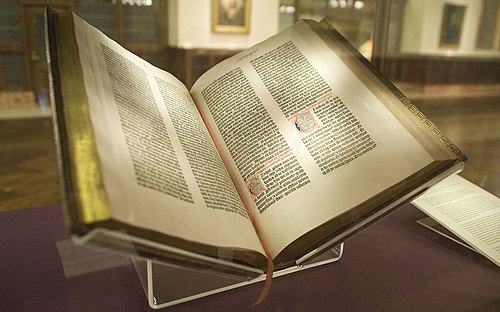
On 23 February 1455, Johannes Gutenberg’s workshop in Mainz finished printing a Latin Bible — two volumes, 1,282 pages, forty-two lines per column, set using movable metal type. Roughly 180 copies were produced: most on paper, about thirty on vellum. Forty-nine survive today, twenty-one of them complete. The book itself was not revolutionary in content — it was Jerome’s Vulgate, the standard Latin Bible that monks had been copying by hand for a thousand years. What was revolutionary was how it was made. Gutenberg, a goldsmith by training, had spent the better part of two decades developing a system that combined cast metal type — an alloy of lead, tin, and antimony — with a wooden screw press adapted from the ones used to crush grapes and olives, and an oil-based ink that adhered to metal where water-based inks would not. Each of these components existed in some form before he touched them. His achievement was assembling them into something that worked: a machine that could produce identical copies of a text faster, cheaper, and more accurately than any monasterial scriptorium.
Strictly speaking, Gutenberg did not invent printing. Woodblock printing had been common in China since at least the ninth century. Bi Sheng, a Chinese artisan, developed movable ceramic type around 1040. Korean printers cast movable metal type and used it to produce the Jikji — a collection of Buddhist teachings — in 1377, nearly eighty years before Gutenberg’s Bible. But none of these earlier systems changed their societies the way Gutenberg’s press transformed Europe. The reasons were partly technical — the Latin alphabet’s twenty-six letters suited movable type far better than the thousands of characters in Chinese script — and partly circumstantial. Europe in the mid-fifteenth century was a continent of competing states, independent cities, ambitious universities, and a Church whose authority was already under pressure. It was, in other words, a place primed to do something with cheap books once someone figured out how to make them.
Gutenberg himself did not profit from his invention. He had borrowed heavily from Johann Fust, a Mainz financier, to fund the workshop. In November 1455 — months after the Bible was completed — Fust sued for repayment of the loans plus interest: roughly 2,026 guilders, an enormous sum. Gutenberg lost. Fust seized the press, the type, and the printed sheets, and went into business with Peter Schöffer, Gutenberg’s former assistant. Fust and Schöffer published successfully for years. Gutenberg carried on in obscurity, possibly running a smaller press, and died on 3 February 1468. He was buried in Mainz in a church that was later demolished. No portrait made during his lifetime survives. The man who gave Europe its most consequential technology left almost no trace of himself.
The technology, however, left traces everywhere. By 1460, printing had spread from Mainz to Strasbourg and Bamberg. By 1470, presses were operating in Italy, France, the Netherlands, and Switzerland. By 1500, an estimated 270 towns across Europe had presses, and they had produced somewhere between fifteen and twenty million volumes — more books than European scribes had copied in the previous thousand years combined. The cost of a book dropped by roughly 80 per cent within decades of the press’s introduction. A Bible that once took a scribe two years to copy could now be printed in a matter of weeks. Books moved from cathedral libraries and monastic scriptoria into universities, merchants’ houses, and eventually the hands of anyone who could read — and the surge in available reading material meant that, for the first time, learning to read was worth the effort for ordinary people.
The consequences ran from Martin Luther to the screen you are reading this on. When Luther nailed his Ninety-Five Theses to the door of the Castle Church in Wittenberg on 31 October 1517, printers had copies circulating across Germany within two weeks. His German translation of the New Testament, published in September 1522, sold 5,000 copies in its first two months — a raving bestseller by any standard of the age. Without the press, the Reformation is a local dispute in Saxony that Rome handles the way it had handled hundreds of others: quietly and decisively. With the press, it was a continental upheaval that split Western Christianity in two. Copernicus published De Revolutionibus in 1543. Newton’s Principia appeared in 1687. The Encyclopédie of Diderot and d’Alembert — seventeen volumes of text and eleven of engravings — reached subscribers between 1751 and 1772. Each depended on the ability to produce and distribute identical copies of complex, technical material, a capacity that did not exist before Gutenberg’s workshop.
The printed word belongs on the shortest list of technologies that altered the human condition. Fire, the wheel, agriculture, and the press — you can argue the order, but you cannot argue the membership. Every advance in science, medicine, and industry over the past five and a half centuries rests, at some point in its chain of causation, on the ability to record knowledge in a form that can be copied exactly and distributed widely. We would not be reading these words from an electronic device without it. A few centuries ago, most people could not have read them at all — not because the words did not exist, but because books were expensive, rare, and reserved for clergy, aristocrats, and the occasional wealthy merchant who wanted to seem learned. A monk in a scriptorium could produce perhaps two complete Bibles in his working life. Gutenberg’s press could produce hundreds. That difference — between two and two hundred, between a lifetime’s labour and a season’s work — remade the world. It is still remaking it, a word at a time.