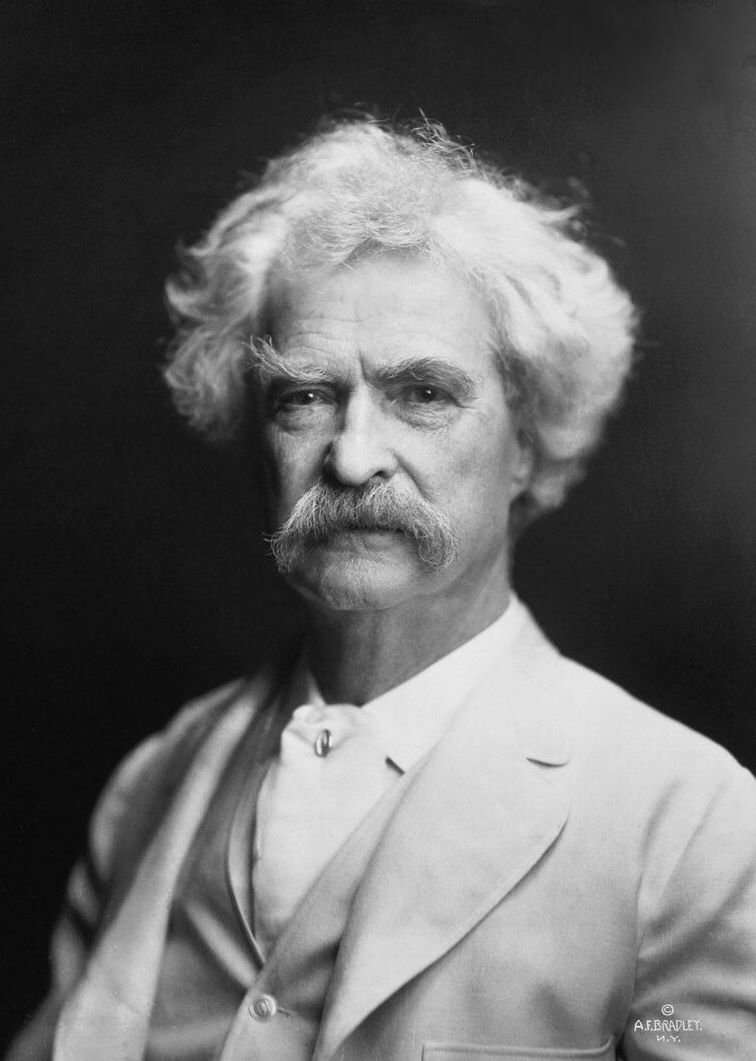
On 18 February 1885, Adventures of Huckleberry Finn went on sale in the United States. It was not just the sequel to Tom Sawyer or another bestseller. It was a book that made the American public uncomfortable — and it still does. Huck’s decision to help Jim escape slavery, and the language Twain put in his characters’ mouths, forced a conversation about race and complicity that plenty of readers would rather have avoided. The Brooklyn Public Library banned it from the children’s department twenty years later. Schools have been fighting over it ever since, even though the reasons changed with generations. That kind of lasting unease is a fair measure of how much the book mattered.
The man behind it had a life that could have filled a novel on its own. Samuel Langhorne Clemens grew up in Hannibal, Missouri — the town that became St. Petersburg in Tom Sawyer. His father died when he was eleven. He left school after the fifth grade, worked as a printer’s apprentice and then a typesetter, and in his twenties became a pilot on the Mississippi. The leadsman’s cry for safe water — two fathoms, twelve feet — gave him his pen name: mark twain. When the Civil War shut down river traffic, he went west. He tried mining in Nevada and failed. He turned to journalism at the Territorial Enterprise in Virginia City, then hit big with “The Celebrated Jumping Frog of Calaveras County” in 1865. Travel books and lectures followed — The Innocents Abroad, Roughing It — and in 1876 he published The Adventures of Tom Sawyer, which was basically exaggerated tales of his own boyhood. Huckleberry Finn was the darker, weightier sequel: the one that asked what a white kid from the slave-holding South does when he has to choose between the law and his conscience.
Clemens kept moving. He married Olivia Langdon in 1870, built a house in Hartford, wrote his best work there and at Quarry Farm in Elmira. He also bet heavily on the wrong horses. He poured a fortune into the Paige compositor — a mechanical typesetter that was too complex to work reliably — and lost almost everything when the Linotype made it obsolete. His publishing house, Charles L. Webster and Company, scored big with ex-president Grant’s memoirs, but ultimately collapsed. Twain’s lack of business management skills are mainly to blaim here. As a result of these financial misfortunes, he filed for bankruptcy in 1894. Then h spent years on a round-the-world lecture tour to pay back his creditors in full, even though the law did not require it. He wasn’t always a rational or shrewd, but he was conscious of his obligations.
The losses were not only financial. His younger brother Henry had joined him on the river; Clemens had arranged the job on the Pennsylvania. In June 1858 the steamboat’s boiler exploded. Henry died of his wounds eight days later. Clemens carried the guilt for the rest of his life. I’ve always found it hard not to feel for him there — he was twenty-two, and he had put his brother on that boat. He outlived most of his family. His son Langdon died at nineteen months. His daughter Susy succumbed to meningitis in 1896; his wife Olivia followed in 1904; his daughter Jean in 1909. Clara was the only child who survived him. He was born two weeks after Halley’s Comet passed in 1835 and said he expected to go out with it when it returned. And he did: he died of a heart attack on 21 April 1910, the day after the comet’s perihelion.
So you get the full picture — the humourist who drew crowds and made presidents laugh, and the man who went broke, buried his brother and his children, and kept writing. Controversial, tragic, funny, and central to American and world literature. Faulkner called him the father of American literature. Hemingway said all modern American literature comes from one book, Huckleberry Finn. The claim is arguable, but the book’s place is not. On 18 February 1885 it entered American life. It has not left.
A footnote on the death report. In 1897 a newspaper ran an obituary for Mark Twain. He was in London, alive and well. He sent a reply: “The report of my death was an exaggeration.” He got another decade and change. The line stuck — and the man behind it kept producing work, gathering crowds, paying his debts, and outliving the people he loved until the comet came back.