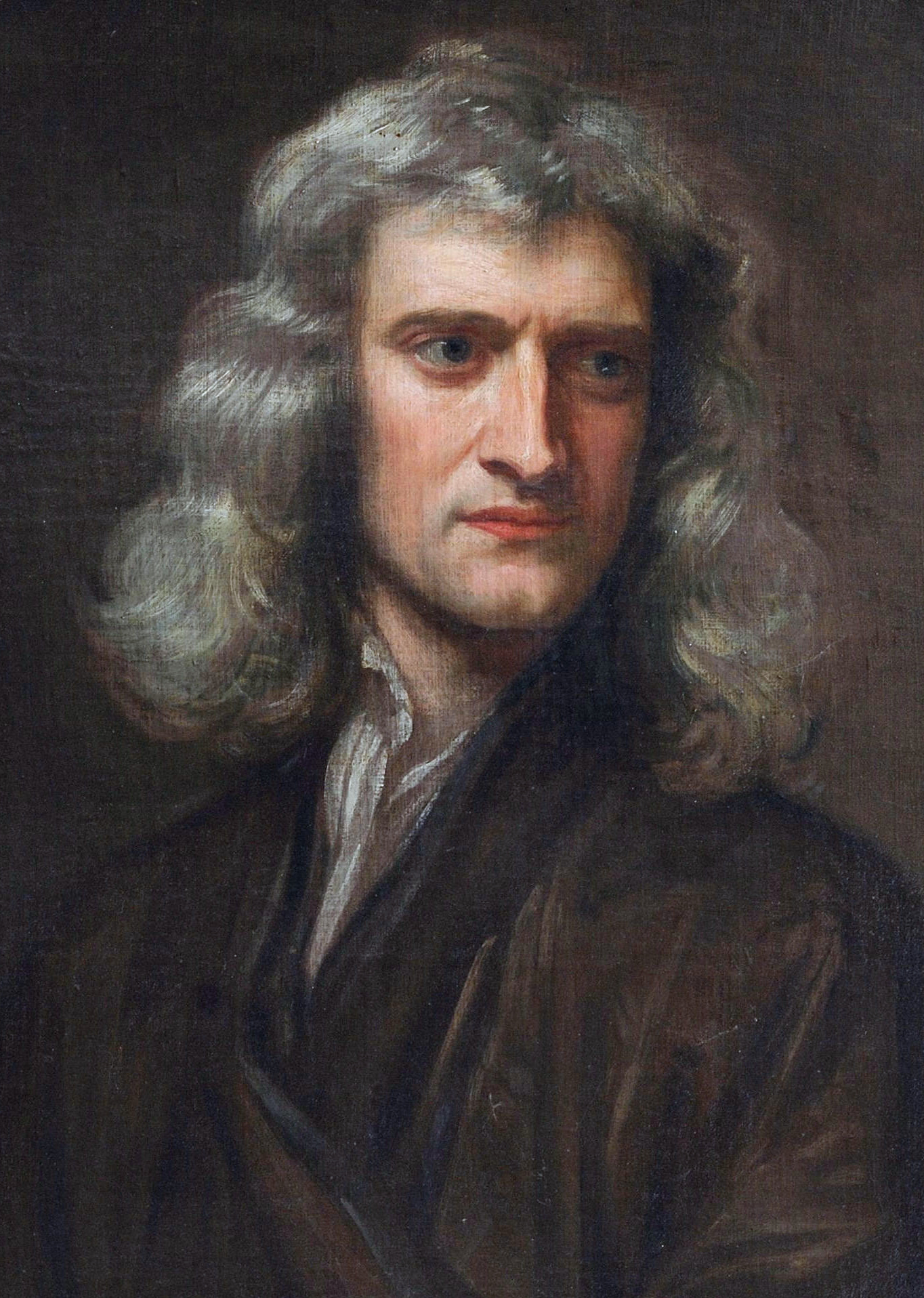
Isaac Newton was born on Christmas Day 1642 - at least by the Julian calendar England was still using at the time; by the modern Gregorian reckoning, it was 4 January 1643. His father had died three months earlier, before ever meeting him. He arrived so small and premature that his mother said he could have been fitted inside a quart mug. When he was three, she remarried a clergyman named Barnabas Smith and moved away, leaving the boy with his maternal grandmother. Newton kept a written list of sins committed before the age of nineteen. One entry reads: “Threatening my father and mother Smith to burn them and the house over them.” He wasn’t a very cheerful boy.
That child became, by most serious accounts, the greatest scientific mind in the history of our species. The fact that he arrived as a sickly, abandoned, quietly furious infant in a hamlet in Lincolnshire is one of history’s stranger jokes.
The years that made him were 1665 and 1666. Cambridge had sent Newton home because of the Great Plague, and he retreated to Woolsthorpe, the family farm. In those two years, working alone, he invented the calculus, developed a theory of colour based on a prism splitting white light into its constituent spectrum, and worked out the mathematics of gravity. He was twenty-two when it started. The physicist Louis Trenchard More later wrote that “there are no other examples of achievement in the history of science to compare with that of Newton during those two golden years.” He told almost no one. He published little of it for decades.
He returned to Cambridge, was appointed Lucasian Professor of Mathematics at twenty-six, and in 1687 finally put it together: Philosophiæ Naturalis Principia Mathematica, published with Edmond Halley’s money because the Royal Society had spent its budget on a book about fish. The Principia contained Newton’s three laws of motion and his law of universal gravitation - the first unified account of how objects move, from a falling apple to a planet in orbit. It demonstrated that the same force governs both, that the cosmos operates by consistent expressible rules, and that those rules can be written down in mathematics. Stephen Hawking called it “probably the most important single work ever published in the physical sciences.” Lagrange, not given to extravagance, called it “the greatest production of the human mind.”
The rivalry with Leibniz over the calculus is one of the less dignified episodes in the history of mathematics. Newton developed the method in the mid-1660s, kept it private. Leibniz independently produced his own version in the 1670s and published it in 1684. When the dispute erupted in 1711, the Royal Society conducted an official inquiry that declared Newton the true discoverer and labelled Leibniz a fraud. Newton had written the inquiry’s concluding remarks himself. It was later established that Newton came first, beyond serious doubt - and that Leibniz’s notation, not Newton’s, became the standard across Europe and remains so today. Newton won the historical argument. Leibniz won the practical one.
Then there is the other half of Newton’s life, which tends to receive less discussion because it is harder to celebrate.
Of an estimated ten million words Newton put to paper, roughly one million concern alchemy - attempting to transmute metals, working towards the philosopher’s stone. Vast amounts of the rest deal with biblical chronology, prophecy, and theological controversies most of his contemporaries had already abandoned. His library of 1,752 identifiable books contained 477 on theology, 169 on alchemy, 126 on mathematics, and 52 on physics. The works of natural philosophy that made his reputation accounted for less than twelve per cent of the whole. John Maynard Keynes, who bought a large portion of Newton’s private papers at auction in 1936, wrote that Newton was “not the first of the age of reason” but “the last of the magicians, the last of the Babylonians and Sumerians.” The man who described gravity in equations also prescribed, as a cure for the bubonic plague, a toad suspended upside down in a chimney for three days until it vomited up earth and insects. One million words of that.
Whether to call it wasted talent depends on what you think talent is for. Newton clearly did not draw a boundary between natural philosophy and the search for hidden knowledge; to him they were different aspects of reading the same universe. But the alchemy produced nothing. The biblical chronologies produced nothing. If he had spent those decades on physics and mathematics, the mind that invented calculus at twenty-two might have done it again. We will never know what was in that room.
His later career was stranger in its own way. In 1696 he left Cambridge to become Warden of the Royal Mint, a post intended as a comfortable sinecure for distinguished men who needed rewarding. Newton treated it as a job. He estimated that twenty per cent of the coins taken in during the Great Recoinage of 1696 were counterfeit - and counterfeiting was high treason, punishable by being hanged, drawn, and quartered. Newton put on disguises, spent time in taverns gathering evidence, made himself a justice of the peace in all the home counties, and personally conducted more than a hundred cross-examinations between June 1698 and Christmas 1699. He successfully prosecuted twenty-eight coiners. One of them, a serial counterfeiter named William Chaloner, was hanged. Newton raised the weekly output of the Mint from 15,000 pounds of coin to 100,000 pounds and reduced the standard deviation of guinea weights from 1.3 grams to 0.75 grams. He remained Master of the Mint until his death.
He also, less gloriously, lost somewhere between £10,000 and £20,000 when the South Sea Bubble collapsed in 1720 - the man who had described the motion of the planets could not predict the behaviour of a speculative frenzy. He forbade to ever mention the affair in his presence.
He never married. Voltaire, who attended his funeral, wrote that Newton “was never sensible to any passion, was not subject to the common frailties of mankind, nor had any commerce with women” - confirmed, Voltaire noted, by the physician and surgeon present at Newton’s death. Newton himself is said to have boasted of it, as though celibacy were an achievement he wished credited to his account. His closest documented attachment was to Nicolas Fatio de Duillier, a Swiss mathematician he met in 1689; when that friendship ended abruptly four years later, Newton suffered a breakdown and sent incoherent accusatory letters to Samuel Pepys and John Locke. He recovered, resumed work, and apparently did not revisit the question.
He died on 20 March 1727 (31 March new style), aged eighty-four. He received a state funeral - the first in England for someone recognised primarily for intellectual achievement. Two dukes and three earls carried his pall. He was buried in Westminster Abbey. His monument reads, in translation: “Mortals rejoice that there has existed such and so great an ornament of the human race.”
Alexander Pope’s intended epitaph was never put on the stone: “Nature, and Nature’s laws lay hid in night. / God said, Let Newton be! and all was light.” Perhaps it was too neat. It misses the toad in the chimney, the million words of alchemy, the thirty years looking for something that was not there. The ornament of the human race was, by some estimates, running at less than half capacity. That a man could waste so much and still be Newton tells you something about the man. It also tells you something about everyone else.