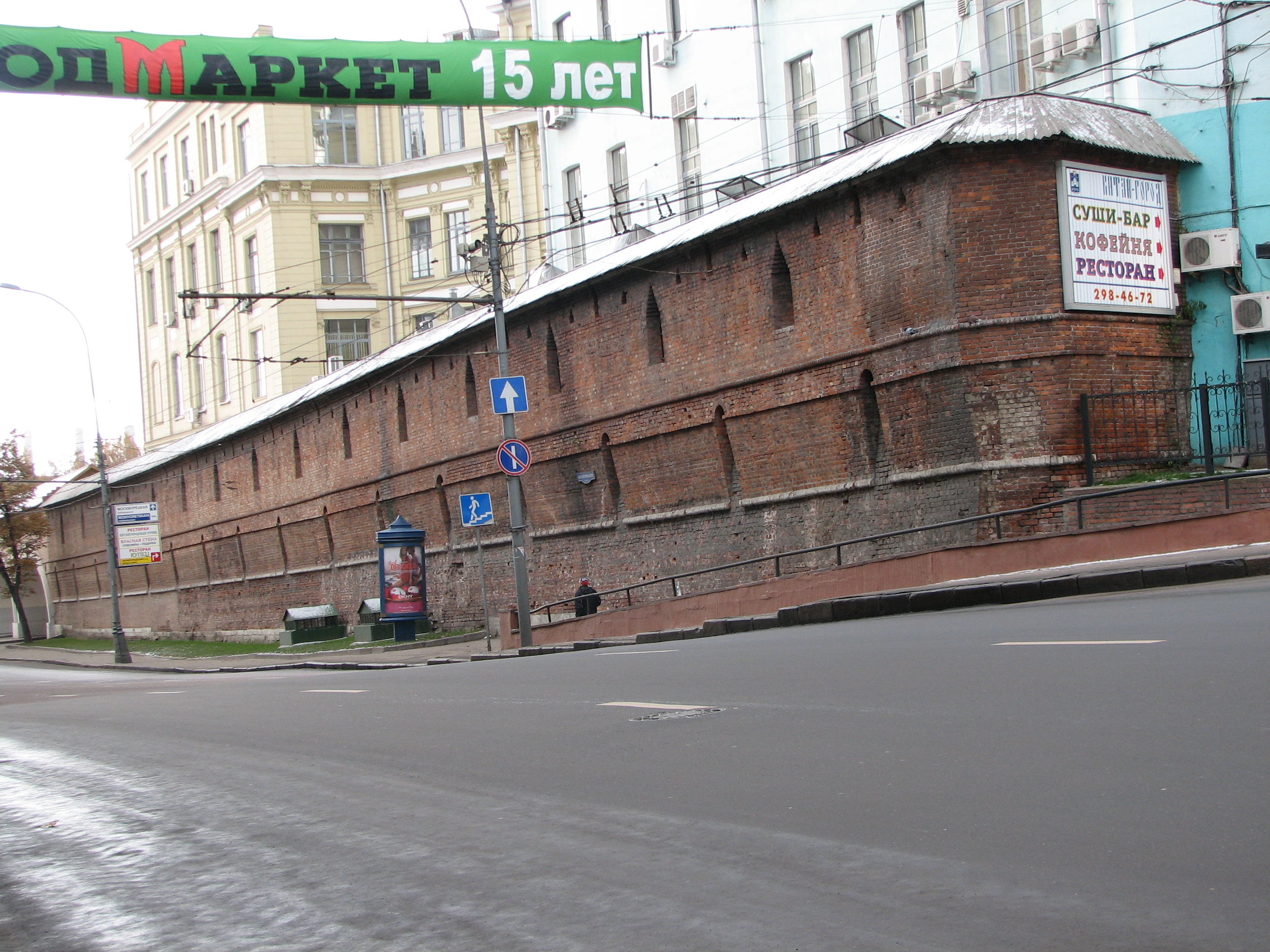
In 1535, Elena Glinskaya — regent of Muscovy, mother of the boy who would become Ivan the Terrible — commissioned a defensive wall around Moscow’s main trading quarter. The project took four years. An Italian architect working under the Russified name Petrok Maly raised thirteen towers and six gates around a dense commercial district sitting just east of the Kremlin, separated from it by what is now Red Square. When the work was done, the quarter already had a name. It was called Kitay-gorod.
Kitay-gorod. In modern Russian, kitay (Китай) means China. Gorod means city. Taken together, the name translates, without any ambiguity whatsoever, as China City — or, in the idiom most English speakers would reach for, Chinatown. However, there has never been a Chinese community in Moscow’s Kitay-gorod. There was no trade delegation from the Ming court, no silk merchants from Guangzhou, no diplomatic enclave, no colony of any kind. The name has nothing to do with China. It is one of the more spectacular false friends in European urban geography.
The actual etymology is less exotic but more interesting. In 16th-century Russian, kita (plural kity) referred to braided or woven construction — plaited stakes, wicker frames, bundles of material bound together. A 17th-century Russian source uses the word to describe braids hanging from Janissary caps. Robert Wallace, writing in 1967, argued that the term specifically described the rough defensive bulwarks built from wicker baskets filled with earth and rock — a standard medieval fortification technique. The walls Petrok Maly built incorporated exactly this kind of construction in their foundations and lower sections. Kitay-gorod was, most likely, Basket City or Stake City or Wicker City, named for how it was built rather than who lived there.
The collision with China came later. Kitay — the Russian name for China — derives from the Khitan people, a Mongolic-speaking group who established the Liao dynasty in northeastern China in 916 and dominated the region for two centuries. The Khitan gave their name to the territory they ruled, and that name spread westward along trade routes and through diplomatic contacts until it reached medieval Russia as a standard term for the lands to the east. The same word entered English through Marco Polo and other medieval travellers as Cathay, the name that Francis Drake and John Milton still used for China centuries later. So: Khitan became Cathay became Kitay, and Kitay was already sitting in the name of a Moscow trading quarter by the time Russia had formalised the word as its standard term for China. The two words had completely different origins, but they arrived at identical form. Nobody appears to have been confused at the time. By the time anyone noticed, the name had been fixed for generations.
What Kitay-gorod actually contained, throughout most of its history, was commerce. Its three main streets — Varvarka, Ilyinka, and Nikolskaya — were the arteries of Moscow’s merchant class. Ilyinka housed banks and trading houses; Nikolskaya, Moscow’s oldest street, was home to the first printing press in Russia, established in the 1560s, and later to the Slavic Greek Latin Academy, Russia’s first institution of higher learning. The quarter was so densely developed that by the late 19th century, developers were building covered streets rather than individual buildings — the Tretyakovsky Proyezd, commissioned by Pavel Tretyakov (the same man who funded the Tretyakov Gallery), was essentially a shopping arcade driven through the existing urban fabric to connect streets that had no other connection. By 1907, the quarter had acquired the Metropol Hotel on its western edge, the largest Art Nouveau building in Moscow, with interior ceramics by Mikhail Vrubel. The building is still there.
The Soviet government did enormous damage to Kitay-gorod during the 1930s. All ten of the quarter’s chapels were demolished. Seven of its eighteen parish churches were pulled down. The Kazan Cathedral, which had stood on the corner of Nikolskaya Street and Red Square since the 17th century, was razed in 1936 on Stalin’s orders. The thirteen towers of Petrok Maly’s wall — the wall that gave the district its name — were demolished one by one to make way for traffic and construction. The wall itself was almost entirely destroyed, leaving only scattered fragments. The street names were replaced with the names of revolutionary figures; the historic topography was erased along with the buildings. What survived did so because Stalin designated it a protected monument, an irony given that he was personally responsible for most of what was lost.
Today, the Kitay-gorod metro station deposits passengers into a district of government ministries, banks, and restaurant terraces. The Metropol still stands. Zaryadye Park — a landscaped public space that opened in 2017 on the site of the demolished Rossiya Hotel — occupies the southern edge of the quarter along the Moscow River. A short section of Petrok Maly’s wall survives near the park, partially restored in the 1990s after the Soviet-era demolitions, the stone dark and slightly incongruous between modern office façades. The six gates are gone. The thirteen towers are gone. The merchants and the trading houses and the printing presses are gone.
The name is still there, and it still means, if you consult a modern Russian dictionary, China City. A tourist from Shanghai stepping out of the metro and reading the sign would be forgiven for expecting something familiar. What they find instead is a fragment of medieval wall, a luxury hotel, and the offices of several Russian government agencies. Kitay-gorod was never Chinatown. It was always something stranger: a city built from wicker, named for its walls, and then misread by accident for the better part of five centuries.