When Babur was cataloguing his competition across the Indian subcontinent, he was not in the habit of paying compliments idly. He was a Central Asian warlord who had lost and retaken Samarkand twice before the age of twenty, who had crossed the Khyber Pass five times, and who would go on to defeat the Delhi Sultanate at Panipat in 1526 and found the Mughal Empire. His memoirs, the Baburnama, are one of the most self-aware military autobiographies in any language. When Babur surveyed the rulers of India and identified the most powerful among them, the name he put at the top of the list was Krishnadevaraya, emperor of Vijayanagara. The most extensive empire on the subcontinent. He stated it as a fact.
Krishnadevaraya was born on 16 February 1471 at Vijayanagara - the city that now lies in ruin at Hampi, Karnataka, its temples and market streets stripped by the sack of 1565. He came to the throne in 1509 as the third ruler of the Tuluva dynasty, at a moment when the empire was under sustained pressure from the Deccan Sultanates: the fractious collection of Muslim successor states to the Bahmani Kingdom that had been raiding Vijayanagara towns for a generation. The raid-and-plunder cycle ended almost immediately. In the first year of his reign, Krishnadevaraya’s armies engaged Sultan Mahmud, left him severely wounded and in retreat, and annexed the Raichur Doab. Bidar, Gulbarga, and Bijapur followed. The new emperor had made his position clear within months of taking power.
Over the following decade he subdued the Gajapati kingdom of Odisha in a two-year campaign that ended with the Gajapati king giving his daughter in marriage to the emperor. He defeated the Sultan of Golconda. He managed alliances and enmities with five separate sultanates simultaneously, keeping any single one from coordinating a serious challenge to the empire. On several occasions, he turned a losing battle by changing his plan mid-engagement. Portuguese witnesses described this as one of his defining qualities: the capacity to read a collapsing situation and reverse it.
The defining moment of his military career came on 19 May 1520 at Raichur Fort. Ismail Adil Shah of Bijapur held the fortress. Krishnadevaraya brought 700,000 infantry, 32,600 cavalry, and 550 war elephants - all numbers are probably exaggerated. A Portuguese contingent commanded by Cristovão de Figueiredo contributed firearms. The siege cost 16,000 Vijayanagara soldiers their lives before Raichur fell. When the other Deccan sultans sent envoys to negotiate terms, Krishnadevaraya’s reply was unambiguous. If Adil Shah wished his lands restored, he was welcome to come in person, do obeisance, and kiss the emperor’s foot. The submission never took place. Krishnadevaraya marched north and occupied Bijapur.
The Portuguese were watching all of this carefully. Domingo Paes and Duarte Barbosa both visited the Vijayanagara court and left accounts that historians have been grateful for ever since. They described him as an able administrator and exceptional commander who personally led campaigns and tended to wounded soldiers after battle. These were experienced people, who had to travel far just to be able to witness this. They had seen Lisbon, the Persian Gulf, and the Swahili Coast. Vijayanagara impressed them. Krishnadevaraya had established relations with the Portuguese at Goa in 1510, obtaining firearms and Arabian horses, and used their expertise to improve the capital’s water supply. He understood what the Europeans had brought to the Indian Ocean world and moved to acquire it.
The military record, though, is not the whole picture - and not always the most interesting part.
Krishnadevaraya’s court housed what became known as the Ashtadiggajas: eight legendary Telugu poets, their title borrowed from the eight elephants that Hindu cosmology held supported the corners of the earth. The greatest of them, Allasani Peddana, is still called the “father of Telugu poetry.” The period produced prabandha literature of such density and sophistication that the era is named after it. Krishnadevaraya himself composed the Amuktamalyada - an epic Telugu poem on the devotional theme of the goddess Andal - considered one of the five great masterworks of Telugu literature. He also wrote original works in Sanskrit: Madalasa Charita, Satyavadu Parinaya, Rasamanjari, Jambavati Kalyana. He patronised poets in Kannada and Tamil as well. Purandara Dasa, whom musicologists regard as the father of Carnatic music, spent his final years at the court at Hampi. The official court language was Kannada; the emperor was fluent in all four. A soldier who commanded armies of hundreds of thousands and wrote devotional epics in four languages is a particular kind of person.
He also governed, with evident care. He abolished the marriage fee - a tax on weddings, whose existence tells you something about the fiscal creativity of medieval states. He undertook large-scale irrigation works across the empire. He made annual tours to hear the grievances of his people in person. Foreign visitors described the prosperity they found during his reign consistently enough that it cannot be dismissed as diplomatic courtesy.
The end carries a particular shadow. In 1524, he crowned his six-year-old son Tirumala Raya as crown prince. Within a year the boy was dead, poisoned. Krishnadevaraya had previously credited his prime minister Timmarusu as the man who had built his empire from the beginning - the strategist who bribed deserters to discover hidden gates and won battles no one else thought winnable. Suspecting him of involvement in his son’s death, Krishnadevaraya had him blinded. There is no softening this. It is the kind of decision grief produces in men who have operated through ruthlessness for twenty years. The emperor died five years later, on 17 October 1529, aged 58.
The empire did not long survive him. His successors were weaker, the Deccan sultanates regrouped, and in 1565, at the Battle of Talikota, a coalition of five sultans shattered the Vijayanagara army and sacked the capital. Hampi was abandoned and never rebuilt. It is now a UNESCO World Heritage Site of ruins, temples and market pavilions and royal enclosures scattered across a boulder-strewn landscape on the Tungabhadra River.
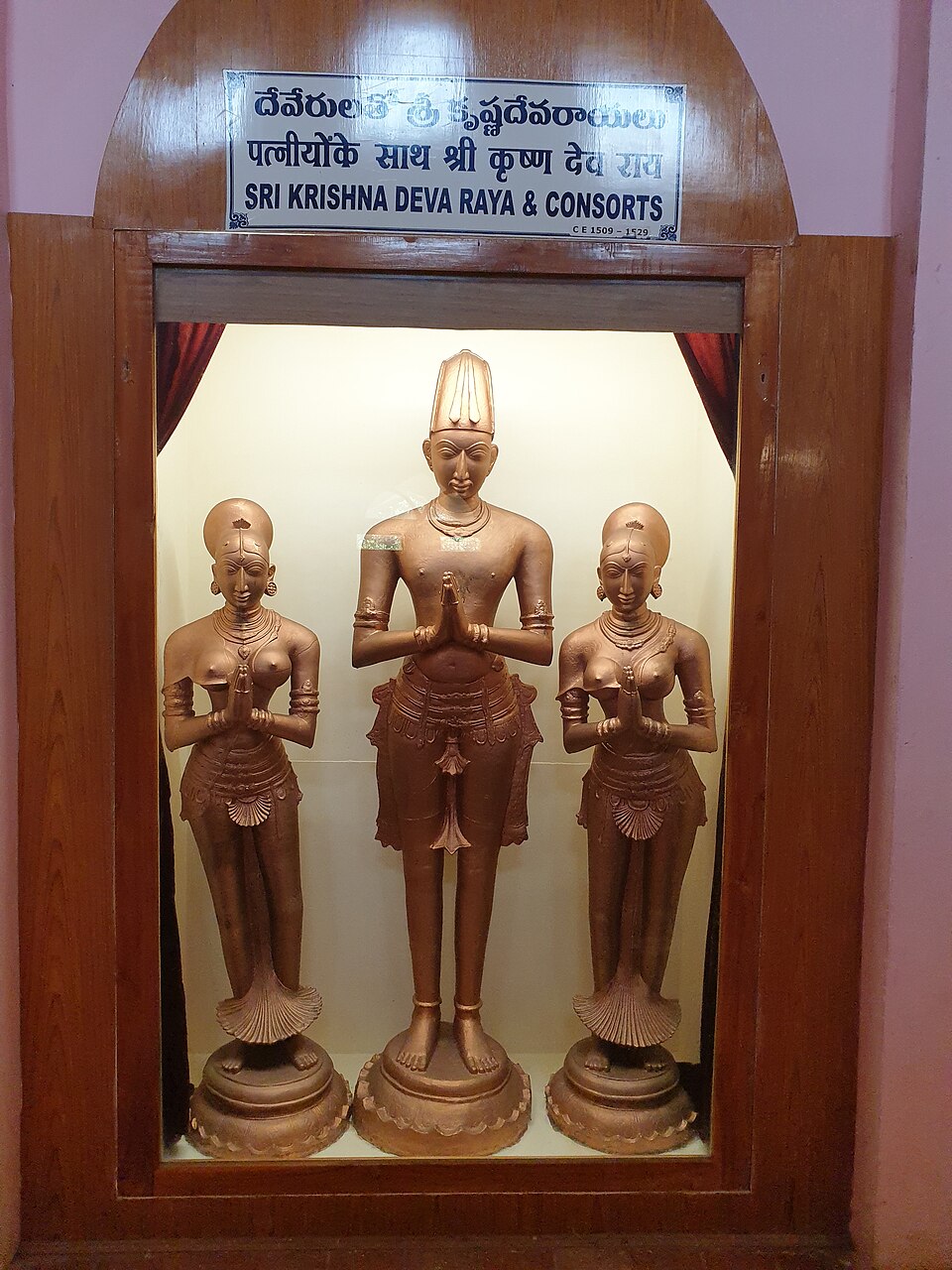
In India, he is still venerated: universities named after him, commemorative stamps, a statue of Krishnadevaraya flanked by his two wives still standing at the entrance of the Tirumala temple complex, where 229 of the roughly 1,250 published epigraphs are attributed to him. The 500th anniversary of his coronation in 2010 prompted India Post to release a commemorative sheet. His title Andhra Bhoja - placing him alongside Bhoja of Paramara, the ideal poet-king of the Sanskrit tradition - is still used. Outside India, the name is almost unknown, which reflects a failure of historical attention that has tended to follow the paper trail into European archives and stop there.
The court poet Mukku Timmana called him the “Destroyer of the Turks” - meaning the Deccan sultans who had been raiding Vijayanagara for a generation before Krishnadevaraya ended the practice for good. He destroyed them with 700,000 soldiers, told their king to come and kiss his foot, and then went home and wrote devotional poetry. Babur, who was himself a poet-general with similar habits, surveyed every king in India and put this name at the top. That is the highest kind of assessment: one conqueror measuring another, and finding someone worth the comparison.