In July 1324, the outskirts of Cairo received a visitor the city was not equipped to absorb. Mansa Musa, king of the Mali Empire, arrived with an entourage variously estimated at 60,000 people — soldiers, attendants, officials, wives — and at the procession’s core, 12,000 servants dressed in brocade and Yemeni silk, each carrying a gold bar weighing 1.8 kilograms. Behind them walked 80 camels, each loaded with between 23 and 136 kilograms of gold dust. He camped for three days beside the Pyramids of Giza before crossing the Nile into the city on 19 July. Al-Umari, an Arab scholar who visited Cairo about twelve years later and interviewed people who had witnessed the arrival, described it as “a lavish display of power, wealth, and unprecedented by its size and pageantry.” The formulation suggests he ran out of comparative material.
The Mali Empire, at its height, covered territory now divided between Guinea, Senegal, Mauritania, the Gambia, and the modern country of Mali. Its wealth had two engines: gold mined in the Bambuk and Bure fields in the south, and salt traded from the mines at Taghaza in the north. Both commodities were essential in medieval West Africa, and controlling both trade routes made the empire, in economic terms, something close to a natural monopoly. Gold had been flowing out of Mali and into the wider world for a century before Musa came to the throne. The stockpile he inherited was substantial. He spent a decade adding to it before the Hajj.
His accession to the throne is itself a story worth knowing, partly because it suggests something about how Musa operated. His predecessor — probably a ruler named Muhammad ibn Qu — reportedly launched two expeditions into the Atlantic Ocean. The first sent 200 ships into the open sea. None returned. The second was larger: 2,000 ships, with the Mansa commanding in person. He appointed Musa as his deputy, then sailed west and was never heard from again. Musa waited, and when the king did not return, was crowned in his place. Some historians have suggested Musa invented the ocean story to explain away a deposition. The possibility of an actual Atlantic expedition has been taken seriously by several scholars. Either way, the man who told this story to Egyptian officials in 1324 had clearly thought about how he wanted his reign to begin.
By the time Musa left for Mecca, he had spent most of his early reign in almost continuous military conflict. He told Egyptian officials that he had conquered 24 cities and their surrounding districts. The preparation for the Hajj was not merely spiritual: historian Michael Gomez estimates that Mali may have captured over 6,000 enslaved people per year to staff the kind of caravan Musa was assembling. The gold on those 80 camels represented years of accumulated tribute from subject kingdoms. He was not spending petty cash.
The Hajj — the pilgrimage required of all Muslims who can make the journey — was about 2,700 miles each way, across the Sahara, through Egypt, and into Arabia. Musa reportedly built a new mosque every Friday along the route, a detail that would be implausible from anyone else. He fed the entire company throughout. The procession that arrived outside Cairo was, by any reasonable measure, the most expensive single journey in medieval history.
The Cairo stop was where the performance concentrated. Musa met the Mamluk sultan al-Nasir Muhammad, who had already hosted one previous Malian king on the Hajj and presumably thought he knew what to expect. Court protocol required Musa to prostrate before the sultan. Musa declined. He eventually bowed, but stated plainly that he was bowing to God alone, not to any king. It was the kind of statement that requires a significant amount of gold to support. He had brought enough.
He stayed three months, and his men “bought all kinds of things,” in the words of one contemporary account, “and they thought that their money was inexhaustible.” Musa gave gold to officials, to the poor, to pilgrims he encountered, and to anyone who caught his attention. He traded it for souvenirs. He is said to have given the governor of Cairo’s Qarafa district such quantities that the official became his close confidant and primary source for later Arab historians. Musa continued distributing gold on the journey through Medina and on to Mecca, where, at the Masjid al-Haram, a confrontation broke out between a group of his Malian pilgrims and a group of Turkic pilgrims. Swords came out. Musa persuaded his men to back down before anyone died.
The scale of the gold given and spent in Cairo had consequences that outlasted the visit. Al-Umari, writing approximately twelve years after Musa’s arrival, reported that before his visit a mithqal of gold traded for 25 silver dirhams in Cairo. By the time al-Umari was writing, it had not recovered above 22 dirhams. The price of gold in Egypt fell because Musa had introduced an enormous additional supply in a very short time. He brought an estimated 18 tons of gold to Cairo and distributed much of it within three months. Converted to current gold prices, that quantity is worth roughly US$1.4 billion.
Historian Warren Schultz has since argued that the price drop was well within normal fluctuations for Mamluk Egypt and that the “wrecking” of the local economy is probably overstated. He may be right. The baseline claim nonetheless survives his revisionism: one visitor’s gift-giving shifted a commodity market that stayed shifted for over a decade.
Then the return journey happened.
Travelling separately from the main caravan, the Malian pilgrims were hit by cold weather, starvation, and bandit raids. Many died between Mecca and Suez. By the time the survivors reached Suez, the supplies were exhausted and the money was gone. Musa borrowed 50,000 dinars from a merchant named Siraj al-Din ibn al-Kuwayk, one of the wealthiest traders in Alexandria. To service part of the debt, he sold the palace that al-Nasir Muhammad had given him as a gift. Al-Nasir, to his credit, reciprocated Musa’s earlier generosity with gifts of his own.
Siraj al-Din sent his vizier to Mali to recover what he was owed. The vizier died on the way. He sent another emissary, then his own son, Fakhr al-Din Abu Jafar. Fakhr al-Din managed to recover some portion of the debt before Musa died — probably around 1337 — but the accounts disagree on how much. Other merchants who had lent money during the visit fared worse. Al-Umari records that one creditor, a Moroccan scholar named Shams al-Din ibn Tazmart, “lent them gold of good form but none of it came back.” The man described by contemporaries as having inexhaustible wealth had, in fact, exhausted it on one trip.
Musa did not come back entirely empty-handed. On the return from Mecca he encountered Abu Ishaq al-Sahili, an Andalusian poet and jurist from Granada, and persuaded him to travel to Mali. Al-Sahili designed the Djinguereber Mosque in Timbuktu, which still stands, and Musa’s royal palace. He was part of a broader effort Musa undertook after the Hajj to bring scholars from across the Muslim world to Mali. The University of Sankore was restaffed with jurists, astronomers, and mathematicians. Timbuktu, already a trading city, became a serious centre of Islamic learning — one that would eventually draw merchants from Venice, Granada, and Genoa to its markets, and students from Egypt and across West Africa to its lecture halls.
This is Musa’s more durable legacy. The Djinguereber Mosque, the Sankore institution, and the scholarly culture he cultivated in Timbuktu outlasted the gold. The Mali Empire itself did not survive long after Musa: it was already in decline by the century’s end, and the wealth that had made it formidable drained away through conquest and succession disputes. The buildings and the books remained.
Mansa Musa is described in modern articles, with some regularity, as the richest person who has ever lived. Estimates of his wealth range from US$400 billion to figures that become arithmetically incoherent. Historian Hadrien Collet has noted that these calculations are impossible to make accurately: Arabic sources were probably trying to express that Musa possessed more gold than they could conceive of, not providing balance-sheet figures. Separating a medieval monarch’s personal fortune from the wealth of the state he controlled is, in any case, an exercise in category confusion, and comparing the result to a modern billionaire’s net worth compounds it.
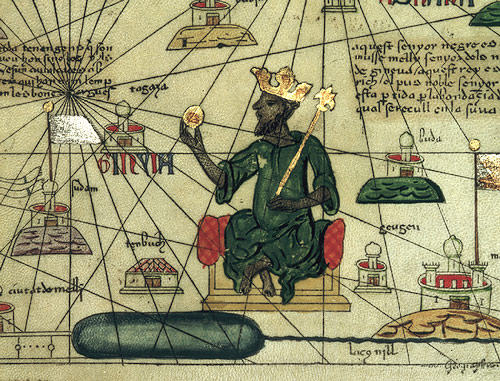
Musa himself was not disinterested in the myth. He spread stories that gold grew like a plant in his kingdom, an image designed to convey inexhaustibility. The 1375 Catalan Atlas, drawn by the Mallorcan cartographer Abraham Cresques fifty years after the Hajj, depicts him on a golden throne in a golden crown, holding a golden sceptre in one hand and a gold nugget in the other. The caption identifies him as “the richest and most noble king in all the land.” It says nothing about the 50,000 dinars.
That gap — between the image on the map and the man who left Egypt owing money to merchants whose families were still trying to collect it years after his death — is the actual history. Musa staged one of the great spectacles of the medieval world, gave gold to an entire city, moved markets that took a decade to recover, and came home broke. He left Egypt with a borrowed fortune and an architect from Granada. The mosque the architect built is still standing. The debts were never entirely paid.