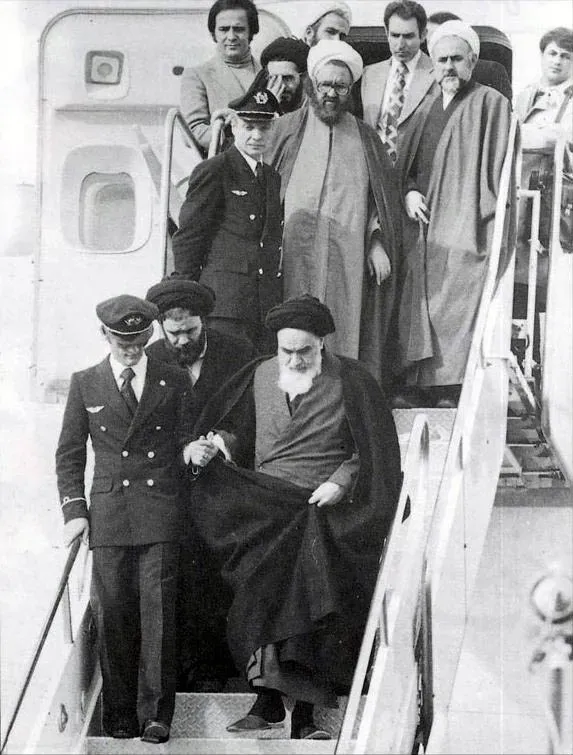
On 1 February 1979, a chartered Air France Boeing 747 touched down at Mehrabad Airport in Tehran. Ayatollah Ruhollah Khomeini, seventy-six years old, stepped onto the boarding stairs and was driven through a city that had effectively ceased to be governed. The Shah had left two weeks earlier, sick and defeated. The caretaker prime minister, Shahpour Bakhtiar, was trying to hold a state together with nothing. Somewhere between two and five million people lined the route to Behesht-e Zahra cemetery, where Khomeini stood before the crowd and announced what was about to happen. “I will appoint a government,” he said. “I will hit this government in the mouth.” Ten days later, the Bakhtiar government was gone. Iran was in other hands.
It had taken fifteen years to get to that moment. Khomeini had first come to the authorities’ attention in 1963, when he delivered a blistering public attack on Mohammad Reza Shah’s White Revolution — land reform, women’s suffrage, secularisation — which he characterised as a programme of American domination and cultural destruction. SAVAK, the Shah’s secret police, arrested him. He was held for ten months, then expelled in 1964 to Turkey, then to the shrine city of Najaf in Iraq, where he spent thirteen years. In October 1978, under pressure from the Shah, Saddam Hussein asked him to leave. He went to a village outside Paris called Neauphle-le-Château.
The move turned out to be the revolution’s logistical breakthrough. From a suburb of Paris, Khomeini had access to international telephone lines, Western journalists, and the global postal system. His sermons were recorded onto cassette tapes and smuggled into Iran by the thousands, copied and passed hand to hand in a country where the Shah’s modernisation drive had made cassette players ubiquitous. The SAVAK had no answer to this. A cleric in a French farmhouse was running the most effective media operation the Iranian opposition had ever seen.
The Shah, meanwhile, was ill — lymphoma, diagnosed years earlier and concealed even from most of his inner circle — and visibly indecisive. He had spent decades as Washington’s preferred strongman in the Gulf, and Washington sent contradictory signals as the crisis deepened. He left on 16 January 1979 with a jar of Iranian soil and a promise to return for medical treatment that both sides understood was never coming.
Khomeini did not take power alone. The coalition that swept him in was a coalition of convenience, and the most consequential idiots in modern Middle Eastern history sat on the left wing of it. The Tudeh Party — Iran’s communists, with decades of organisation behind them — threw their support behind the revolution on the theory that a destabilised capitalist state was the necessary precondition for a socialist one. The Fedayan-e Khalq, Marxist guerrillas who had been fighting the Shah since the early 1970s, marched alongside the Islamists. Both groups believed they were using Khomeini: that the old cleric would provide the mass mobilisation, the religious credibility, the numbers in the streets, and that the left would then inherit the apparatus. The calculus made a certain kind of sense if you had no idea who Khomeini was.
By 1983, the Tudeh was banned and its leadership arrested; several of them appeared on state television to recant. The Fedayan were crushed. The Islamic Republic had no further use for its non-Islamist allies, and it disposed of them with the same efficiency it applied to everything else it wanted to destroy. The revolution eats its enablers. This is not a new observation. It was not a surprise. It happened anyway.
What the revolution built, over the following decades, is the architecture that still stands. The doctrine of velayat-e faqih — rule of the supreme jurisprudent, Khomeini’s constitutional innovation — placed a cleric above every elected office in the country. The Islamic Revolutionary Guard Corps grew from a revolutionary militia into a parallel state: its own army, navy, air force, intelligence service, and business empire, estimated to control somewhere between a quarter and a third of Iran’s economy. The regional proxy network extended outward — Hezbollah in Lebanon from 1982, Hamas funded through the 1990s, the Houthis in Yemen, Shia militias across Iraq. The Iran-Iraq War, that began soon after the revolution, killed somewhere in the region of a million people on both sides. The nuclear programme, begun under the Shah and accelerated under the Republic, has absorbed twenty years of international diplomacy and sanctions. One man’s return flight from Paris produced all of this.
Forty-seven years on, the regime is under more stress than at any point in its history, and I say that without certainty about what it means. The Woman Life Freedom protests of 2022 — sparked by the morality police killing of Mahsa Amini, a twenty-two-year-old Kurdish Iranian woman — were the broadest internal challenge the Republic had faced. The regime killed several hundred people and held on. In 2024, Iran’s regional position collapsed at speed: Assad fell in Syria in December, ending forty years of the Assad-Iran alliance; Hezbollah was badly degraded by Israel over the preceding months, losing most of its senior leadership; Hamas’s military command structure was systematically dismantled. The forward positions that Iran had spent four decades building took catastrophic damage in under two years. The economy has been in slow-motion crisis for much longer — inflation above 40%, the rial at a fraction of its pre-sanctions value, a brain drain that has been emptying universities and hospitals for a generation.
Then came December 2025. Shopkeepers in Tehran’s electronics district closed their shutters on 28 December — the rial at 1.45 million to the dollar, food prices up 72 per cent year-on-year, annual inflation at 42 per cent — and within a week the closures had spread to the Grand Bazaar, then to university campuses, then to streets in all 31 provinces. The slogans were not about exchange rates: they were “Death to the Dictator” and “Neither Gaza nor Lebanon, my life for Iran.” On 8 January, Reza Pahlavi — the Shah’s son, calling from exile — issued a call for unified demonstrations. An estimated 1.5 million people came into the streets of Tehran that evening; European intelligence put the national figure at five million the following day. Khamenei, on 3 January, had already stated the regime’s position: “Rioters must be put in their place.” The IRGC and Basij cut the internet, killed the phone networks, and deployed live ammunition at scale. HRANA documented almost 7,000 confirmed deaths; estimates for the peak forty-eight hours ran to 36,500. A doctor in Nishapur told reporters that security forces had shot a five-year-old child in its mother’s arms. By 16 January the protests were mostly suppressed. On 11 February, Pezeshkian apologised to the nation — a statement notable for how little it meant.
The pattern is familiar enough. The 1999 student uprising: crushed. The 2009 Green Movement, when millions marched after a stolen election: crushed, with Mousavi and Karroubi under house arrest for over a decade. The 2019 petrol-price protests: the IRGC killed more than 1,500 people in under two weeks, then cut the internet and waited for the silence to return. Western analysts filed pieces about terminal fragility; the security apparatus demonstrated what it was willing to do. In December 2025, it demonstrated it again, at a scale the previous crackdowns did not approach. The question is not whether the Republic can kill its way through a crisis. It has answered that question, repeatedly. The question is whether it can keep answering it.
The honest answer is that I don’t know whether the cumulative damage — to the proxy network, to the economy, to the regime’s internal legitimacy — adds up to something the security apparatus cannot absorb this time. Nobody does. What I do know is that everything we are anxious about, everything we are watching in 2026, traces back to one morning at Mehrabad Airport, and one old man stepping off a plane into a crowd of millions who thought they were welcoming a liberator.
Many people in the crowd had high hopes for the man. Little did they know, that soon they would rather be liberated from him and his regime.