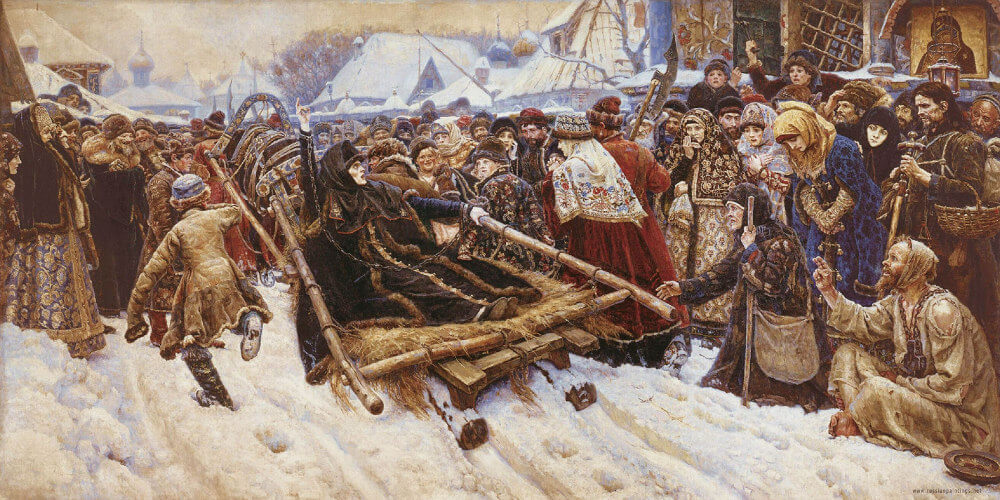
In 1652, a monk named Nikon was appointed Patriarch of Moscow. He was close to Tsar Alexei — close enough that the monarch called him his “special friend” — and he came to the job with a project. Russian liturgical books, accumulated over centuries of hand-copying, had drifted from the Greek originals. Nikon intended to fix that. What followed was one of the ugliest institutional breakdowns in Russian history, a schism so deep that four hundred years later it has not fully closed.
The actual changes were small. Make the sign of the cross with three fingers, not two. Say Alleluia three times in services, not twice. Perform two prostrations during the Prayer of St Ephrem, not four. Process around the church in the opposite direction. Standardise the spelling of Iisus instead of the older Isus. Bring the icons in line with Byzantine models; destroy or confiscate the ones that deviated.
To a 21st-century eye this looks like a dispute about stationery. In 1652 it was something else. The Russian Church had been using those forms for generations — the two-fingered cross, the double Alleluia, the icons with their distinctly Russian faces. These were not felt as errors. They were the shape of prayer. Every Russian Christian had learned to cross themselves with two fingers. Their parents had. Their grandparents had. When Nikon declared the practice incorrect, he was not correcting a typo; he was telling the faithful that everything they had ever done in church was wrong.
The councils of 1654 and 1656 turned that into official doctrine. Those who refused to adopt the new rites were anathematised. The traditionalists — later called Raskolniki, the Schismatics, or Old Believers — had a choice: conform, flee, or die. Many fled into the forests. Some chose a third option: mass self-immolation. Entire communities locked themselves into their wooden churches and burned rather than worship in the wrong way. Estimates vary, and the sources are not all reliable, but the number of self-immolations in the decades after the schism runs into the thousands. These were not isolated acts of despair. They were a considered theological position — that the reformed Church was so corrupted it was better to die outside it than live within it.
The powers that be thought that they had a good reason for pushing throw with the changes. Russia in 1652 was twenty years out of the Time of Troubles — a decade and a half of civil war, famine, foreign occupation, and dynastic collapse that had very nearly destroyed the country. The new Romanov dynasty, on the throne since 1613, was still consolidating. Tsar Alexei needed the Church, and the Church needed the state, and both needed a version of Russian Orthodoxy that looked credible to the wider Orthodox world.
That second point mattered more than it might seem. The Greek Church was the mother church of Russian Christianity; Moscow had been calling itself the Third Rome since the fall of Constantinople. Aligning the Russian rite with the contemporary Greek one was not just housekeeping. It was a claim to legitimacy and to regional leadership among Orthodox Christians — including those living under Ottoman rule, who might one day look to Moscow for protection. The reform was foreign policy dressed in liturgical clothes.
Nikon was successful initially, but he misread what all this meant for his own position. He styled himself “Great Sovereign,” a title reserved for the Tsar, and began acting as if the Patriarch and the monarch were co-rulers of equal standing. Alexei, who had been happy to use Nikon’s energy for the reform project, had no intention of sharing the throne. The friendship cooled, then broke. Nikon was stripped of the patriarchate in 1666 and ended his days in a remote monastery. But the reforms he pushed survived him. The councils of 1666–67 confirmed them and doubled down on the anathemas. The state had spoken. The Old Believers could submit or be excluded.
Most refused. They scattered across Russia’s vast interior — Siberia, the Ural foothills, the far north — anywhere the arm of the church and state reached slowly. Some went further. Old Believer communities settled in Prussia, in the Ottoman Empire, and eventually much further afield. Today there are villages in Brazil, in the state of Paraná, where descendants of Old Believers have been keeping the old rites since the early 20th century. Communities in Argentina too. Closed, insular, wary of outsiders — they do not readily discuss their rituals with strangers. They make the sign of the cross with two fingers. Four hundred years on, the gesture is an act of continuity across one of the longer-running acts of resistance in Christian history.
The schism is usually told as a story of religious stubbornness, two sides fighting over finger positions while more important things went on around them. That framing misses what the episode was actually about. Nikon’s reform was one of the first large-scale demonstrations that the new Russian state could reach into the most intimate corner of its subjects’ lives — the form of their daily prayer — and change it by decree. The Old Believers who refused were not just preserving a ritual; they were refusing a claim to authority. And the state’s response, anathema and exile and worse, showed exactly how it intended to handle that kind of refusal.
Peter the Great would make the same move a generation later, more drastically and with less theological pretext: closing the patriarchate entirely in 1721, replacing it with a state-controlled Holy Synod, forcing nobles to shave their beards, importing German and Dutch engineers to run the army. The shape of the Nikon episode — state power overriding tradition, dissenters expelled to the margins, the church subordinated to the dynasty’s agenda — was the template Peter used, scaled up and stripped of its religious justification. By the early 18th century Russia was expanding on every front, fighting Sweden for the Baltic, pushing south towards the Black Sea, absorbing Siberia. It was not yet the empire it would become under Catherine. But the machinery was being assembled, piece by piece, and the Nikon schism was one of the earlier trials of that machinery — proof that the centre could impose its will, and that the price of refusal was exile to the forests, or worse.
What looks, from a distance, like a quarrel over minor theological rituals turns out to be something more recognisable: a government testing the limits of what it can demand from its subjects, and establishing, with considerable force, that the limits are wherever it says they are. That pattern, too, has proved durable.
That thread — from the Romanov consolidation through the Nikon schism to the Petrine state and the empire beyond it — is one I follow at length in The Butterfly Effect. The connections are never obvious in the moment. A new way to cross yourself seems like a small thing. Follow it far enough and you end up somewhere else entirely.