On 3 February 1488, two battered caravels — the São Cristóvão and the São Pantaleão — dropped anchor in what is now Mossel Bay, on the southern coast of Africa. Their commander, Bartolomeu Dias, had left Lisbon roughly six months earlier with orders from King João II to push further down the African coast than any European had gone, and to search for Prester John, the mythical Christian king supposedly ruling somewhere beyond the known world. Dias brought two caravels of about fifty tons each and a supply ship captained by his brother Diogo, which he left behind on the Angolan coast. Somewhere off Namibia, storms or favourable winds — the sources disagree, and the 1755 Lisbon earthquake destroyed almost all the original records — swept the two remaining ships southwest into the open Atlantic. They sailed blind for thirty days. When they finally turned east and found land again, they had rounded the entire southern tip of Africa without ever seeing it. Dias wanted to keep going. His crew did not. Supplies were short, the ships were battered, and the officers voted unanimously to turn back. On the return voyage, Dias finally sighted the great cape he had unknowingly passed and named it Cabo das Tormentas — the Cape of Storms. King João, who understood exactly what the discovery meant for trade, renamed it the Cape of Good Hope. The route to the Indian Ocean was open. Dias himself would never use it: twelve years later, captaining a ship in Cabral’s fleet bound for India, he was lost in a storm off the same cape he had discovered. The sea giveth and the sea taketh away, but not before it gave Portugal an empire.
It took less than a decade to exploit the opening. Vasco da Gama sailed the route in 1497 and reached Calicut on India’s Malabar coast the following year. Pedro Álvares Cabral followed in 1500, stumbling on Brazil along the way. Then came Afonso de Albuquerque, the real architect of Portuguese power in the East, who began assembling a chain of fortified trading posts — the Estado da Índia — stretching from Mozambique to Malacca. The Indian Ocean had been a busy place for centuries before any Portuguese caravel appeared on its horizon. Arab, Gujarati, and Chinese merchants had criss-crossed those waters for generations, trading spices, textiles, and precious metals through networks that ran from the Swahili coast to the South China Sea. The trade was ancient, sophisticated, and enormously profitable. Portugal’s contribution to this arrangement was the armed carrack: a deep-draught sailing ship capable of crossing oceans and carrying enough cannon to flatten anything it encountered at the other end. Where the existing traders had competed through commerce, the Portuguese competed through firepower. They meant to monopolise the spice trade by controlling the sea lanes, and they were not in a mood to ask permission.
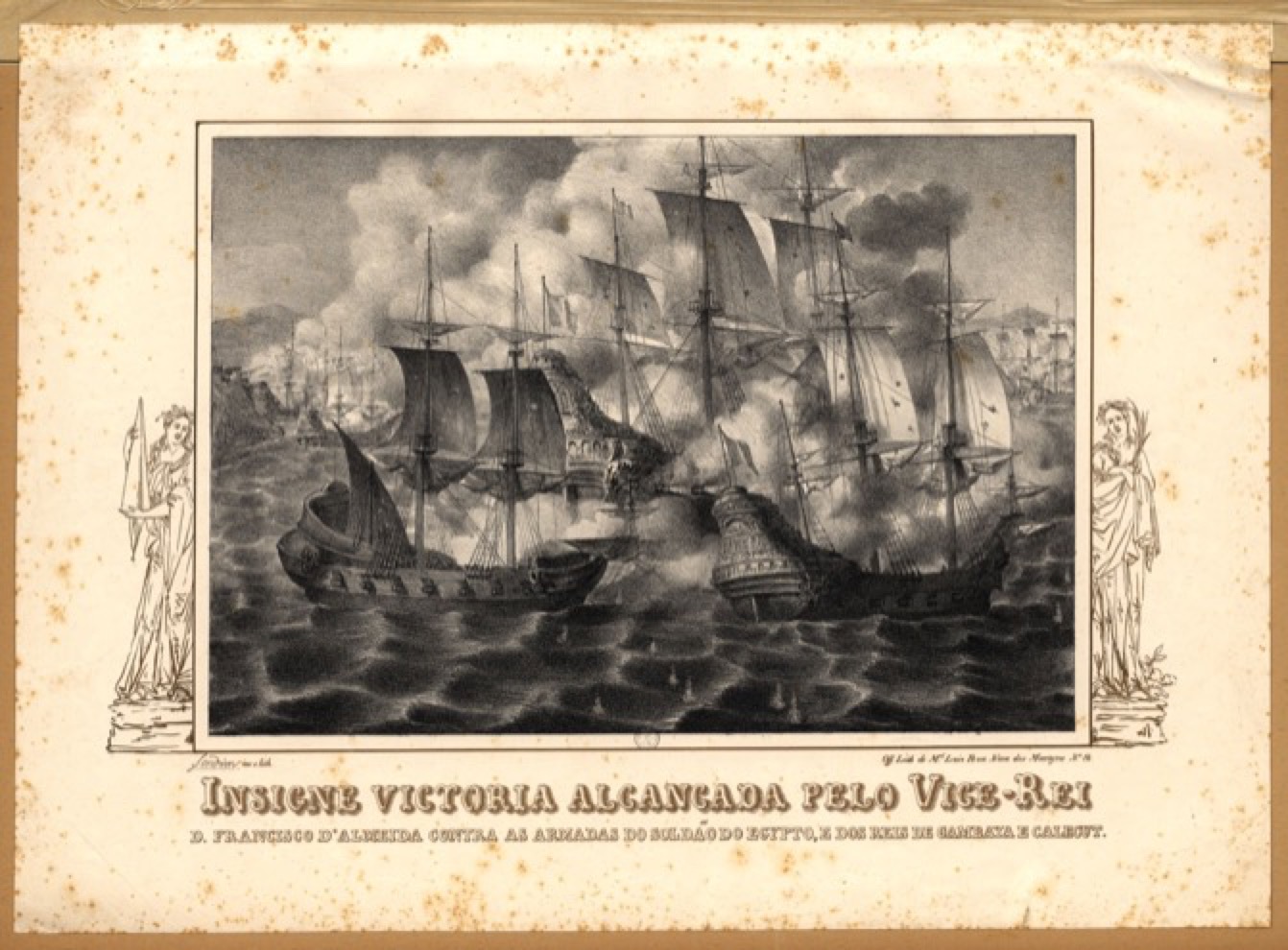
Twenty-one years to the day after Dias landed at Mossel Bay, the consequences of that opened route reached their decisive point in the harbour of Diu, off the coast of Gujarat. On 3 February 1509, the Portuguese Viceroy Francisco de Almeida sailed in with eighteen warships and roughly 1,200 men — 800 Portuguese and 400 Indian Nair allies — to face a combined fleet assembled to drive Portugal out of the Indian Ocean for good. The coalition ranged against him was extraordinary: the Mamluk Sultanate of Egypt, which had been the dominant middleman in the spice trade and stood to lose the most; the Sultan of Gujarat, whose ports were being strangled; the Zamorin of Calicut, who had been fighting the Portuguese since they first appeared on his coast; and behind them, Venetian money, shipwrights, and gunners. Venice had supplied the Mamluks with Mediterranean-type carracks and war galleys, assembled at Suez and crewed partly by Venetian specialists, because Portuguese competition was destroying the Venetian spice monopoly in Europe. Ottoman and Ragusan ships rounded out the fleet. Three continents’ worth of naval power, aligned against a country of roughly one million people clinging to the western edge of the Iberian Peninsula.
The battle was not close. Almeida’s ships were better armed, better crewed, and designed for the kind of stand-off gunnery engagement the Portuguese forced on their enemies. The coalition had lashed its ships together near the shore, surrendering the initiative. The Portuguese bombardment tore them apart. Almeida’s flagship, the Flor de la Mar, blocked the harbour channel and fired over six hundred shots, preventing the lighter oar-ships from flanking the assault. The Zamorin’s boats, unable to break through, turned and ran for Calicut. By dusk, the allied fleet was destroyed. Portuguese losses: thirty-two dead. The spoils included captured galleys, carracks, and six hundred bronze cannon sent back to Portugal. Almeida wrote to King Manuel afterwards with a line that served as both summary and strategic doctrine: “As long as you may be powerful at sea, you will hold India as yours; and if you do not possess this power, little will avail you a fortress on the shore.” Within two years of Diu, Portugal had taken Goa, then Malacca, then Ormuz — the chokepoints of Indian Ocean trade, held by cannon and enforced by the threat of more cannon. A generation’s work, from a country most of Europe’s great powers would not have taken seriously in 1480. Dias opened the door. At Diu, Almeida kicked it off the hinges. Soon Portuguese forts, factories, and warships would stretch from Brazil to Macau — the first global empire, built on gunpowder and the route one storm-battered navigator stumbled onto while looking for a mythical king, that was never found.