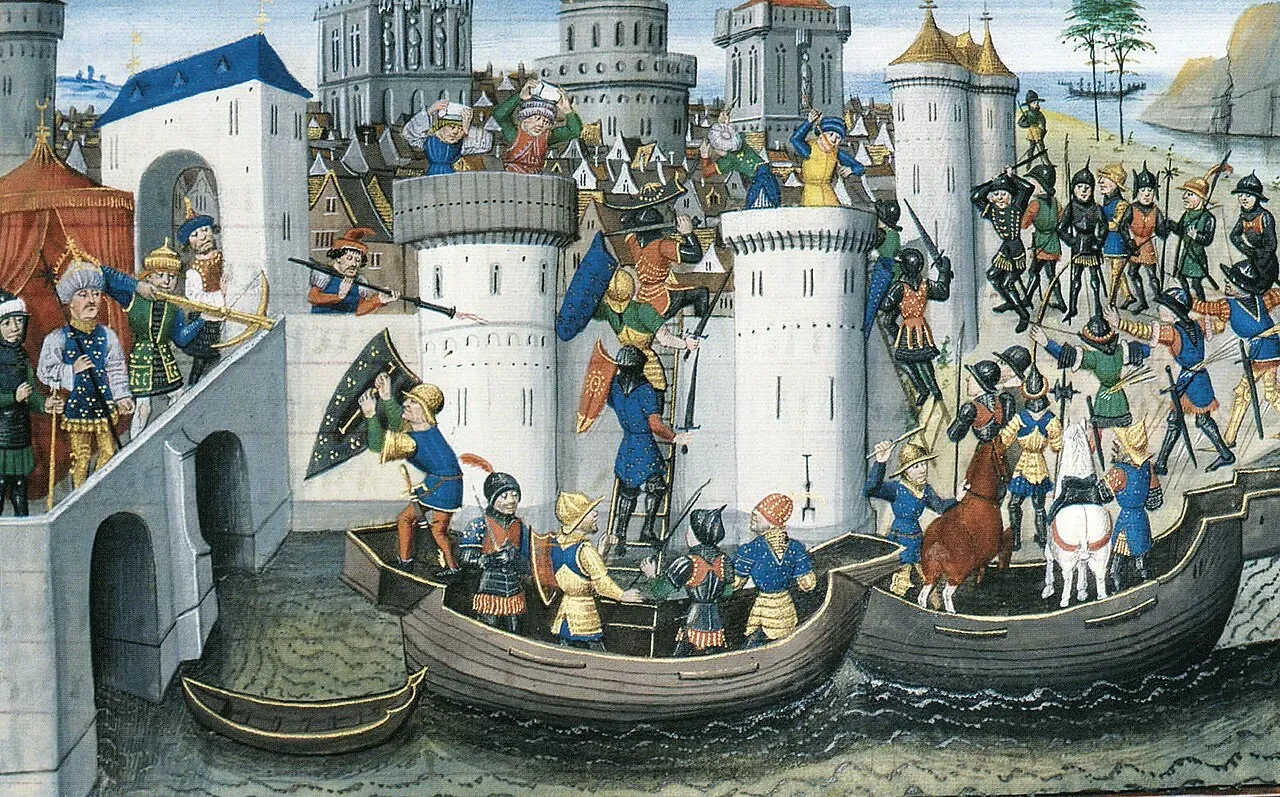
The Fourth Crusade set out to liberate Jerusalem from Muslim rule. It never got within a thousand miles of Jerusalem. What it did instead was breach the walls of Constantinople on 12 April 1204, occupy the city the following day, and proceed to sack it for three days with a thoroughness that astonished even its perpetrators. The city’s residents, watching the carnage, reportedly concluded that the Turks - had they taken Constantinople - could not have done worse. They were not wrong, and in due course they would get to test that theory.
How a crusade designed to attack Egypt ended up destroying the capital of Eastern Christendom is a story about money, opportunism, and a ninety-year-old blind Venetian who was one of the most effective political operators of the medieval period. In 1201, the crusade’s leaders contracted with the Republic of Venice to transport 33,500 soldiers to Egypt. They overestimated badly. When the army assembled at Venice in 1202, roughly 12,000 men had shown up instead. The Venetians had spent a year building ships and training sailors for an expedition three times that size, and their patience for the crusaders’ insolvency was limited. Enrico Dandolo, the doge, proposed a solution: help Venice recover the rebellious port of Zara on the Adriatic, and the debt would be deferred. Zara was Catholic. Its citizens hung crosses from their windows to remind the crusaders of this fact. The city fell in November 1202. The Pope excommunicated the entire army.
From Zara, the crusade’s trajectory took one more impossible turn. A Byzantine prince named Alexios IV Angelos arrived with an offer: help him overthrow the usurper on Constantinople’s throne and restore his deposed father, and he would pay off the entire Venetian debt, provide 200,000 silver marks to the crusaders, send 10,000 Byzantine troops to Egypt, and - the one that Pope Innocent III actually wanted - subordinate the Eastern Orthodox Church to Rome. Dandolo almost certainly knew these promises were impossible to keep. No Byzantine emperor could have raised that money or delivered those concessions. He backed the deal anyway. The crusaders sailed for Constantinople in April 1203.
The first siege that summer placed Alexios IV on the throne alongside his restored father. What followed was predictable: the young emperor could not pay what he had promised. He ordered the melting of sacred icons to extract their gold and silver, raising 100,000 marks against a debt of several times that. Constantinople turned on him. In January 1204, his father died; in February, a nobleman named Alexios Doukas - known as Mourtzouphlos, “bushy eyebrows” - threw Alexios IV in prison and had him strangled. The crusaders had lost their patron and their pretext simultaneously. They decided to take the city by force.
The first assault, on 8 April, failed. Bad weather kept the Venetian ships from the walls, and the Byzantine defenders, who had spent the better part of a year watching these men camp outside their city and had stopped being frightened, threw heavy stones onto the siege engines and broke most of them. The crusaders pulled back, the clergy assured them that God was merely testing their resolve, and on 12 April a northerly wind pushed the Venetian galleys close enough to the sea walls. About seventy crusaders managed to enter through breaches and over the walls. The city’s garrison of Anglo-Saxon Varangians - descendants of men who had fled England after 1066 and ended up in imperial service at the far end of the known world - attempted to negotiate higher wages from their Byzantine employers before dispersing. By 13 April, Constantinople belonged to the crusaders.
The sack ran for three days. The total looted has been estimated at 900,000 silver marks. The Venetians took their contracted share; the crusade’s leaders took theirs; the rank and file reportedly kept back another 500,000 marks privately. The Byzantine chronicler Niketas Choniates described what was done to Hagia Sophia - built by Justinian in the sixth century, for seven hundred years the greatest church in the world - in terms that do not reflect well on Latin Christendom. The silver iconostasis was smashed and divided. The holy vessels were used for drinking wine. A prostitute was seated on the patriarch’s throne and sang songs. Ancient statues from the classical period were melted down for their metal. Three separate fires over the crusaders’ year in and around the city had already burned much of Constantinople; what remained was stripped. When Innocent III learned what his pilgrims had done, he wrote to them with something closer to prosecution than rebuke: “They violated the holy places… they even ripped silver plates from the altars and hacked them to pieces among themselves.”
The Byzantine Empire was divided between Venice and the crusade’s leaders. Baldwin of Flanders became Emperor of Constantinople. Boniface of Montferrat got Thessalonica. Venice took the ports and islands that suited its trade, including three-eighths of Constantinople itself, and held some of them until the Republic’s final collapse in 1797. The surviving Byzantines established three rump states - the Empire of Nicaea in Anatolia, the Empire of Trebizond on the Black Sea coast, and the Despotate of Epirus. The Nicaean Empire recovered Constantinople in 1261, restoring something called the Byzantine Empire. But it was a reduced thing: stripped of much of Anatolia, perpetually short of money, encircled by enemies, and sundered from Western Christendom by a hatred that 1204 had made permanent.
That diminished state was what faced the rising Ottoman sultanate over the following two centuries. The Ottomans had been expanding steadily through Anatolia since the late thirteenth century. The Byzantines, once capable of mounting serious resistance, could no longer field the armies to stop them. Appeals to Western Europe for help produced occasional expeditions, none decisive, and a great deal of theological argument about reunifying the churches - a project that 1204 had made practically impossible. On 29 May 1453, Mehmed II took Constantinople after a fifty-three-day siege. The last Byzantine emperor, Constantine XI, died in the final fighting. The Eastern Roman Empire, which had outlasted the Western by nearly a thousand years, was over. Within a generation, Ottoman armies were at the Danube. In 1529, they besieged Vienna.
The connection between 1204 and 1453 is not a straight line - empires do not fall from a single blow two and a half centuries earlier - but it is not a metaphor either. The destruction of the Byzantine treasury, the permanent loss of Anatolia, the fragmentation into competing successor states, the religious estrangement that made effective Western-Eastern cooperation almost inconceivable: all of these were direct consequences of what happened after the walls were breached on 12 April. A crusade convened to push Islam out of Jerusalem ended up doing more than anything else in the medieval period to ensure that Islam would reach the walls of Vienna.
The crusaders did get something out of it. Not Jerusalem - they never got close to Jerusalem - but the 900,000 marks that had made the whole misadventure financially viable. The Venetian debt was settled. The invoices were paid. What the transaction cost, measured over the following centuries, was the eastern frontier of European civilisation. Medieval history is not short of ugliness, but it takes a particular kind of ingenuity to set out to defend Christendom and end up destroying it.