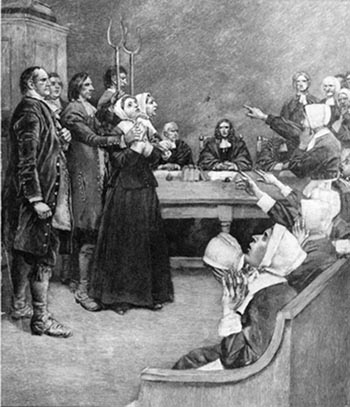
On 1 March 1692, in the meeting house of Salem Village, Massachusetts, three women stood before the local magistrates John Hathorne and Jonathan Corwin. Sarah Good was a beggar, homeless and sharp-tongued. Sarah Osborne had scandalised the village by marrying her indentured servant and rarely attending church. Tituba was an enslaved woman from South America, brought to Massachusetts via Barbados, a stranger in every sense. They had been accused of witchcraft by a group of girls — Betty Parris, aged nine; Abigail Williams, eleven; Ann Putnam, twelve; and Elizabeth Hubbard, seventeen — who claimed to be suffering fits, contortions, and visions of spectral tormentors.
Good and Osborne denied everything. Tituba confessed. She spoke of a tall man from Boston who made her sign a book, of red cats and yellow birds, of other witches in the village whose names she did not know. The confession was almost certainly coerced — she was beaten by her owner, the Reverend Samuel Parris, before the examination — but it did what confessions do. It confirmed that the threat was real. It demanded more names.
Over the following fifteen months, more than two hundred people were accused. Thirty were convicted. Nineteen were hanged — fourteen women and five men. Giles Corey, an eighty-one-year-old farmer, was pressed to death under stones when he refused to enter a plea. At least five more died in the disease-ridden jails. The youngest accused was four years old. The oldest executed was seventy-one.
The mechanism was spectral evidence. If an accuser claimed to see the shape of the accused tormenting them — invisible to everyone else — that vision was admissible in court. The accused could not disprove what only the accuser could see. Confess, and you might live. Deny, and the accusers’ fits grew worse, their screams louder, their certainty more absolute. The feedback loop was perfect. Each confession validated the accusers. Each denial proved the witch’s cunning. The more people were accused, the more plausible the conspiracy became.
By the standards of European witch hunts, Salem was a minor episode. The witch trials of the early modern period killed somewhere between forty and sixty thousand people across Europe — the exact number is disputed, but the scale is not. Germany alone executed more than twenty-five thousand. In the Basque region, the Würzburg trials, the Trier prosecutions, entire communities were emptied. Salem’s nineteen dead barely register on that ledger.
But the psychology is identical. A community under stress — Salem Village was riven by property disputes, religious quarrels, and the terror of Native American raids along the frontier — finds an explanation for its misfortunes. The explanation requires villains. The villains are identified by accusers whose testimony cannot be challenged. Doubt itself becomes suspect. To question the accusers is to side with the accused. The crowd consolidates around its certainty, and the dissenters fall silent or join in.
The trials ended when they began to consume the wrong people. As accusations spread beyond the outcasts and the marginal — reaching the wife of Governor Phips, the minister George Burroughs, prominent merchants and their families — the colony’s leadership lost its nerve. Increase Mather, one of the most influential clergymen in Massachusetts, published a tract arguing that spectral evidence was unreliable: “It were better that ten suspected witches should escape, than that one innocent person should be condemned.” Governor Phips dissolved the Court of Oyer and Terminer in October 1692. The remaining prisoners were eventually released. By 1711, the colonial legislature had reversed the convictions and paid compensation to the families. The last victim, Elizabeth Johnson Jr., was formally exonerated in 2022 — three hundred and twenty-nine years after her conviction.
Several of the accusers later admitted they had lied. Ann Putnam, who had named dozens of witches, stood before the Salem Village congregation in 1706 and asked forgiveness, claiming she had been “deluded by Satan.” The admission changed nothing for the dead. It did establish, for the historical record, that the entire episode had been built on fabrication, coercion, and collective delusion.
I find it difficult to read about Salem without thinking about how little has changed. We no longer hang witches. We have, in theory, due process, rules of evidence, the presumption of innocence. But the underlying psychology — the readiness to believe accusations that confirm what we already suspect, the social pressure to join the consensus, the punishment of doubt — is as available to us as it was to the Puritans of 1692.
The phrase “witch hunt” has become a cliché, deployed so promiscuously that it has lost most of its meaning. But the phenomenon it describes is real and recurring. Moral panics — the satanic ritual abuse hysteria of the 1980s, the day-care sex abuse cases that sent innocent people to prison for decades — follow the same pattern. So do the smaller, faster cycles of online denunciation, where an accusation can destroy a reputation in hours, where the accused’s denial is taken as proof of guilt, where to defend the target is to become a target yourself. The technology changes. The instinct does not.
The people of Salem were not unusually stupid or unusually cruel. They were frightened, credulous, and caught in a system that rewarded accusation and punished scepticism. When the meaning of events is uncertain and the stakes feel high, the temptation to find someone to blame is overwhelming. The crowd provides safety. The accusation provides clarity. The execution provides closure. These are not seventeenth-century impulses. They are human ones.
Three hundred and thirty-four years after Sarah Good, Sarah Osborne, and Tituba stood before the magistrates in Salem Village, the lesson remains the same. Crowds can be wrong. Certainty is not evidence. The accused deserve a defence, even when — especially when — the accusation is horrifying. These are not difficult principles to state. They are very difficult to hold when the crowd is moving and you are standing in its path.