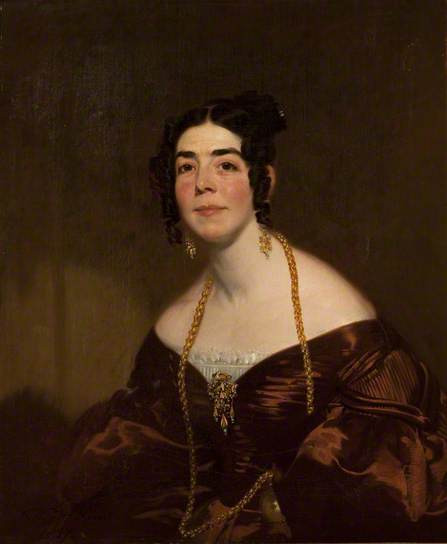
On 7 March 1826, a carriage arrived at the Misses Daulby’s boarding school in Liverpool carrying a man named Edward Thevenot, a servant in the employ of Edward Gibbon Wakefield. Thevenot delivered a message: Mrs Turner had been struck with paralysis and wished to see her daughter immediately. The Misses Daulby — daughters of Daniel Daulby, a noted Liverpool collector — were suspicious enough to observe that their fifteen-year-old pupil, Ellen Turner, did not recognise the man at the door. They let her go anyway. Thevenot took Ellen to Manchester, to the Hotel Albion, where Wakefield was waiting. He told her that her father’s textile business had collapsed and that William Turner had fled to Carlisle to escape his creditors. At Kendal, the story was upgraded: Turner was now a fugitive, but Wakefield’s banker uncle had arranged a solution — if Ellen would consent to marry Wakefield, the debts would be settled and her father would be saved. At Carlisle, Wakefield’s brother William appeared and testified that he had personally spoken to Turner and obtained his blessing for the match. Ellen consented. They crossed the Scottish border to Gretna Green, where they were married by the blacksmith David Laing, whose sideline in hasty weddings was made possible by the fact that Scotland had never adopted England’s 1753 Marriage Act, which required parental consent for anyone under twenty-one. The whole operation, from carriage to ceremony, had taken a day and a half.
Wakefield was thirty years old — a former King’s Messenger, a diplomatic courier, a man with the kind of surface credibility that made strangers inclined to trust him. He had also done this before. At twenty, he had eloped to Scotland with a seventeen-year-old heiress named Eliza Pattle. Her mother had accepted the marriage rather than face public scandal and settled £70,000, a very substantial sum at that time, on the couple. Eliza died four years later in childbirth. Wakefield subsequently attempted to grab more of his father-in-law’s will and there were suspicions of perjury and forgery. He did not find a second fortune that way, so he went looking elsewhere. His plan for Ellen Turner was built on the same calculation that had worked with the Pattles: that her family, faced with a legally binding marriage, would accept the fait accompli rather than submit the matter to public examination. The logic was not irrational; it reflected how social convention actually operated. And Ellen was, in the relevant legal sense, an instrument: the sole child of a wealthy man, the High Sheriff of Cheshire. Marrying her transferred her inheritance to her husband. What she thought about any of this did not feature in Wakefield’s scheme, except as an obstacle to be managed with a sequence of carefully escalating lies. Each stage of the con closed off another exit: Manchester removed her from the school’s protection, the story of financial ruin removed her faith in her father’s stability, the claim of paternal consent removed her last reason to refuse.
What Wakefield had not counted on was that William Turner refused to do as Mrs Pattle had done. He did not accept the marriage and reach for the cheque book. He went to London and enlisted the Foreign Secretary. His brother and a solicitor and a police officer tracked the couple to a hotel in Calais. Wakefield, on surrendering Ellen, issued a written statement attesting that she remained a virgin — as though this were the thing that mattered. The brothers were tried at Lancaster in March 1827; the jury found all defendants guilty the same day they were put on trial. Edward was sentenced to three years in Newgate, William to three years in Lancaster Castle. The marriage was annulled by Act of Parliament on 14 June 1827. Ellen Turner married Thomas Legh, a wealthy Cheshire neighbour, at seventeen. She died in childbirth at nineteen. She was survived by a daughter.
Wakefield served his three years and emerged with views on prison reform and an interest in colonial affairs. He developed what became known as the “Wakefield scheme” — the theory that colonial land should be sold at a controlled price to finance the immigration of labourers, creating a balanced social structure in new territories from the start. He had a role in the colonisation of South Australia, shaped Canadian immigration policy, and was one of the principal architects of British settlement in New Zealand. His brother William became a founding leader of the New Zealand Company. Edward Gibbon Wakefield has a Wikipedia article running to several thousand words. Statues, streets, and institutions across New Zealand bear his name. Ellen Turner does not have a Wikipedia article. She has a footnote in his. What I find instructive about all this — and why a crime that shook no government and changed no border still deserves attention — is not the abduction itself, which was ultimately punished, but the career arc that followed it. The same qualities that made Wakefield a competent criminal — methodical confidence, fluency with deception, and a complete indifference to the preferences of people he’d classified as obstacles — also made him a useful empire-builder. Men who are prepared to treat a fifteen-year-old as a line item in a balance sheet often prove well suited to treating an entire continent similarly. The type has not disappeared. The specific mechanism — forged letters, fake family emergencies, a Scottish blacksmith — belongs to 1826. The underlying operating logic does not.