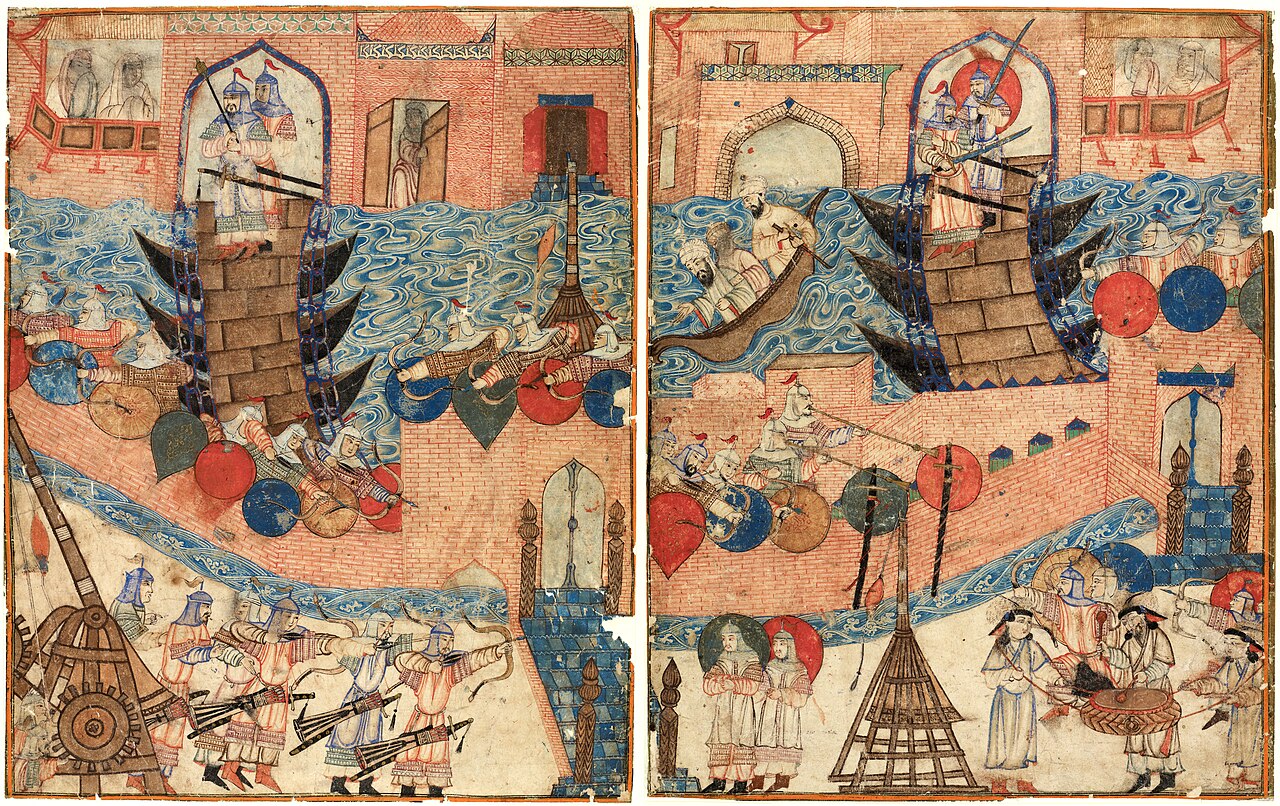
In September 1257, Hulegu Khan sent a letter to the Abbasid caliph al-Musta’sim in Baghdad. The historian René Grousset called the ensuing exchange “one of the most magnificent dialogues in history.” Hulegu’s opening position was direct: submit peacefully, send your three principal ministers to me, and things will go well for you. His closing lines were less diplomatic, typical of the Mongolian approach at that time. “I will bring you crashing down from the summit of the sky, like a lion I will throw you down to the lowest depths. I will not leave a single person alive in your country, I will turn your city, lands and empire into flames.”
The caliph’s reply called Hulegu young and ignorant. It presented al-Musta’sim as a ruler capable of summoning armies from across the Islamic world. Hulegu’s envoys, sent to deliver the letter and receive the response, were subjected to taunting and mockery by mobs on Baghdad’s streets.
Hulegu heard him loud and clear, and took action. On 13 February 1258, the sack of Baghdad began.
To understand what happened, you need to know what Baghdad was. Founded in 762 by the Abbasid caliph al-Mansur on the west bank of the Tigris, it had grown into one of the largest cities on earth - by one estimate, over a million inhabitants between the years 1000 and 1200, a figure matched in that period only by Kaifeng, that already fell victim to Mongolian armies, and Hangzhou, that will do so in a few decades, both in China. The city contained the House of Wisdom, an institution that gathered translated texts from ancient Greece, Persia, and India, and produced new work in mathematics, astronomy, medicine, and philosophy. Justin Marozzi, in his history of Baghdad, calls it “the intellectual capital of the planet.” For five centuries, that was not an exaggeration.
The caliphate had been weakening for three hundred years before Hulegu arrived. The Buyids had occupied Baghdad in 945, the Seljuks in 1055. The caliphs had long since lost temporal power over most of the Islamic world and focused on the city itself, where they retained local authority and the prestige of the dynasty that had ruled since the Umayyads were overthrown. Al-Musta’sim, the last of them, was not an incompetent ruler by the standards of a caliph who had no real army and no reliable allies. His problem was that he failed to understand, until far too late, that Hulegu was not a raider or a rival dynasty. He was an extinction event.
The sign were clear. The Mongols had been pressing towards Baghdad for two decades. The general Chormaqan had raided up to its walls in 1238. His successor Baiju had attacked it nearly every year afterwards. By 1251, the new Great Khan Möngke had resolved to deal with two remaining problems in the west: the Nizari Ismaili Assassins in the Elburz Mountains, and the Abbasid Caliphate. He dispatched his brother Hulegu with between 138,000 and 300,000 men - one fifth of the empire’s total manpower. The Assassins surrendered in November and December 1256, their mountain fortresses falling one by one. Hulegu then turned his attention south.
His expectation had been that the caliph would contribute troops to the campaign against the Assassins. Al-Musta’sim initially agreed, then reversed his decision when his ministers argued that the real purpose of the request was to empty Baghdad of its defenders. That reversal was, in hindsight, the first of several fatal decisions. A subsequent outbreak of sectarian violence between Sunni and Shi’a in Baghdad had left the city internally divided. The Mamluk Sultanate in Egypt was hostile to the caliph. The Ayyubid rulers in Syria were preoccupied with their own survival. The caliphate’s appeal to the broader Islamic world for military assistance went unanswered. Baghdad was alone.
When Hulegu’s three-pronged army descended on Mesopotamia in late 1257, the caliph’s forces attempted a sortie on 16 January 1258 with roughly 20,000 infantry. Mongol cavalry retreated, in its customary faschion drew the caliphal army out, and then, that night, Baiju’s forces broke the dykes of the Dujayl Canal and flooded the pursuing army’s camp. Many drowned. The survivors were cut down the following morning. A handful, including the military commander known as the dawatdar, made it back to Baghdad.
The city’s walls were in poor repair after a flood the previous year. The garrison, at most 50,000 strong before the sortie reduced it further, was largely untrained. Mongols, on the other hand, knew siege warfare intimately by this time in history. Hulegu enclosed Baghdad in a palisade with a moat, cut off the river on both sides with pontoon bridges, and erected stone-throwing siege engines. The assault on the walls began on 29 or 30 January. The eastern battlements were in Mongol hands by 4 February. Hulegu showed no mercy. He killed soldiers who attempted to surrender. On 7 February, a large number of unarmed inhabitants emerged from the city hoping to be spared and allowed to settle elsewhere. They were divided into groups and executed.
Al-Musta’sim surrendered the city on 10 February. He sent out his family and 3,000 dignitaries. Then, as instructed by Hulegu, he ordered the population to lay down their weapons and leave. Those who obeyed were slaughtered.
The sack began on 13 February and ran for a week. Certain groups were spared: Sayyids, scholars, merchants with Mongol trade connections, and Christians, on whose behalf Hulegu’s wife Doquz Khatun - herself a Christian - had personally interceded. Everyone else was subject to killing and pillaging. An Armenian historian, Kirakos Gandzaketsi, recorded that the Christians in Hulegu’s army took particular pleasure in the work.
The death toll is genuinely unknowable. Hulegu himself, in a letter to Louis IX of France written shortly afterwards, estimated his army had killed 200,000. Later Muslim historians put the figure at between 800,000 and two million. Both numbers must have been inflated by a subsequent epidemic - a physician present recorded that a “pestilence” killed so many refugees that their bodies could not be buried and were thrown into the Tigris. The historian Monica Green has argued that Hulegu’s unexplained five-camp moves in early 1257 suggest he was already dealing with plague outbreaks before the siege began. Whether the epidemic that followed was plague, or a precursor to the Black Death that would sweep Asia and Europe a century later, is still debated.
A 16th-century historian wrote that so many books from Baghdad’s libraries were thrown into the Tigris that “the colour of the river changed into black from their multitude.” Whether literally true or not, the image has survived for seven centuries. The House of Wisdom was destroyed. Five hundred years of accumulated scholarship, translated and original, went into the river or onto fires.
Two days into the looting, Hulegu summoned al-Musta’sim to the caliphal palace and demanded to be shown his treasures. The exchange that followed was recorded by Nasir al-Din al-Tusi, who was likely present. Hulegu set a golden tray in front of the caliph and said: “Eat.”
“It is not edible,” the caliph replied.
“Then why did you keep it, and not give it to your soldiers? And why did you not make these iron doors into arrow-heads and come to the bank of the river so that I might not have been able to cross it?”
“Such,” replied the caliph, “was God’s will.”
“What will befall you,” said Hulegu, “is also God’s will.”
On 20 February, after halting the killing and moving his camp upwind of a city that was becoming putrid, Hulegu had al-Musta’sim executed along with his entire family and court. The Mongols had a taboo against spilling royal blood, so the caliph was rolled in a carpet and trampled to death by horses. The 500-year-old Abbasid Caliphate ended in a carpet on a street in the city it had built.
The conventional account of Baghdad’s fall presents it as the moment that ended the Islamic Golden Age and set the trajectory for the subsequent rise of the West. Modern historians have been less convinced. Michal Biran has shown that large libraries in Baghdad had reopened for teaching and learning within two years of the siege. Hulegu and his Ilkhanate successors actively patronised music, literature, and scholarship; the very same Nasir al-Din al-Tusi who told Hulegu that none of the predicted disasters would befall him went on to build an astronomical observatory at Maragha under Ilkhanid patronage. It was later sieges - Timur’s sacks of Baghdad in 1393 and 1401, and the Ottoman conquest of 1534 - that completed the city’s long-term marginalisation.
The argument that 1258 killed the Islamic Golden Age is, as Biran puts it, simplistic. The broader Islamic world kept producing scholars, scientists, and philosophers long after Hulegu went home to Azerbaijan. Cairo, not Baghdad, became the new centre of Sunni learning. A descendant of the Abbasid dynasty was installed as a puppet caliph by the Mamluks in Cairo and recognised almost nowhere. The Ottomans eventually absorbed even that title.
What did end in 1258 was the thing al-Musta’sim had been custodian of: the idea that the Abbasid Caliphate was an inviolable, sacred, and permanent institution. Hulegu had made his calculations on exactly this point. He debated whether to execute the caliph at all, and then decided to do it precisely to shatter that myth. A man who had been the nominal successor of the Prophet, wrapped in a carpet and trampled by horses in the ruins of his own city - that was the message. There would be no rallying cry around al-Musta’sim’s survival, no restoration, no reconquest. The dynasty that had built Baghdad, housed the House of Wisdom, and given the Islamic world its intellectual centre for half a millennium was simply over.
The Mongols had been destroying cities, armies, and civilisations for forty years before they reached Baghdad. Genghis Khan’s campaigns against the Khwarazmian Empire in the 1220s had killed hundreds of thousands; the sacks of Merv, Nishapur, and Samarkand were among the most destructive events of the medieval period. By 1258, the pattern was well established. Baghdad was not a unique crime so much as the most consequential one: the destruction of a city whose intellectual output had been feeding Islamic and even European scholarship for generations, carried out in thirteen days, in a river valley where the evidence was still floating in February of 1258.
Al-Musta’sim told Hulegu it was God’s will. Perhaps he believed it. Perhaps it was all he had left to say. The caliph who had called his enemy young and ignorant, and who had watched his own sortie drown in a flooded camp, ended his reign as a man rolled in a carpet having just been lectured about gold. The man who had lectured him about gold then rebuilt Baghdad, reopened its markets, and patronised its scholars. History has a particular kind of irony reserved for the very worst of its episodes: the same person who destroys something sometimes turns out to be the one who understands its value.