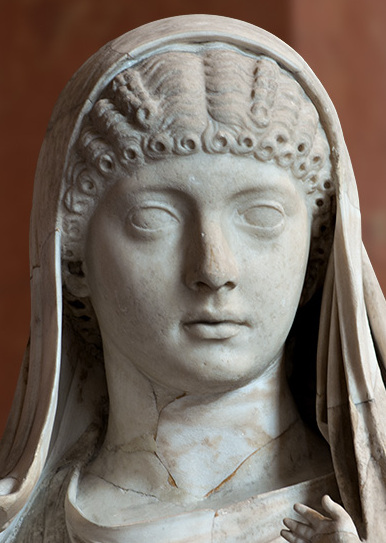
The dinner party was going well until the boy drank the water. Britannicus, thirteen years old and one day short of his fourteenth birthday, had asked for his wine to be cooled. A slave brought cold water. The taster had already checked the wine — hot, and safe — so the water went untested. Britannicus drank. Within moments he lost the ability to speak or breathe. He collapsed. The other guests froze. Nero, the seventeen-year-old emperor who had been watching from his couch, did not move. “It’s just epilepsy,” he said. “He’s had it since childhood. He’ll recover.” Britannicus did not recover. He was dead before anyone could carry him from the room.
Nero held the funeral the next day, in the rain, and gave no eulogy. He explained that it was Roman tradition not to burden the public with speeches for those who died young. According to Cassius Dio, he had the corpse covered in gypsum to hide the discolouration that poison leaves on skin. The rain washed it away as the body was carried through the Forum, and everyone who looked could see what had happened. The boy was cremated and his ashes placed in the Mausoleum of Augustus, alongside his father’s. The emperor who had ordered his death went back to the palace.
The name Britannicus came from a war his father never really fought. In 43 AD, Emperor Claudius — a man the Roman aristocracy had spent decades dismissing as a stammering fool — launched an invasion of Britain. The legions did the work. Claudius arrived after the hard fighting was done, spent sixteen days on the island, accepted the surrender of several tribal kings at Camulodunum, and returned to Rome to celebrate a triumph. The Senate awarded him the title Britannicus. He never used it. Instead, he gave it to his infant son, born two years earlier, whose original name had been Tiberius Claudius Germanicus. The boy became Tiberius Claudius Caesar Britannicus — named for a conquest his father had barely participated in, heir to an empire his father had stumbled into, and ultimately a victim of the succession politics that made the Julio-Claudian court a killing floor.
Claudius had not expected to become emperor. When the Praetorian Guard found him hiding behind a curtain after Caligula’s assassination in 41 AD, he was fifty years old and had spent his life being kept away from power by relatives who considered him an embarrassment. The soldiers dragged him to their camp and proclaimed him emperor because he was the last adult male of the dynasty still breathing. He proved more capable than anyone had expected — competent administrator, builder of public works, conqueror of Britain. He also proved incapable of managing his own household.
His third wife, Valeria Messalina, was Britannicus’s mother. She was executed in 48 AD after staging a bigamous marriage with her lover Gaius Silius while Claudius was out of Rome — a plot that may have been intended to place Silius on the throne as regent for Britannicus. Claudius, informed of the affair by his freedmen, had her killed. He then married his niece Agrippina the Younger, a woman whose ambition made Messalina look restrained.
Agrippina had a son from a previous marriage: Lucius Domitius Ahenobarbus, three years older than Britannicus. Within a year of the wedding, she had convinced Claudius to adopt the boy. His name became Nero Claudius Caesar. Within two years, Nero had received the toga of manhood early, been granted proconsular authority, and been betrothed to Britannicus’s sister Octavia. Britannicus, meanwhile, was progressively isolated. Agrippina replaced his tutors with her own nominees. She had the two prefects of the Praetorian Guard removed and replaced with Sextus Afranius Burrus, a man who understood where his loyalty was owed. At public games, Nero appeared in triumphal robes while Britannicus still wore the clothes of a child. The message was clear to anyone watching.
Claudius eventually noticed. According to Suetonius, he began speaking of giving Britannicus the toga of manhood early and declaring him his true heir. “That the Roman people may at last have a genuine Caesar,” he reportedly said. He mentioned divorcing Agrippina. He did not live long enough to do either. On 13 October 54 AD, Claudius died after eating a dish of mushrooms. The ancient sources agree that Agrippina had them poisoned. The same poisoner, a woman named Locusta, would later be employed to deal with Britannicus.
Nero became emperor at sixteen. For the first months, Agrippina ran the government. Then her son began asserting independence — taking a mistress, removing her allies from positions of power. When she threatened to champion Britannicus’s claim to the throne, Nero decided the boy had to die. Locusta was summoned. The first dose she provided was too weak — it gave Britannicus diarrhoea but nothing worse. Nero, according to Suetonius, beat her and demanded something faster. She produced a poison that killed a goat instantly. Nero was satisfied. The dinner party was arranged.
The murder of Britannicus was not an aberration in the Julio-Claudian dynasty. It was the pattern. No emperor of this line was ever succeeded by his biological son. Augustus spent decades trying to secure the succession for his descendants, and they kept dying — his nephew Marcellus in 23 BC, his grandsons Gaius and Lucius in 4 and 2 AD. He ended up adopting his stepson Tiberius, whom he did not particularly like, because there was no one else left. Tiberius’s own son Drusus predeceased him; his grandsons Nero Caesar and Drusus Caesar were killed during the reign of terror orchestrated by the Praetorian prefect Sejanus. Caligula adopted his cousin Tiberius Gemellus as co-heir, then had him executed within a year. Claudius was the only Julio-Claudian emperor to be outlived by his biological son. That son was then murdered by his adopted one.
The dynasty had no mechanism for legitimate succession. Augustus had created the principate as a polite fiction — he was merely the “first citizen,” not a king, and certainly not the founder of a hereditary monarchy. The fiction meant there was no law of succession, no clear rule about who came next. What filled the gap was adoption, intrigue, and murder. Adoption became a weapon: you adopted someone to make them your heir, which meant that anyone standing between the adopted son and the throne had a target on their back. The women of the dynasty — Livia, Agrippina the Elder, Agrippina the Younger — learned to play this game as ruthlessly as the men, because their survival and their children’s survival depended on it.
Britannicus’s death cleared the path for Nero, and Nero’s reign demonstrated what the dynasty’s dysfunction could produce. He murdered his mother in 59 AD, after several failed attempts including a collapsing boat. He kicked his pregnant wife Poppaea to death in 65 AD. He executed or drove to suicide dozens of senators, generals, and aristocrats. When Rome burned in 64 AD, he used the disaster to build himself a palace complex covering a third of the city. The Pisonian conspiracy of 65 AD failed to remove him, but the provincial revolts of 68 AD succeeded. Nero fled Rome and killed himself with the help of a freedman, reportedly lamenting: “What an artist dies in me.”
His death ended the Julio-Claudian dynasty and plunged the empire into civil war. The Year of the Four Emperors — 69 AD — saw Galba, Otho, Vitellius, and finally Vespasian fight for the throne. Tens of thousands died. The lesson was clear: the system Augustus had built could not manage succession peacefully. It would take another century and a half of experimentation — adoptive emperors, military coups, civil wars — before Diocletian finally restructured the empire into something more stable. And even that did not last.
Britannicus was thirteen when he died, named for a conquest, heir to nothing. His friend Titus — the future emperor who had been educated alongside him — later erected a golden statue in his memory and issued coins bearing his image. It was a gesture of sentiment from a man who had tasted the same poison at that dinner party and survived only by luck. The Julio-Claudian dynasty left Rome an empire that stretched from Britain to Mesopotamia, a legal and administrative framework that would endure for centuries, and a model of succession so broken that it guaranteed violence at every transition of power. Britannicus was one casualty among many. The cold water that killed him was just the dynasty doing what it had always done.