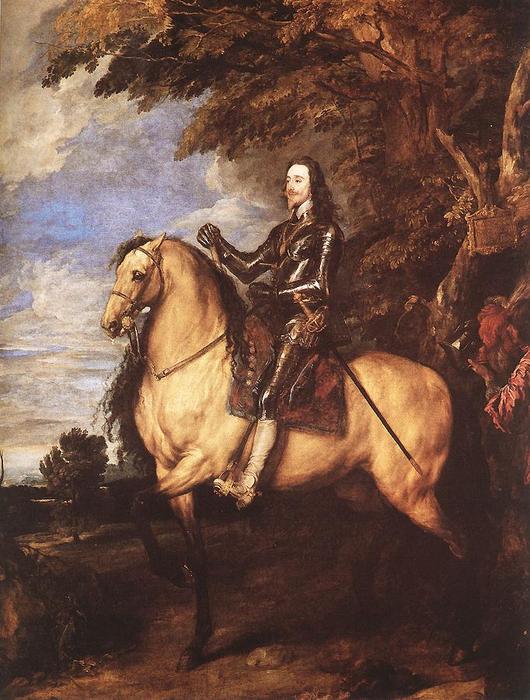
On 2 February 1626, Charles Stuart was crowned King of England at Westminster Abbey. He was twenty-five, slight, and already king — his father James I had died the previous March. The coronation was ceremony; Charles had been ruling for ten months. What nobody in that abbey could have foreseen was that this king’s reign would end with his head on a block outside the Banqueting House in Whitehall, and that the consequences of his rule would reshape not just England but much of the world.
Seven years later he staged a second coronation, at Holyrood in Edinburgh, conducted according to Anglican rites. Scottish Presbyterians saw it as a provocation. They were right. Charles had a gift for making enemies of people who might otherwise have left him alone.
The name tells its own story. After Charles and his son Charles II, no English monarch touched it for nearly four centuries. We got a Charles III only in 2022, and even that felt like a minor act of courage. The first two Charleses did not recommend the brand. Charles I lost his head. Charles II spent much of his reign secretly negotiating with Louis XIV, fathered at least fourteen illegitimate children, and left a brother whose Catholic ambitions triggered yet another constitutional crisis. Not a dynasty you’d name your son after.
The first Charles’ political missteps were not subtle. The list of blunders is probably as long as his hair in the Van Dyck portraits that still hang in the National Gallery — and the hair was considerable. He dissolved Parliament three times in his first four years on the throne, then decided to rule without it altogether. The Personal Rule — eleven years, 1629 to 1640, during which no Parliament sat — was not quite illegal, but it was unwise in a country where Parliament controlled taxation. To fund his government without parliamentary approval, Charles resorted to expedients. Ship Money, a tax traditionally levied on coastal towns during wartime, was extended to the entire country in peacetime. John Hampden, a Buckinghamshire gentleman, refused to pay and took the case to court. He lost the legal argument by a narrow margin but won the political one. The principle that the king could tax without consent became a rallying point.
Then he overreached in Scotland. In 1637, Charles attempted to impose a new Book of Common Prayer on the Scottish Kirk. The result was immediate: riots in Edinburgh, the National Covenant of 1638, and eventually the Bishops’ Wars — two brief military campaigns that Charles lost. He was forced to recall Parliament in 1640 to raise money for the wars he had started, and the Parliament he recalled was in no mood to cooperate. The Long Parliament dismantled much of his apparatus of personal rule. When Charles marched into the Commons with armed soldiers in January 1642 to arrest five members, the breach became irreparable. Civil war broke out that summer.
The war lasted, in its various phases, from 1642 to 1651. Charles lost. He was captured, tried by a court that most of Europe regarded as illegitimate, and executed on 30 January 1649. The crowd, reportedly, groaned. It was an act almost without precedent. Kings had been deposed, murdered, poisoned, smothered. But tried and publicly beheaded by their own subjects, on a legal warrant, in broad daylight? The English had done something new.
What followed was messy. The Commonwealth under Oliver Cromwell, then the Protectorate, then Cromwell’s death and a chaotic interregnum, and finally the Restoration of Charles II in 1660. But the Restoration did not restore absolute monarchy. The lesson of the 1640s had sunk in. When James II — Charles I’s second son — tried to reassert royal prerogative and impose Catholic toleration in the 1680s, Parliament removed him with minimal bloodshed in the Glorious Revolution of 1688. The Bill of Rights of 1689 made the settlement explicit: no taxation without parliamentary consent, no standing army without parliamentary approval, free elections, free speech in Parliament. The crown survived, but as a constitutional institution, not an absolute one.
This matters beyond England because of what came next. Parliamentary governance — imperfect, frequently corrupt, riddled with class bias — nonetheless gave Britain structural advantages that absolute monarchies lacked. A government answerable to Parliament could borrow more cheaply, because creditors trusted that debts approved by Parliament would be honoured. The Bank of England, founded in 1694, gave the state a fiscal architecture that France and Spain could not match. The result was that a medium-sized island with unremarkable natural resources and terrible weather could outspend, outbuild, and eventually outfight far larger rivals. Britain became the seat of the largest non-contiguous empire in history. Much of the world we live in today — from the language I am writing in to the legal systems of dozens of countries to the very idea that a government ought to answer to its people — carries the imprint of that transformation.
The line from a coronation at Westminster Abbey in 1626 to the shape of the modern world is not straight. It passes through battlefields, a scaffold, a decade of republican experiment, another Stuart restoration, another revolution, and then centuries of expansion that brought as much suffering as it did structure. But the line is there. Charles I did not cause the British Empire. He caused the crisis that forced England to answer a question it had been deferring: who rules? The answer — Parliament, constrained by law, accountable at least in theory — turned out to be a better operating system than most of the alternatives on offer. Not because it was just. Because it was marginally more adaptive.
Four hundred years ago today, a young king knelt in Westminster Abbey and received a crown. Twenty-three years later he knelt again, on a scaffold outside the Banqueting House, and lost his head. The distance between those two places is negligible, but the distance between the two moments is the distance between the old world and the new.