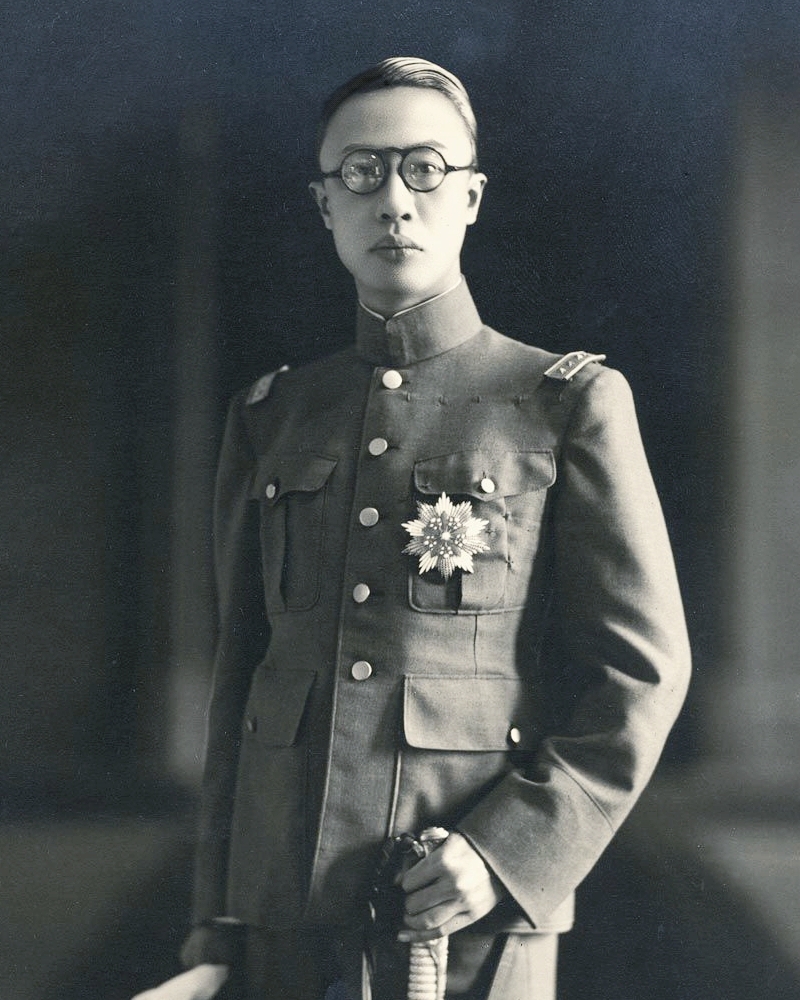
On 7 February 1906, Aisin-Gioro Puyi was born in the Northern Mansion in Beijing, the residence of his father, Prince Chun, who was the half-brother of the reigning Guangxu Emperor. The Qing dynasty — founded by Manchu conquerors who rode through the Great Wall in 1644 and seized the Dragon Throne from the collapsing Ming — had ruled China for 262 years and was running on fumes. The Guangxu Emperor was thirty-four and powerless, a prisoner in all but name inside his own palace since his aunt, the Empress Dowager Cixi, had crushed his Hundred Days’ Reform in 1898 and resumed control. Cixi was seventy-two, ill, and running out of time. On 14 November 1908, the Guangxu Emperor died — almost certainly poisoned, as forensic analysis of his remains confirmed in 2008 when lethal levels of arsenic were found in his hair and bones. Cixi, who had selected Puyi as the next emperor the day before, died herself on 15 November, one day after the man she had kept caged for a decade. Whether she ordered the poisoning from her own deathbed to ensure he did not outlive her and undo her work remains debated; the timing alone is damning enough. Puyi, two years and nine months old, was carried into the Forbidden City and placed on the Dragon Throne. According to every account of the enthronement ceremony, the child screamed. His father, appointed regent, reportedly tried to console him by saying: “Don’t cry, it will be over soon.” The courtiers took this as an evil omen. It was, as it turned out, a precise description of the dynasty’s remaining lifespan.
Three years later it was over. The Wuchang Uprising of 10 October 1911 — a military mutiny in Hubei province that succeeded partly because the local revolutionary cell’s bomb-making accident forced them to act before the authorities could arrest them — set off a chain of provincial defections that dissolved Qing control across southern and central China within weeks. Sun Yat-sen, the revolutionary leader who had spent years fundraising and organising from exile in Japan, Hawaii, and London, was proclaimed provisional president of the Republic of China on 1 January 1912 in Nanjing. The dynasty’s last hope was Yuan Shikai, a general and political operator whom the court recalled from retirement to command the only modern army in northern China — the Beiyang Army. Yuan played both sides with considerable skill: he negotiated with the revolutionaries while pressuring the court, extracting concessions from each in turn, until he had made himself indispensable to both. On 12 February 1912, the abdication edict was issued in Puyi’s name — the six-year-old did not write it, did not understand it, and was not consulted. Sun Yat-sen stepped aside, and Yuan Shikai became president of the Republic. The Articles of Favourable Treatment, negotiated as part of the abdication, allowed Puyi to keep his title, his household, and his residence inside the Forbidden City, supported by an annual stipend of four million silver taels. A child emperor in a walled compound, surrounded by eunuchs and tutors, reigning over nine hundred rooms and nothing else. The empire was gone. The palace remained, and inside it time stopped — for a while.
The Republic that replaced the Qing proved that removing a dynasty is easier than rebuilding a state. Yuan Shikai, having secured the presidency, dissolved parliament, revised the constitution to make himself president for life, and in December 1915 declared himself Emperor of a new dynasty. The backlash was immediate. Provincial governors who had tolerated a president would not tolerate a new emperor. Yuan cancelled the monarchy in March 1916 and died three months later, leaving behind a power vacuum that fractured China into competing warlord fiefdoms for the next decade. Puyi, meanwhile, remained in his gilded cage. In July 1917, the warlord Zhang Xun — known as the “Pigtailed General” because he and his troops still wore the Manchu queue as a sign of loyalty — marched into Beijing and restored Puyi to the throne. The restoration lasted twelve days before a rival warlord’s aircraft dropped bombs on the Forbidden City — small bombs, doing little damage, but the first aerial bombardment in Chinese history — and Zhang Xun’s forces collapsed. Puyi went back to being a private citizen with a palace. He acquired a Scottish tutor, Reginald Johnston, who taught him English, Western manners, and an affection for the outside world he was not permitted to see. In November 1924, the warlord Feng Yuxiang, having seized Beijing in yet another coup, sent troops into the Forbidden City and gave Puyi two hours to leave. The Articles of Favourable Treatment were revoked. The stipend was cancelled. Puyi, now eighteen, was escorted out of the only home he had ever known and driven to his father’s residence, then to the Japanese legation in Tianjin. The Japanese were delighted to have him. A deposed emperor is a useful thing if you know what to do with him, and Japan knew exactly what it intended.
Japan’s plan took shape on 18 September 1931, when officers of the Kwantung Army detonated a small charge on the South Manchuria Railway near Mukden, blamed it on Chinese saboteurs, and used the pretext to invade Manchuria. The conquest took five months. In March 1932, Japan established the state of Manchukuo — nominally independent, actually a colony — and installed Puyi as Chief Executive. On 1 March 1934, he was elevated to Emperor, taking the reign name Kangde. The title was the thing Puyi had wanted since the day Feng Yuxiang’s soldiers pushed him out of the Forbidden City. What came with it was not what he had imagined. The Kwantung Army ran Manchukuo. Japanese advisers sat in every ministry, approved every decree, and controlled every budget line. Puyi signed what was placed in front of him. He performed ceremonies in the state Shinto shrine the Japanese built in his capital, Hsinking. His imperial guard was Japanese. His diet was monitored by a Japanese doctor. When he visited Tokyo in 1935 and 1940, he was received with the elaborate courtesy Japan reserved for subordinate monarchs — respect calibrated to advertise the host’s superiority. Manchukuo’s thirteen years produced forced labour, systematic resource extraction for Japan’s war economy, opium monopolies run for revenue, and the horrors of Unit 731’s biological weapons programme in Harbin, where thousands of prisoners — Chinese, Korean, Russian, Allied — were subjected to experiments whose details remain difficult to read eighty years later. Puyi bore formal responsibility for all of this as head of state. Whether he knew the full scope of what happened under his reign name is disputed; that he did nothing to prevent any of it is not. On 9 August 1945, the Soviet Union invaded Manchuria with one and a half million troops. The Kwantung Army, hollowed out by transfers to the Pacific, disintegrated in days. On 19 August, Puyi was captured by Soviet paratroopers at Mukden airport as he attempted to board a plane for Japan. The last Emperor of China ended his second reign the same way he ended his first: removed from a throne by someone else’s soldiers, with no say in the matter.
The Soviets held him for five years — in Chita, then in a sanatorium near Khabarovsk — treating him with a certain curiosity, as one might treat a rare specimen. He testified at the International Military Tribunal for the Far East in Tokyo in 1946, where he gave evidence against his former Japanese handlers with a willingness that suggested either genuine grievance or a well-developed instinct for self-preservation, likely both. Stalin considered using him as a puppet in Manchuria if the Chinese Communists lost the civil war. They did not lose. In 1950, Puyi was handed over to the People’s Republic of China and sent to the Fushun War Criminals Management Centre in Liaoning province. What followed was nine years of re-education: study sessions on Marxism-Leninism, self-criticism meetings, manual labour, the systematic dismantling of everything he had been taught to believe about himself and his place in the world. The man who had been carried to the Dragon Throne learned to make his own bed, tie his own shoes, and write essays confessing his crimes against the Chinese people. On 4 December 1959, Mao Zedong issued a special amnesty for reformed war criminals, and Puyi was among the first released. He was fifty-three. He had spent more of his life as a prisoner — of the Forbidden City, of the Japanese, of the Soviets, of the Communists — than he had ever spent as a free man, and the distinction between captivity and freedom had, in his case, always been academic.
He became a citizen. The government assigned him to the Beijing Botanical Garden, where he worked as a gardener — trimming hedges, pulling weeds, performing the kind of humble labour that made for excellent propaganda about the transformative power of socialist re-education. Later he was transferred to the literary and historical research committee of the Chinese People’s Political Consultative Conference, where he edited historical texts and contributed to a project documenting the Qing dynasty’s final years. He published his autobiography, From Emperor to Citizen, in 1964 — ghostwritten in large part, heavily shaped by the political requirements of the moment, but containing enough genuine detail to remain a primary source despite its obvious constraints. He married for the fifth time in 1962, a hospital nurse named Li Shuxian. They lived in a small house in Beijing. He took the bus. He stood in queues. When the Cultural Revolution erupted in 1966, Red Guards targeted him — a former emperor was precisely the kind of class enemy the movement existed to destroy. Zhou Enlai intervened personally, placing Puyi under state protection. The protection held, but his health did not. He was diagnosed with kidney cancer and admitted to hospital. He died on 17 October 1967, aged sixty-one, in the same city where he had been born and enthroned and deposed and restored and deposed again. His ashes were cremated and placed at the Babaoshan Revolutionary Cemetery — the burial ground for Communist Party officials and revolutionary heroes — before being moved in 1995 to a private cemetery near the Western Qing Tombs in Hebei, close to but not among the emperors who preceded him. Even in death, he was adjacent to the dynasty but not quite part of it.
Puyi’s life is remembered not because he shaped events but because events shaped him so completely that his biography reads as a history of modern China in miniature. The collapse of a 268-year dynasty, the failure of the Republic, the warlord fragmentation, Japanese imperialism, world war, communist revolution, and the convulsions of Mao’s Cultural Revolution — he was present for all of it and the author of none of it. Every regime that used him discarded him when he ceased to be useful. The Qing court placed a screaming toddler on the throne because a dying empress needed a successor she could control from beyond the grave. The Republic kept him as a decorative relic until a warlord decided the decoration was a nuisance. The Japanese dressed him in imperial robes and pointed him at a microphone. The Communists dressed him in a worker’s jacket and pointed him at a flower bed. He was the same man in each costume — compliant, hopeful that this time the role might be real, and wrong every time. Bernardo Bertolucci made a film about him in 1987, shooting inside the Forbidden City with the Chinese government’s cooperation, and the film won nine Academy Awards. It is a beautiful piece of cinema. It is also the most fitting tribute to Puyi imaginable: even the telling of his own story was directed by someone else. The last man to sit on the Dragon Throne died tending plants in a garden, in a country that had remade itself so thoroughly that the empire he once nominally ruled had become not a wound or a grievance but a tourist attraction. That is what we remember when we remember Puyi — not a ruler, but a life that proved how completely a century can unmake the world it inherits.