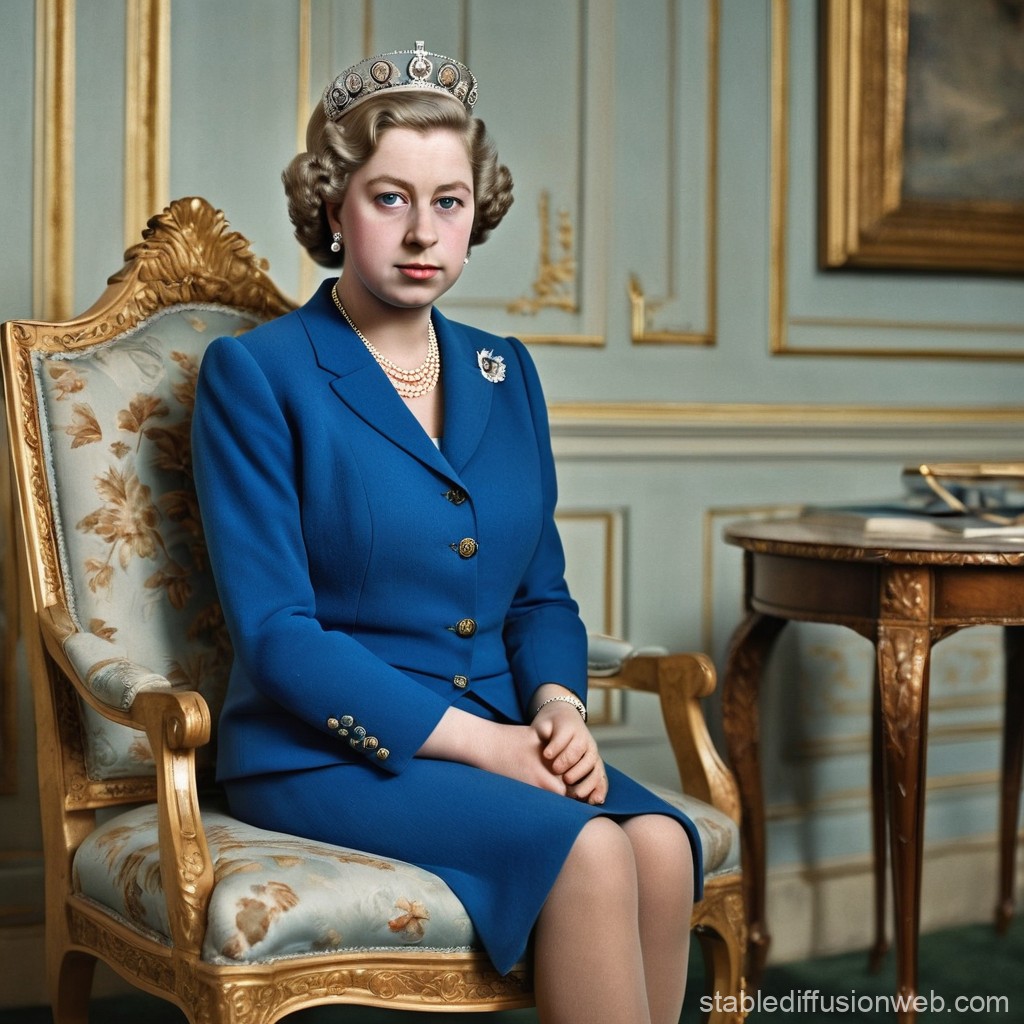
On 6 February 1952, the British king George VI died in his sleep at Sandringham House, Norfolk. He was fifty-six. Lung cancer, diagnosed the previous year, had cost him his left lung that September; arteriosclerosis was closing accounts on the rest. His daughter Elizabeth — twenty-five, married to Philip, Duke of Edinburgh — was seven thousand kilometres away in Kenya, on the first leg of a Commonwealth tour she was making because her father was too ill to make it himself. The night before, she had stayed at Treetops, a game-viewing lodge built into a fig tree above a watering hole in the Aberdare forest, watching elephants come to drink. Sometime during that night — the exact hour was never pinned down — her father’s heart stopped. The news reached Kenya by roundabout means: a Reuters wire, a local journalist, a telephone call to Mike Parker, Philip’s equerry, who confirmed it through Martin Charteris, the princess’s private secretary. Philip took his wife aside and told her. No ceremony was required. The moment the king died, she was queen — that is how British succession works, automatic and instantaneous, the Crown never vacant even for a second. The king is dead, long live the queen. In Elizabeth’s case, the second part of that formula proved truer than anyone had reason to expect.
What she inherited was a country that had won a war and was losing everything else. Britain in 1952 still rationed sugar and butter — seven years after victory. India and Pakistan had gone in 1947. Palestine had been abandoned the following year. Ireland — most of it — had been gone for three decades. The Suez Crisis lay four years ahead, and when it arrived in 1956 it would prove with humiliating clarity that Britain could no longer act as a great power without American permission. Churchill was Elizabeth’s first prime minister — the same Churchill who had rallied the nation through the Blitz — but at seventy-seven he was more monument than executive. The monarchy she took over was already more ceremonial than political, its real powers long since migrated to Parliament and cabinet. But ceremonial is not the same as powerless. The sovereign retained — and retains — the right to be consulted, to encourage, and to warn, as Bagehot put it in the 1860s. The weekly audience with the prime minister was private, unrecorded, and by every account taken seriously by each of the fifteen prime ministers who served during her reign. Soft power, exercised consistently across seven decades, is still power. It is simply harder to photograph.
Seventy years and 214 days. The longest reign in British history, exceeding Victoria’s sixty-three years by a comfortable margin. The second-longest verified reign of any monarch in recorded history, behind only Louis XIV of France, who reigned for seventy-two years but became king at four and spent the first eighteen under a regent. Elizabeth took the throne as a working adult and never left it. Her fifteen prime ministers ran from Churchill to Liz Truss — who was appointed on 6 September 2022 and soon became the answer to one of history’s crueller trivia questions when the queen died two days later. Consider the distance between those endpoints. When Elizabeth became queen, Stalin was alive, the Korean War was being fought, DNA’s structure had not been described, and television was a novelty most British households did not own. By the time she died, Britain had joined and left the European Union, fought wars in the Falklands, the Gulf, Kosovo, Afghanistan, Iraq, and Libya, survived thirty years of conflict in Northern Ireland, devolved power to Scotland and Wales, legalised same-sex marriage, weathered a global pandemic. The British Empire became the Commonwealth. The Commonwealth became, increasingly, a polite fiction held together by her personal relationships with heads of state across fifty-six countries. When she died, nobody was quite sure what held it together any more.
The comparison with Victoria cuts in both directions. Victoria presided over imperial expansion: by 1901, the empire covered a quarter of the earth’s land surface and governed roughly four hundred million people. She gave her name to an age — its morality, its industry, its cast-iron certainty that progress was real and Britain was leading it. Elizabeth presided over the unwinding of nearly everything Victoria had built. Decolonisation accelerated through the 1950s and 1960s — Ghana in 1957, Nigeria in 1960, Kenya in 1963, Rhodesia’s protracted and bloody exit stretching into the 1980s, Hong Kong returned to China in 1997. The empire Elizabeth inherited in 1952 was largely gone by her Silver Jubilee in 1977. What Victoria assembled over six decades, Elizabeth let go of — with less carnage and bitterness than the French, the Dutch, the Belgians, or the Portuguese brought to their own retreats. That is not nothing. Managed decline demands a kind of steadiness that expansion does not, and she carried it off with a consistency that deserves recognition even from those who think the whole institution should have been pensioned off decades ago.
The monarchy itself changed on her watch in ways that would have baffled her grandfather. George V had been a remote, bearded symbol; George VI was reserved and dutiful. Elizabeth began in the same mould, but the culture around the Crown refused to sit still. The 1969 BBC documentary Royal Family — which she approved, apparently hoping to humanise the institution — pulled back the curtain and showed the Windsors eating, joking, barbecuing at Balmoral. She later regarded it as a mistake, and it was withdrawn from broadcast. But the door, once opened, does not close. By the 1980s, the tabloids had found their subject: Charles and Diana’s marriage, then its very public disintegration, played out in competing newspaper leaks and Panorama confessionals. The annus horribilis of 1992 brought the collapse of three royal marriages and a fire that gutted part of Windsor Castle. Diana’s death in a Paris underpass in August 1997 produced a wave of public grief so intense and so angry — directed, for a few astonishing days, at the queen herself for remaining at Balmoral and failing to perform sufficient sorrow on camera — that the monarchy’s survival as a popular institution looked, briefly, like an open question.
Elizabeth adapted. She returned to London, addressed the nation, stood outside Buckingham Palace as the coffin passed and bowed her head. It was enough. Over the following two decades, the institution steadied, helped by the queen’s own unshakeable routine, by William and Catherine’s carefully managed normality, and by the British public’s apparently limitless appetite for royal pageantry when done well. The Diamond Jubilee in 2012, the Platinum Jubilee in 2022 — these were not empty spectacles. They were proof that the monarchy had found a formula for survival in a democratic, media-drenched age: be boringly, reliably competent, and never be interesting in the wrong way. Elizabeth understood, whether by instinct or by seven decades of practice, that a constitutional monarch’s greatest asset is predictability.
She was not a great thinker or a great reformer. She did not reshape law, command armies, or bend policy in directions it would not otherwise have taken. She opened Parliament, received ambassadors, read her red boxes, held her audiences, and kept her opinions — which by all evidence she held firmly — almost entirely to herself. What she was, above everything, was durable. Seventy years of showing up, of performing the same role with the same discipline and the same handbag, through crises that would have broken less steady temperaments. In a constitutional monarchy, that is the job description: not to lead, but to last — to be the constant while everything else shifts beneath it. The country she left in September 2022 bore almost no resemblance to the one she had inherited in February 1952: smaller in reach, uncertain of its place, arguing with itself about Europe and identity and whether the past was something to be proud of or apologise for. Through all of it, she was there — the same wave, the same composure, the same faintly amused expression suggesting she had seen this sort of thing before and expected to see it again. A well-meaning and impeccably groomed monarch who understood that the point of her role was not to change anything, but to remain while everything else did. She was right about that for seventy years. It is not a record anyone is likely to match.