On 2 March 1797, the Bank of England issued its first £1 and £2 banknotes. They were handwritten, printed on one side only, and bore the name of the payee, the date, and the signature of the issuing cashier. Before that day, the smallest note the Bank produced was worth £5 — roughly two months’ wages for a labourer, useless for buying bread or paying rent. The new notes were not a planned innovation. They were an emergency measure, improvised in the space of a week, to keep an economy running after its gold had vanished.
The crisis had been building for years. Britain had declared war on revolutionary France in 1793, and the conflict was expensive. William Pitt the Younger’s government printed banknotes to cover the costs, and by early 1797 the Bank held £10.8 million in notes against only £5.3 million in gold — a ratio that invited disaster the moment confidence wavered. The wavering began in the north. Runs on banks in Newcastle, Sunderland, and Durham drained reserves and spread panic southward. Then, on 22 February, a French force of 1,400 troops landed at Fishguard in Wales — the last foreign invasion of British soil. The invasion was a fiasco; the French surrendered within two days, reportedly after mistaking Welsh women in traditional red cloaks for British soldiers. But the news reaching London was not yet reassuring, and the prospect of a French army on British territory sent depositors rushing to convert their paper into metal.
On 26 February, the Privy Council met and issued an order forbidding the Bank of England to pay out gold for banknotes. The Bank Restriction Act, formalising the suspension, passed Parliament on 3 May. In the meantime, the economy needed currency. Gold coins had largely disappeared — hoarded, melted, or shipped abroad. The Bank’s existing notes were too large for ordinary transactions. So the directors authorised the issue of £1 and £2 notes, and on 2 March the first of them entered circulation. The notes were crude by later standards. Each was filled out by hand, a process that invited forgery and required an army of clerks. But they worked. Wages could be paid. Shops could make change. The economy, deprived of metal, kept moving on paper.
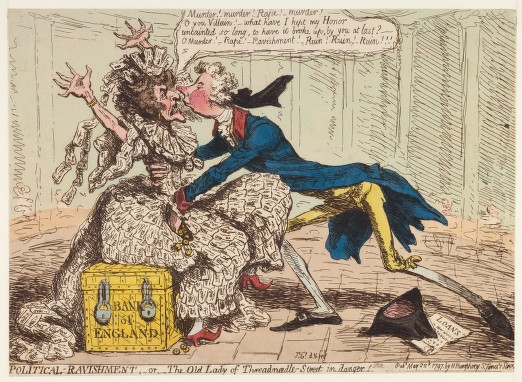
The public was not entirely convinced. Paper money was a novelty, and novelties are suspect. People were used to coins made of gold and silver — objects with intrinsic value, not promises written on cotton. The playwright Richard Brinsley Sheridan, speaking in Parliament, described the Bank as “an elderly lady in the City, of great credit and long standing who had unfortunately fallen into bad company.” The satirist James Gillray made the image literal. His cartoon, published in May 1797, shows Pitt as a lecherous suitor, reaching into the pockets of an old woman seated on a chest marked “Bank of England.” The woman — dressed in a gown made of £1 notes — cries “Murder! Rape! Ravishment!” The title was Political Ravishment, or The Old Lady of Threadneedle Street in Danger! The nickname stuck. The Bank of England has been “the Old Lady of Threadneedle Street” ever since.
The restriction was meant to be temporary. It lasted twenty-four years. By the time the Napoleonic Wars ended in 1814, the Bank had £28.4 million in notes circulating against just £2.2 million in gold — a ratio that would have been unthinkable a generation earlier. Convertibility was finally restored on 1 May 1821, after Robert Peel’s Bullion Committee forced through reforms that rebuilt the gold reserves. The £1 note was withdrawn that same year, replaced by the gold sovereign. For nearly a century, Britain returned to hard money. Then came the First World War, and the cycle repeated: gold vanished, paper returned, and the £1 note was reissued in 1914. The gold standard was abandoned for good in 1931. The £1 note itself survived until 1984, when inflation made it cheaper to mint a coin.
Every Bank of England note still carries the phrase “I promise to pay the bearer on demand the sum of” followed by the denomination. The promise is a fossil. You cannot walk into the Bank and demand gold for your twenty-pound note. You will get, at best, two tens. The words remain because they have always been there, a reminder of a time when paper was a claim on metal and the claim could be enforced. That time ended, in practical terms, on 2 March 1797, when the Bank issued notes too small to be backed by anything except the government’s word. The word turned out to be enough. It still is — for now, and for as long as people believe it.
The shift from commodity money to fiat currency is one of those changes so gradual that no single date captures it. But if you had to pick a moment when Britain began the journey, 2 March 1797 is as good as any. A French invasion that failed, a bank run that succeeded, and a government that discovered it could pay its bills with paper. The Old Lady learned to live without her gold. Two centuries later, so have the rest of us.