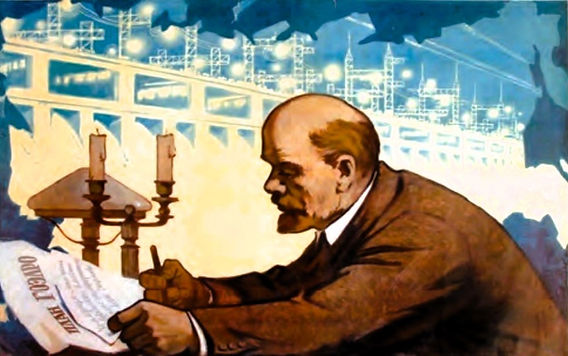
In the 21st century, February 14th means flowers, overpriced dinners, and performative romance. But in 1918, on the territory of what had recently been the Russian Empire, the date carried a different charge entirely. It was the day that materialised out of thin air — thirteen days conjured into existence by decree, as Bolshevik Russia leapt from the Julian calendar to the Gregorian one. The day before had been 31 January. Then, overnight, it was 14 February. No one in Russia lived through the first thirteen days of that month. They simply did not happen.
The decree came from the Council of People’s Commissars — the Sovnarkom — signed by Lenin on 24 January 1918 by the old Julian reckoning. It ordered the adoption of what the text called the “Western European calendar,” aligning Russia with the system already used by most of Europe and the Americas. The practical justification was straightforward: diplomacy, trade, and communication all suffered when your dates were thirteen days behind everyone else’s. The old empire had clung to the Julian calendar out of tradition and Orthodox piety. The new regime had no such attachments.
A small but telling detail: for several months after the switch, official documents had to carry both dates — the new Gregorian date followed by the old Julian one in brackets. Bureaucracies do not abandon habit quickly, even revolutionary ones. And the state issuing the decree was not the Soviet Union. The USSR would not exist for another four years, until December 1922. In February 1918, the country was the Russian Soviet Federative Socialist Republic — the RSFSR — a freshly proclaimed entity still fighting for its own survival.
That survival was far from guaranteed. The civil war was gathering force. The Bolsheviks had seized power from the Provisional Government only months earlier, in October 1917 (November by the Gregorian calendar — the confusion of dual dating followed the revolution even into its own name). They had dissolved the Constituent Assembly in January 1918, concentrating authority in the soviets they controlled. Peace talks with Germany dragged on at Brest-Litovsk; the Treaty, signed in March 1918, would cost Russia enormous swathes of territory, but Lenin judged that price acceptable if it bought time to consolidate the revolution at home.
The calendar reform slotted into a far broader programme of upheaval. The Decree on Land had already abolished private land ownership. Banks and major industries were being nationalised. The Cheka — the new political police — was operational from late 1917, hunting down “counter-revolutionaries” with a zeal that would only intensify. The Red Army was being built from scratch, armed workers and poor peasants replacing the old imperial officer class. Church and state were formally separated, and the calendar change was one visible piece of that secularisation drive: the Orthodox Church had treated the Julian calendar as a matter of religious identity, and stripping it away was a deliberate act.
Many of these reforms read well on paper. Legal equality for women. Civil marriage and divorce. Universal literacy campaigns. Land to those who worked it. Workers’ control of factories. The intentions, at least in the early decrees, were genuinely progressive by any standard. But intentions and outcomes diverged fast. Power was centralising in the hands of the Bolshevik party at speed, and the civil war gave every centralising impulse a ready justification. Rights proclaimed in January could be suspended by summer in the name of revolutionary defence. The 1918 RSFSR Constitution, adopted in July, formally disenfranchised the “exploiting classes” — a category elastic enough to include almost anyone the regime found inconvenient.
The calendar decree is a useful microcosm of the whole Bolshevik project in this period. On one level, it was a sensible, overdue modernisation — Russia’s Julian dating had been an anachronism for centuries, and every other major European power had already made the switch. On another level, it was an assertion of state power over daily life, a signal that the new government would reshape even the most basic shared conventions if it saw fit. Practical improvement and political control were not opposites; they were the same gesture, viewed from different angles.
The Bolsheviks framed the change as joining “civilised countries.” The phrase tells you something about how they saw themselves — as modernisers dragging a backward nation into the twentieth century, whether it liked it or not. That self-image would persist, and it would justify a great deal more than a calendar adjustment. The pattern was set early: reform as vehicle for consolidation, progress as cover for control.
That symbolic step — skipping thirteen days to enter the modern world — was a small but real milestone on a longer historical arc, one I trace in The Butterfly Effect. Administrative decisions that look minor at the time have a way of compounding. The chain from 1918 to the formation of the USSR, from the USSR to its eventual collapse, and from that collapse to the geopolitics we live with today is longer than any single blog post can cover. But the pattern holds: each link in the chain seems unremarkable until you follow the whole sequence to its end.
A footnote on the old calendar’s afterlife. The Bolsheviks forced the state onto Gregorian time, but the Russian Orthodox Church refused to follow. It kept the Julian calendar for its liturgical year — and never adopted the secular innovation. Through two world wars, Stalin’s purges, the collapse of the Soviet Union, and everything since, the Church held its ground on this one point. The result is visible every year: Russian Orthodox Christmas falls on 7 January (25 December Julian), Easter drifts out of sync with Catholic and Protestant dates, and the faithful ring in the “Old New Year” on 14 January. A century after Lenin’s decree, the thirteen-day gap between state and church still structures Russian religious life — a quiet, stubborn echo of a revolution that tried to abolish the past and never quite managed it.