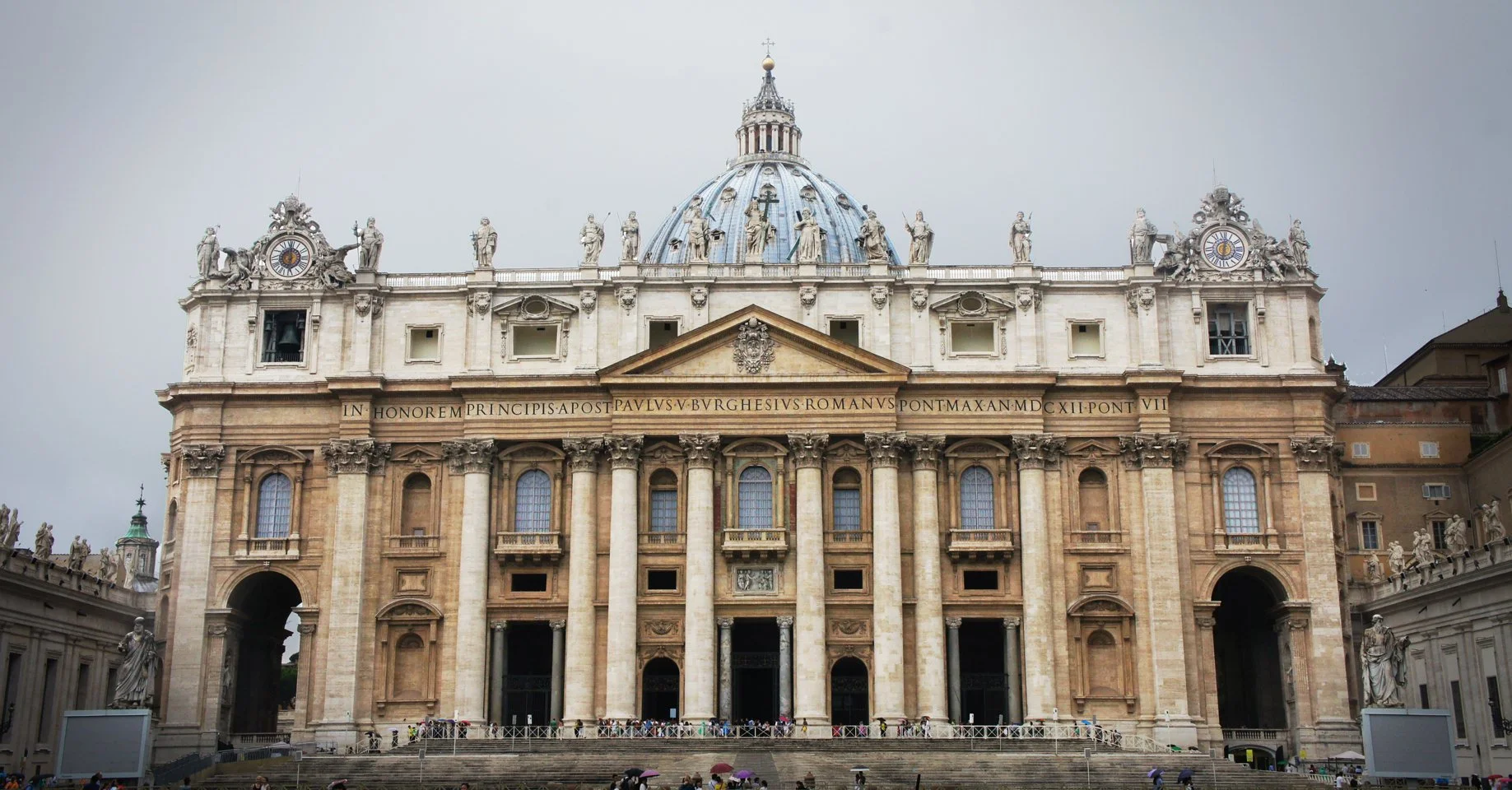
On 20 February 1798, Pope Pius VI was escorted out of Rome by French soldiers. He was eighty years old, in poor health, and no longer in charge of anything. Ten days earlier, General Louis-Alexandre Berthier had marched into the city at the head of a French army. On the 15th, Berthier stood in the Forum — the same ground where Roman consuls had once spoken — and proclaimed a Roman Republic. The Pope’s temporal authority was abolished. The Papal States, which had existed in one form or another since the eighth century, were dissolved. Pius was told to renounce his political power and leave. He did both. The longest-running theocratic government in Western history ended not with a siege or a revolution from below, but with a general reading a decree and an old man being put into a carriage.
The road to that carriage ran through the previous decade of European upheaval. The French Revolution had declared war on the Catholic Church almost from the start. The National Assembly nationalised church lands in 1789, abolished tithes, and in 1790 passed the Civil Constitution of the Clergy — a law that turned priests into salaried employees of the state and required them to swear an oath of loyalty to the nation. Half the clergy refused. Pius VI condemned the Revolution. The Revolution returned the favour: France severed diplomatic ties with the Holy See, confiscated papal territory in Avignon and the Comtat Venaissin, and by 1796 had sent an army south under a young Corsican general who was making a habit of redrawing the map of Italy.
Napoleon’s campaign through the peninsula was quick and efficient. Papal forces — never formidable, even by the charitable standards of Italian armies of the period — were brushed aside. The Treaty of Tolentino, signed on 19 February 1797, laid out the cost of losing. Pius ceded Romagna, Ferrara, and Bologna. He ceded Avignon formally, confirming what the French had already taken. He agreed to pay thirty million francs in indemnity. And he surrendered over a hundred paintings and works of art from the Vatican collections, to be shipped to Paris and displayed in the Louvre. The treaty was humiliating, but it left the Pope in Rome, still nominally sovereign. The Directory in Paris considered this insufficient.
The pretext arrived in December. On the 28th, a riot broke out near the French embassy in Rome. Léonard Duphot, a French military attaché — who had, along with ambassador Joseph Bonaparte, been quietly encouraging Roman republicans — threw himself between the crowd and papal soldiers and was shot dead. Pius sent an apology within twenty-four hours. The Directory rejected it. Berthier received his orders and marched south.
What followed was not a battle. Berthier entered Rome on 10 February 1798 without significant resistance. Five days later he declared the Republic. A five-man directory, modelled on the one in Paris, was installed. The Pope was stripped of temporal authority — the power to govern territory, command troops, levy taxes, administer justice — and given a choice between voluntary departure and forced removal. On the 20th he left, heading first to Siena, then to a Carthusian monastery outside Florence. He might have ended his days there in quiet obscurity. The French had other plans. In March 1799, with war spreading again across Italy, they dragged him north — through Parma, Turin, across the Alps on snow-covered passes, sick and barely able to travel — to Valence in southeastern France. No cardinals were permitted to accompany him. He died there on 29 August 1799, aged eighty-two. His captors buried him in Valence. His body was not returned to Rome until 1802.
At the time, serious people speculated that the papacy was finished — not just as a political entity but as an institution. They were half right. The spiritual office survived. What did not survive, except as a diminishing relic, was the idea that the Bishop of Rome should also be a king.
The temporal power of the popes had its origins in 756, when Pepin the Short, king of the Franks, defeated the Lombards and granted the conquered territories in central Italy to Pope Stephen II. The Donation of Pepin gave the papacy a state — a real one, with borders, revenues, and armies. For over a thousand years, the pope was not merely a religious leader; he was a territorial sovereign who ruled a swath of the Italian peninsula, appointed governors, waged wars, collected taxes, and sat as an equal — sometimes a superior — among the crowned heads of Europe. Medieval popes deposed emperors, launched crusades, and excommunicated kings who defied them. The Papal States at their height covered most of modern Lazio, Umbria, Marche, and Romagna. It was not a metaphor. The pope ran a country.
Berthier’s ten days in February 1798 broke that arrangement for the first time since it began. The Roman Republic itself lasted barely a year — Neapolitan troops restored papal authority in late 1799, and Pius VII returned to a diminished but functioning papal state. Napoleon, characteristically, made his own arrangements: the Concordat of 1801 restored a working relationship between France and the papacy, but on terms that made clear who held the upper hand. When Pius VII displeased him, Napoleon had him arrested too — in 1809 — and annexed what remained of the Papal States outright. The pattern was set. After the Congress of Vienna in 1815, the Papal States were restored yet again, but their legitimacy never recovered. Italian nationalists spent the next half-century chipping away at them. On 20 September 1870, Italian troops breached the walls of Rome at Porta Pia, and that was the end of it. The pope retreated behind the walls of the Vatican and declared himself a prisoner. The Lateran Treaty of 1929 formalised the arrangement: Vatican City, forty-four hectares, the smallest sovereign state in the world. A thousand years of temporal dominion, reduced to a walled garden.
The significance runs beyond Italy. What happened in Rome in February 1798 was one act in a larger drama — the slow, violent, uneven separation of political authority from religious sanction that produced the modern European state. France had been leading that charge since 1789 and would formalise it in the laïcité law of 1905. But France was dealing with its own clergy and its own national church. Rome was different. Rome was the centre — the seat of an authority that claimed jurisdiction not over one country but over all of Christendom. When Berthier walked into the Forum and announced that the Pope no longer ruled here, he was not just rearranging Italian politics. He was demonstrating, in the most visible way possible, that the oldest theocratic authority in Western Europe could be removed by a secular government with enough soldiers and enough conviction.
The modern secular state — the principle that governments derive their legitimacy from their citizens, not from God or his appointed representatives — did not spring from a single event. It has roots in the English Civil War, in the American and French Revolutions, in the Reformation, in a thousand local struggles between bishops and princes and parliaments. But among those roots, February 1798 holds a particular place. For over a millennium, the papacy had been the most visible, most durable example of religious authority exercising political power in Europe. Its removal was not a theory or a pamphlet or a philosophical argument. It was a fact, enacted in public, in the capital of Christendom, by men who believed that the age of theocratic government was over. They were, on the whole, correct. Every secular constitution in Europe carries, somewhere in its DNA, the principle that was demonstrated on the road out of Rome: that no church, however ancient, however powerful, however sure of its divine mandate, has an inherent right to govern.