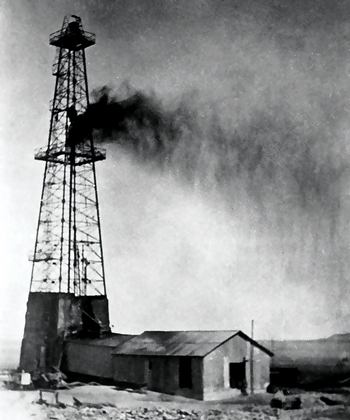
On 3 March 1938, at a depth of 1,440 metres beneath the Saudi desert, a drill bit punched into porous limestone and oil began to flow. The well was Dammam No. 7 — the seventh attempt by the California Arabian Standard Oil Company to find commercial quantities of petroleum in a concession that covered 371,000 square miles of sand, rock, and not much else. The first six wells had failed. The company’s San Francisco headquarters was ready to write off the entire Arabian venture as a loss. Max Steineke, the chief geologist, had talked them into one more try: drill deeper, past the zone where Bahrain’s oil had been found, into the older Arab limestone formation below. On that March morning, the gamble paid. Dammam No. 7 produced 1,585 barrels on its first day. Within a week, output had risen to 3,810 barrels daily. Crown Prince Abdullah would later name it the Prosperity Well. The name was accurate. What came out of that hole in the ground would transform a poor desert kingdom into one of the wealthiest nations on earth, reshape the global economy, and make the geopolitics of the twentieth and twenty-first centuries unimaginable without it.
The Arabia that Steineke arrived in was not the Arabia of glass towers and sovereign wealth funds. When King Abdulaziz ibn Saud unified the peninsula and proclaimed the Kingdom of Saudi Arabia in 1932, he ruled a country with almost nothing to rule. The interior was desert, inhabited by Bedouin tribes whose economy had not changed in centuries: camels, goats, seasonal migration between wells, occasional raids on neighbours. The coasts had fishing villages and a pearl trade that was collapsing as Japanese cultured pearls flooded the market. There were no roads, no railways, no industry. The only significant revenue came from the hajj — pilgrims travelling to Mecca — and even that was irregular. Ibn Saud’s treasury depended on British subsidies, and the British were not feeling generous. The discovery of oil in Bahrain in 1932 raised the possibility that similar geology might extend under Saudi territory, and in 1933 Ibn Saud signed a concession with Standard Oil of California: exclusive rights to explore and extract petroleum in exchange for £50,000 in gold up front and a promise of royalties if anything was found. The Americans sent geologists. The geologists found a landscape that offered almost no infrastructure, no maps, and summer temperatures that could kill a man who ran out of water. They also found Khamis ibn Rimthan, a Bedouin guide who knew the desert better than any survey could, and who would spend years leading Steineke’s teams across terrain that no American had ever seen. The collaboration between Californian technology and Bedouin knowledge produced the most consequential geological discovery of the century.
What Dammam No. 7 revealed was only the beginning. In 1940, Steineke’s structural drilling techniques identified the Abqaiq field, thirty miles away, which flowed at nearly 10,000 barrels per day from its first well. In 1948, Aramco — as the company had been renamed — discovered Ghawar, an underground reservoir stretching 280 kilometres through the Eastern Province. Ghawar is the largest conventional oil field ever found. It has produced more than 65 billion barrels since 1951 and still accounts for roughly a third of Saudi output. At its peak, Ghawar alone produced more oil than most countries. The scale is difficult to grasp. Saudi Arabia sits on approximately 17 per cent of the world’s proven oil reserves. It can produce 12 million barrels per day when it chooses to, and it often chooses not to — because the kingdom’s real power lies not in how much oil it pumps, but in how much it can add or subtract from global supply at will. The Saudis are the swing producer, the thermostat of the world oil market. When prices fall too far, they cut production. When prices rise too high, they open the taps. No other country has that lever.
The lever was pulled most dramatically in October 1973. After the United States resupplied Israel during the Yom Kippur War, King Faisal led the Arab oil-producing states in an embargo against America and its allies. Oil prices quadrupled in four months — from roughly $3 per barrel to $12. The shock rippled through every economy that depended on imported energy, which was nearly all of them. Petrol queues stretched around blocks in American cities. Inflation surged. The post-war economic order, built on the assumption of cheap and abundant fuel, discovered that the assumption had a single point of failure, and that point was a desert kingdom most Westerners could not find on a map. The embargo ended in March 1974, but its consequences did not. The “petrodollar” system emerged: Saudi Arabia agreed to price its oil exclusively in US dollars and to recycle its surplus revenues into American Treasury bonds, and in return the United States guaranteed the kingdom’s security. That arrangement — oil for dollars, dollars for protection — has underpinned both Saudi wealth and American influence in the Gulf for half a century. It is fraying now, as the Saudis hedge their bets with China and the Americans grow less certain about what they owe their old partners. But the architecture Faisal and Kissinger built in the 1970s still stands, however uneasily.
The kingdom that oil built is a strange construction. Saudi Arabia has no income tax, no sales tax, and until recently almost no economy outside hydrocarbons. The state employs most of its citizens, subsidises their fuel and electricity, and expects political quiescence in return. The arrangement worked as long as oil revenues kept rising and the population stayed small. Neither condition holds any more. The population has grown from six million in 1970 to over thirty-five million today. Oil prices are volatile. The reserves, however vast, are finite. Mohammed bin Salman’s Vision 2030 is an attempt to build an economy that can survive the end of the oil age — tourism, entertainment, technology, a city in the desert called Neom that exists mostly in renderings and press releases. Whether any of it will work is an open question. Diversifying an economy that has never needed to diversify is not a problem anyone has solved at this scale. The kingdom is betting its future on the idea that it can become something other than what Dammam No. 7 made it. The bet may be correct. It may also be too late.
Eighty-eight years after Steineke’s drill bit hit limestone, the well still stands — a museum piece now, surrounded by the infrastructure of the world’s most valuable company. Saudi Aramco’s 2019 IPO valued the firm at nearly $2 trillion, making it briefly the most valuable public company on earth. The Prosperity Well produced 32 million barrels over its forty-four-year operational life, a rounding error compared to what Ghawar and Abqaiq have yielded since. But every barrel that followed traces back to that March morning in 1938, when a handful of Americans and Bedouins proved that the empty quarter was not empty after all. The discovery changed Saudi Arabia. It changed the Middle East. It changed the price you pay to fill your car and the temperature of the planet your children will inherit. One well, in a desert that had nothing, and everything that came after.