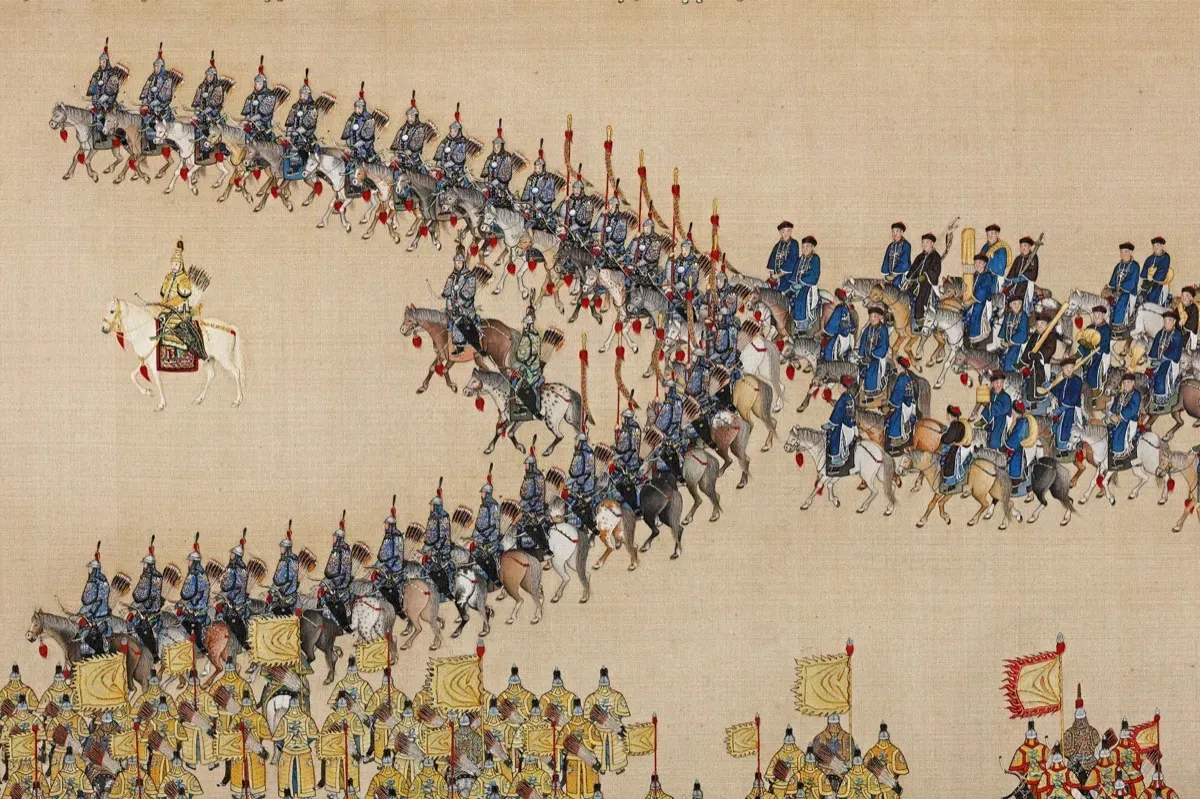
On 17 February 1616, a man named Nurhaci proclaimed himself Khan. He was not emperor of China. He did not rule from Beijing. He was the chieftain of the Jianzhou Jurchens — a collection of semi-nomadic tribes in Manchuria, up in the cold forests north of the Great Wall. By Chinese standards, this was a frontier nobody. His announcement was barely worth a footnote.
Four hundred and ten years ago today. And from that footnote grew the Qing dynasty — the last dynasty of imperial China, and arguably the most consequential.
Nurhaci had spent decades pulling the fractured Jurchen tribes together through warfare, marriage alliances, and the occasional well-timed betrayal. His masterstroke was the Eight Banners system — a structure that sorted his people into hereditary units for war, tax collection, and governance all at once. One organisation that handled everything. It turned a loose federation of clans into a fighting machine capable of beating the Ming dynasty’s vastly larger forces.
He named his state the Later Jin — a deliberate callback to the Jurchen Jin dynasty that had ruled northern China four centuries earlier. The branding was intentional: this was not a raid. It was a claim to sovereignty. Nurhaci died in 1626, but the project survived him. His son Hong Taiji expanded the realm, renamed it the Great Qing in 1636, and absorbed the Mongol tribes. In 1644 — less than thirty years after Nurhaci’s proclamation — Qing forces rode through the gates of Beijing. The Ming, hollowed out by famine, rebellion, and its own sclerotic bureaucracy, simply folded. China had new management.
Here’s the twist. The Qing were outsiders who became insiders. They came from the frontier — the latest in a very long line of northern peoples who had conquered the settled civilisation to their south. Which meant they understood the threat that frontier posed better than any dynasty before them.
The pattern was ancient and reliable. Nomadic peoples from the steppe — Xiongnu, Turks, Khitans, Jurchens, Mongols — would periodically sweep south into China’s rich agricultural heartland. The Great Wall, that most famous monument to defensive anxiety, was the oldest attempted fix. It never really worked. Walls need garrisons, garrisons need supply lines, and the steppe is enormous. Nomads moved faster than imperial armies. They raided, retreated, and came back next season.
The Qing took a different approach. Instead of walling out the frontier, they swallowed it. They conquered Xinjiang — a territory bigger than France and Germany combined, mostly desert, thinly populated — and filled it with forts, supply routes, and garrisons. They subdued the Mongols by folding their leaders into the Qing aristocracy through military pressure, strategic marriages, and generous patronage of Tibetan Buddhism. They absorbed Tibet itself. They kept going until there was no frontier left to produce the next wave of invaders.
It worked spectacularly. The Qing pulled off something no previous Chinese dynasty had managed: they made the nomadic threat go away. The steppe wars that had shaped two thousand years of Chinese history simply stopped. No more invasions from the north, no more frantic mobilisations against horse archers. Borders secure, interior at peace. Problem solved.
You can probably see where this is going.
Stability bred complacency, and complacency bred stagnation. The Qing court saw no reason to modernise its military — the enemies it was built to fight no longer existed. European maritime technology leapt forward through the seventeenth and eighteenth centuries; Chinese technology sat still. The examination system that selected the empire’s bureaucrats rewarded classical scholarship, not science or engineering. Trade was tightly controlled. The operating assumption — deeply embedded, rarely questioned — was that China sat at the centre of civilisation and had nothing of value to learn from the barbarians beyond the sea.
The barbarians beyond the sea had other ideas.
When the British showed up in the early nineteenth century, they brought something the Qing had never had to deal with: industrial-age naval power. The Opium Wars — 1839 to 1842, then 1856 to 1860 — exposed the mismatch with savage clarity. British gunboats sailed up Chinese rivers and did as they pleased. Qing armies, still tooled for land campaigns against steppe cavalry, had no answer for steam-powered warships lobbing explosive shells. The empire that had solved the problem of the steppe found itself helpless against the sea.
The terms were ugly. China ceded Hong Kong. It opened ports to foreign trade under conditions it did not set. It paid indemnities it could not afford. And — in a detail so bitter it reads like satire — it was forced to legalise the opium trade. The government that went to war to stop opium imports ended up contractually obligated to permit them.
This kicked off what China calls the Century of Humiliation — roughly 1839 to 1949, a hundred years in which foreign powers carved up Chinese territory, imposed unequal treaties, and treated the oldest continuous civilisation on earth as a client state. The British, the French, the Russians, the Japanese, the Germans, the Americans — everyone took a piece. The Qing dynasty limped on until 1912, then gave way to a republic that fared no better.
Now, “Century of Humiliation” is also a political tool. Today Beijing deploys it selectively — amplifying the grievances that serve current strategy, quietly shelving the ones that don’t. But the underlying facts are not invented. The treaties were real. The territorial losses were real. The opium was real. And the memory — curated, yes, but anchored in documented history — drives how modern China sees the world. The military build-up, the posture in the South China Sea, the rhetoric on Taiwan, the bone-deep suspicion of Western motives: it all flows through the same channel. Never again.
The irony sits right at the centre. A frontier chieftain’s ambition in 1616 produced, across generations, a dynasty that delivered unprecedented stability — and that very stability created the conditions for the catastrophe that followed. The Qing solved one problem so thoroughly they went blind to the next. Security against the steppe left them naked to the ocean. The wall they no longer needed was replaced by a complacency they couldn’t see.
That arc — from Nurhaci’s proclamation in a Manchurian fortress to British gunboats on the Yangtze — is one of the longer threads I trace in The Butterfly Effect. Not every link in a causal chain looks dramatic at the time. Some are garrison placements, trade restrictions, bureaucratic appointments that seemed perfectly sensible. The pattern holds here as elsewhere: what looks like stability in one century becomes vulnerability in the next, and the consequences keep compounding long after the people who made the decisions are dust.