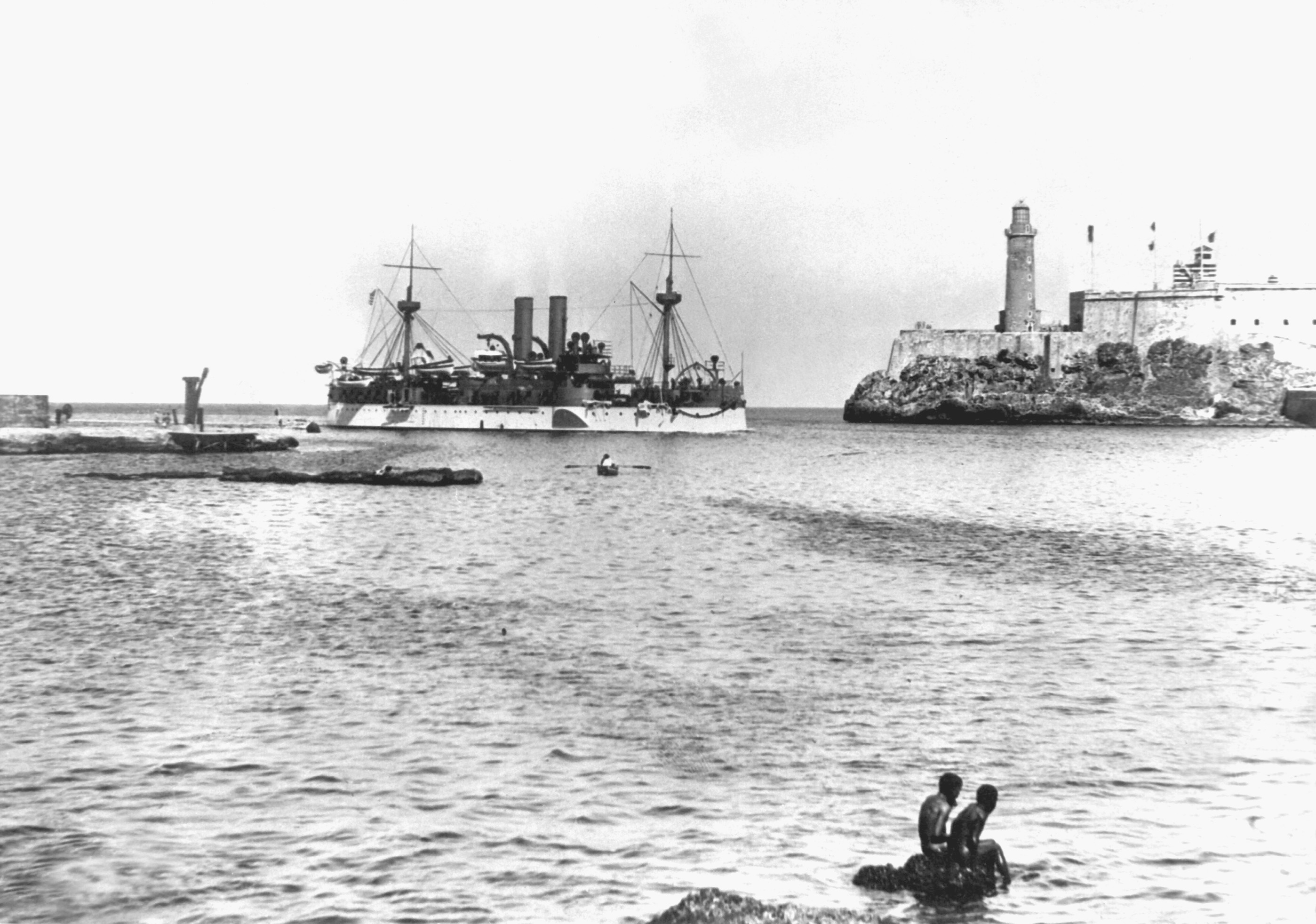
At 9:40 on the evening of 15 February 1898, the armoured cruiser USS Maine blew apart in Havana harbour. The explosion obliterated the forward third of the ship in seconds. Two hundred and sixty-one of her 355 crew died — most of them sleeping in the enlisted quarters at the bow, directly above the magazines that detonated. Of the 94 survivors, only 16 were uninjured. Captain Sigsbee survived because his cabin was aft.
The cause has never been definitively established. A US naval inquiry in 1898 concluded that an external mine had ignited the forward magazines. Spain’s inquiry reached the opposite conclusion: spontaneous combustion in the coal bunkers. In 1974, Admiral Hyman Rickover commissioned a private investigation that agreed with Spain — the navy had recently switched from anthracite to bituminous coal, which releases firedamp, a methane-rich gas prone to explosion, and a coal bunker sat adjacent to the ammunition stores. A 1999 National Geographic analysis using computer modelling found the evidence inconclusive. To this day, nobody knows whether a Spanish mine or the ship’s own coal killed those men. In Havana, a monument at the site reads that they were “victims sacrificed to imperialist greed” — the official Cuban position being that the Americans blew up their own ship. That theory has never been taken seriously outside Cuba, but it has the virtue of being one of the few explanations that is at least internally consistent.
None of this mattered much in February 1898, because the narrative had already been written. William Randolph Hearst’s New York Journal and Joseph Pulitzer’s New York World had found their story. The Journal devoted an average of eight and a half pages per day to the Maine for a week after the sinking. Hearst offered a $50,000 reward for “conviction of the criminals who sent 258 American sailors to their deaths.” The rallying cry “Remember the Maine! To hell with Spain!” spread quickly. Yellow journalism has been blamed ever since for driving the country to war, though historians now largely disagree — the press was noisy but primarily a New York phenomenon, and the current president William McKinley, Wall Street, and most of the business community were pushing hard in the opposite direction for most of the spring. Still, the newspapers created a political atmosphere in which patience was hard to maintain and diplomacy was difficult to sell.
The deeper causes of the war were already well established before the Maine exploded. Cuba had been fighting Spain for independence since 1895, when José Martí launched a three-pronged revolt that settled into protracted guerrilla fighting. Spain’s response was General Valeriano Weyler — “The Butcher” — who ordered civilians in rebel districts into fortified reconcentration zones, where they died in large numbers from disease and starvation. The United States was much closer to Cuba than Spain, it had $50 million invested in the island and received 90 per cent of its total exports. American business interests wanted stability; they did not particularly want war. But the combination of humanitarian outrage at Weyler’s camps and strategic anxiety about Spain’s grip on an island ninety miles from Florida had been building for years.
McKinley tried to hold the line. He sent the Maine to Havana in January 1898 on a notionally “friendly” visit, while simultaneously repositioning a large part of the North Atlantic Squadron to Key West and the Gulf of Mexico — not the disposition of a government that expected peace. After the explosion, he asked Congress for $50 million for defence, urged restraint, and waited for the naval inquiry. Spain appealed to the European powers; Germany proposed a joint European stand against the United States and then declined to organise one. By April, McKinley had run out of room. War was declared on 25 April 1898.
It lasted sixteen weeks. John Hay, the American ambassador in London, later described it as “a splendid little war.” The description was accurate in almost every sense that mattered to the victors. On 1 May, Commodore George Dewey’s Asiatic Squadron destroyed the Spanish fleet half the globe away, at Manila Bay in a matter of hours, with nine men wounded on the American side. On 1 July, American forces assaulted the San Juan Heights outside Santiago de Cuba. Among them was Theodore Roosevelt, who had resigned his post as Assistant Secretary of the Navy in May to raise a volunteer cavalry regiment — the 1st US Volunteer Cavalry, instantly known as the Rough Riders, an improbable mix of former cowboys, Ivy League athletes, and New York socialites. Roosevelt charged up Kettle Hill under fire, and later described it as the great day of his life. He was forty years old, wore thick spectacles, and had been warned by friends that this was a reckless thing to do. He did not seem to find this a persuasive argument.
The war ended in August. The Treaty of Paris, signed in December, ceded Puerto Rico, Guam, and the Philippines to the United States for a $20 million payment to cover Spanish infrastructure. Cuba gained formal independence in 1902 — but only under the terms of the Platt Amendment, which gave the United States the right to intervene militarily whenever Cuban independence seemed “threatened,” prohibited Cuba from signing treaties with foreign powers without American approval, capped its debt, and established a permanent US naval base at Guantánamo Bay. Cuba Libre, it was not. Spain had ruled the island for almost four centuries. The Americans arranged to rule it less visibly for much of the century that followed.
The Philippines proved considerably less splendid. The Philippine-American War, which began in earnest in 1899 when it became clear the United States intended to stay, cost roughly 4,200 American soldiers and, by various estimates, somewhere between 200,000 and 600,000 Filipino civilians. It lasted three years officially and in some provinces more than a decade. Spain had surrendered an empire. The United States acquired one and discovered, not for the last time, that governing is a different kind of problem than conquering.
Roosevelt came home from Cuba as the most famous man in America. He was elected Governor of New York that autumn, became McKinley’s Vice President in 1900, and then President in September 1901, after an anarchist shot McKinley at the Pan-American Exposition in Buffalo. He was forty-two — still the youngest person ever to hold the office. One charge up a Cuban hill in a war sparked by an unexplained explosion in a harbour started the whole chain.
The Maine herself was raised from the harbour floor in 1912, towed four miles out to sea, and scuttled in 600 fathoms of water, her deck adorned with flowers and an American flag. Her main mast is now a memorial in Arlington National Cemetery, where 229 of her crew are buried. What remains genuinely unknown is the thing that started it all: whether those men died because of a Spanish mine or their own ship’s coal. History rarely waits for that kind of clarity before moving on.