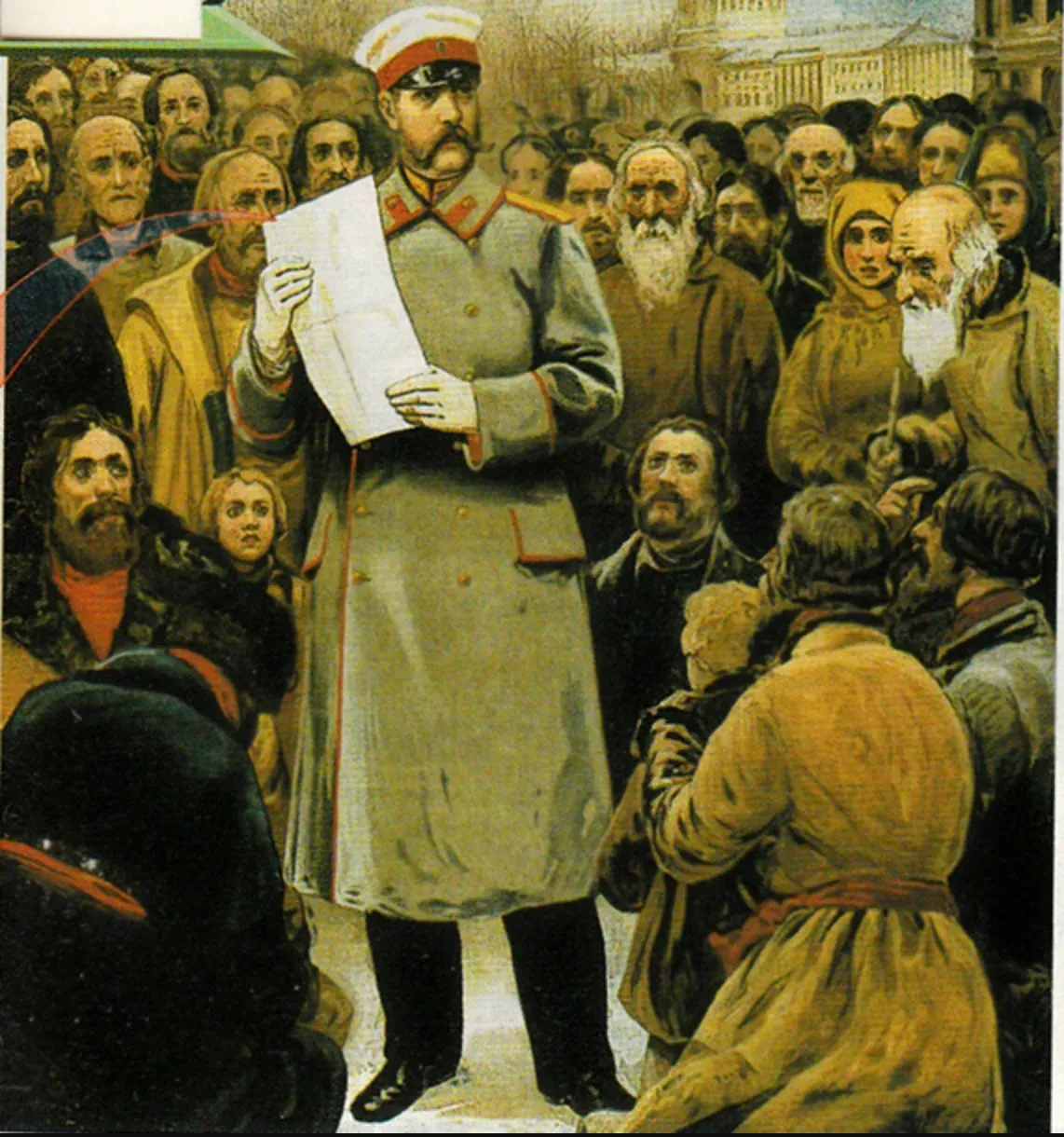
In 1861, the leader of a major country signed a law that freed millions of people from bondage. Not Abraham Lincoln — he would not issue the Emancipation Proclamation for another two years. This was Alexander II of Russia, and on 3 March 1861, he signed the Emancipation Manifesto, abolishing serfdom throughout the Russian Empire. Twenty-three million human beings — roughly 38 percent of the population — ceased to be property. Russia, at last, was lurching toward modernity.
For his troubles, the Tsar Liberator would be assassinated two decades later, his legs blown off by a bomb on a St Petersburg street. The country he tried to drag into the nineteenth century would spend the twentieth tearing itself apart.
Serfdom in Russia was slavery by another name. Serfs were bound to the land and to the landowners who controlled it. They could not leave without permission. They could not marry without permission. They could be bought and sold — not individually, technically, but with the estates they worked, which amounted to the same thing. A serf’s labour belonged to his master; so did a portion of everything he produced. The system had been hardening for centuries, reaching its final form under Catherine the Great, who extended serfdom to Ukraine and gave nobles near-absolute power over their human property. By the mid-nineteenth century, Russia was the last major European power still running on feudal labour. The rest of the continent had moved on. Russia had not.
Alexander II inherited this problem along with the throne in 1855. His father, Nicholas I, had understood that serfdom was unsustainable — “a powder keg under the state,” he reportedly called it — but had done nothing about it. Alexander was more willing to act, and he had a fresh humiliation to concentrate his mind. The Crimean War had just ended in Russian defeat. British and French forces, supplied by steamships and armed with modern rifles, had exposed the empire’s backwardness with brutal clarity. Russia’s serf-based economy could not produce the industry, the infrastructure, or the trained soldiers that modern warfare required. The lesson was obvious: reform or decline.
“It is better to abolish serfdom from above,” Alexander told the nobility in March 1856, “than to wait for the time when it begins to abolish itself from below.” The threat was not subtle. The Pugachev Rebellion of the 1770s — a serf uprising that had engulfed the Volga region and required an army to suppress — was still within living memory. The revolutions of 1848 had swept across Europe. The Tsar was not offering the nobles a choice between serfdom and freedom. He was offering them a choice between orderly reform and violent upheaval.
The negotiations took five years. The landowners wanted to free the serfs without giving them land — creating a pool of cheap labour they could hire back at market rates. Alexander and his advisers understood that landless peasants meant a rootless proletariat, and a rootless proletariat meant revolution. The compromise that emerged was characteristically Russian: elaborate, contradictory, and satisfying to no one.
The Emancipation Manifesto granted serfs their personal freedom. They could marry, own property, conduct business, and move about without their former masters’ consent. But the land question was handled through a system of redemption payments. Peasants could purchase allotments from the landlords, with the government advancing most of the sum and the peasants repaying it over forty-nine years. The land they received was often less than what they had previously worked, and the prices were inflated. The best land — forests, pastures, access to water — frequently remained with the nobility. Many peasants found themselves nominally free but economically trapped, paying for decades for plots too small to support their families.
The reaction was mixed. Some peasants refused to believe the manifesto was genuine — surely the real decree, the one that gave them proper land, was being hidden by the landlords. There were disturbances. Troops were called in. At Bezdna, in April 1861, soldiers killed seventy peasants and wounded a hundred more. The nobles, meanwhile, complained that they had been robbed. Their debts were deducted from the compensation payments, leaving many with bonds that promptly lost value. The old system was gone; the new one satisfied almost nobody.
And yet the emancipation mattered. It broke the legal structure that had bound millions of Russians to the soil for generations. It created, however imperfectly, a class of peasant landowners and a mobile labour force that would staff the factories of Russia’s belated industrialisation. It was followed by other reforms — of the judiciary, the military, local government — that began to reshape the empire along modern lines. Alexander II was not building a democracy. He was building a more efficient autocracy. But even that required dismantling institutions that had been in place since the seventeenth century.
The problem with reform from above is that it creates expectations it cannot satisfy. Free the serfs, and they want land. Give them land, and they want more. Liberalise the press, and critics start asking why the Tsar still has absolute power. Create elected local councils, and people start wondering why they cannot elect the national government. Alexander II opened doors he could not close, and through those doors came demands he could not meet.
The revolutionaries who emerged in the 1860s and 1870s were not grateful peasants. They were educated Russians — students, intellectuals, the children of the gentry — who looked at the half-measures of reform and concluded that the whole system had to go. The Narodniks went “to the people,” trying to radicalise the peasantry. When that failed, some turned to terrorism. The organisation Narodnaya Volya — the People’s Will — decided that assassinating the Tsar was the necessary spark for revolution.
They tried repeatedly. A bomb under the dining room of the Winter Palace in 1880 killed eleven people but missed Alexander. Another attempt derailed his train. On 13 March 1881, they succeeded. A bomb thrown at the Tsar’s carriage wounded his Cossack escort. Alexander, against advice, stepped out to inspect the damage. A second bomber approached and detonated his device at the Tsar’s feet. Alexander’s legs were shattered, his abdomen torn open. He was carried back to the Winter Palace and died within hours. He was sixty-two years old.
The assassins had expected revolution. They got reaction. Alexander III, the new Tsar, abandoned his father’s reforming path and spent thirteen years tightening autocratic control. The revolutionaries were hunted down and hanged. The press was muzzled. The universities were purged. The empire that Alexander II had tried to modernise calcified under his son, storing up the pressures that would eventually blow it apart.
The ironies compound. Alexander II freed the serfs and was killed by people who thought he had not gone far enough. His son reversed course, and the empire survived another thirty-six years — until 1917, when the revolution the terrorists had dreamed of finally arrived, led by men who made the People’s Will look moderate. The Romanov dynasty, which had ruled since 1613, ended in a basement in Yekaterinburg, where Nicholas II and his family were shot by Bolsheviks. The serfs’ great-grandchildren got their land — briefly — before Stalin collectivised it and killed millions more.
The Emancipation Manifesto of 3 March 1861 was one of the largest acts of liberation in human history. It freed more people than Lincoln’s proclamation would two years later. It marked the moment when Russia acknowledged that it could not remain a medieval society in a modernising world. And it set in motion a chain of consequences — reform, backlash, revolution, terror — that would shape the twentieth century in ways Alexander II could not have imagined. The Tsar Liberator lies in the Peter and Paul Cathedral in St Petersburg, alongside the dynasty he tried to save. The country he freed from serfdom would spend the next century learning that freedom, once started, is difficult to control.