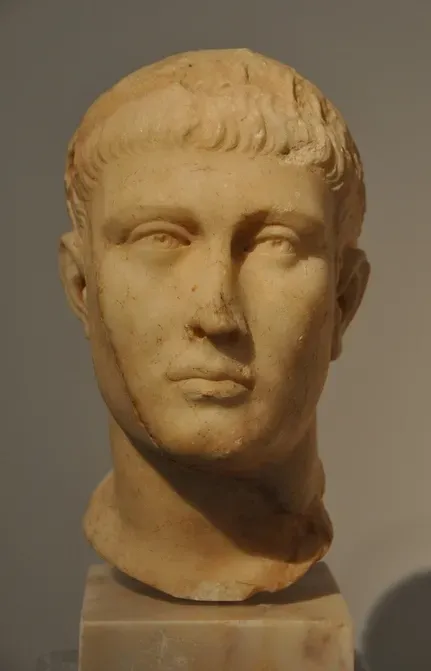
On 17 January 395, the Emperor Theodosius I died in Milan at the age of forty-eight. He was the last man ever to govern a united Roman Empire. Nobody in his court seems to have realised this at the time.
The cause was oedema - fluid building up in the body, almost certainly related to heart failure. He had been ill since the autumn. His eastern court was in Constantinople under his seventeen-year-old son Arcadius; his western court was in Milan with his ten-year-old son Honorius. Theodosius had spent his final months of health fighting a civil war against a usurper named Eugenius, backed by his Frankish general Arbogast, and had won it decisively at the Battle of the Frigidus in September 394. That was the last time a Roman emperor led a unified Roman army. He was dead four months later.
Theodosius had come to power under the worst possible circumstances. In August 378, the Eastern Emperor Valens marched his army against a Gothic coalition at Adrianople, in what is now Turkey, and was annihilated. Roughly two-thirds of the eastern field army - somewhere between 15,000 and 20,000 men - died in the battle or the rout. Valens himself died somewhere in it, his body never recovered. The Goths were inside the empire’s borders, the eastern throne was empty, and the western emperor Gratian had no obvious solution. He appointed a Spanish general named Theodosius as co-emperor in January 379 and handed him the east to fix.
Theodosius fixed it, after a fashion. He could not expel the Goths outright - the army was too shattered and the numbers too large. In 382 he concluded a treaty that settled them in Thrace as foederati: allied troops who fought for Rome in exchange for land, under their own commanders, not subject to Roman provincial governance. It resolved the immediate crisis without resolving the underlying one. The Goths remained an armed nation living inside the empire’s frontiers, legally entitled to stay, answerable to their own leaders. When Alaric and his Visigoths sacked Rome in 410, fifteen years after Theodosius’s death, they were the heirs of men who had entered the empire under that treaty. The decision bought thirty-two years. It also put the burning match next to the fuse.
He was not a mild ruler in other respects. In 390, following a riot in Thessalonica in which the local Roman commander was lynched, Theodosius ordered a reprisal in the city’s hippodrome. His soldiers killed somewhere around 7,000 civilians - men, women, and children who had gathered there and had nothing to do with the original riot. The bishop Ambrose of Milan, the most powerful churchman in the western empire, refused to give him communion until he had performed public penance. Theodosius submitted. He stripped off the imperial purple, knelt in a Milan basilica, and begged forgiveness. No Roman emperor had ever done anything like it. Whether this marked the moment the church began asserting authority over the state, or merely showed what happens when a genuinely pious man does something monstrous and cannot rationalise his way out of it, is a question historians still argue about. What is not disputed is that it happened, and that it was unprecedented.
The Frigidus campaign in 394 nearly went wrong before it succeeded. On the first day of fighting, Theodosius’s forces - which included a large Gothic contingent under Alaric - were badly positioned and took heavy casualties. Contemporary Christian sources insisted the second day’s victory came from divine intervention: a bora wind, the fierce north-eastern gale of the Adriatic coast, rose and struck Eugenius’s army in the face while blowing at Theodosius’s back. It disrupted their archery, drove dust into their eyes, and broke their formation. Eugenius was captured and executed. Arbogast fled into the mountains and killed himself. Whether or not God arranged the meteorology, the outcome was complete. Theodosius returned to Milan the undisputed master of both halves of the Roman world. He had three months to enjoy it.
The division that followed his death looked, at the time, like a routine administrative transfer. The empire had shared rulers before - Diocletian and Maximian, Valens and Valentinian I. The machinery of empire would continue: the tax collectors, the legions on the Rhine and the Danube, the grain ships to Rome. What no one quite said aloud was that Honorius was ten years old, that his actual regent was a Vandal-Roman general named Stilicho, and that Arcadius - nominally competent but not by nature a ruler - had his court controlled by a succession of advisors: first Rufinus, murdered within the year, then the eunuch Eutropius, then his wife Eudoxia. The two imperial courts developed separate interests. The east stopped sending reinforcements west. The west stopped sending tax revenues east. Co-emperorship became a legal fiction covering something closer to two states sharing a memory.
The western half lasted another eighty-one years. Its final emperor, Romulus Augustulus, was deposed by the Germanic general Odoacer in 476. Odoacer did not even claim the title for himself. He sent the imperial regalia to Constantinople and suggested one emperor was sufficient. The eastern court received the package and filed it.
The eastern half ran for another thousand and fifty-eight years after that. It fought the Sassanids, lost Egypt and Syria to the Arab conquests in the seventh century, weathered Bulgarian and Serbian kingdoms pressing at its borders, and was briefly occupied by crusaders who sacked Constantinople in 1204 and established a Latin empire on its ruins for fifty-seven years. It survived all of this. Its emperors called themselves Basileus Rhomaion - Emperor of the Romans - because they were, in their own unbroken legal and institutional continuity, exactly that. The term “Byzantine Empire” was coined by a German historian named Hieronymus Wolf in 1557, a century after the fall. The people who lived and died inside it never used the word. They were Romans until the Ottoman army broke through the Theodosian Walls on 29 May 1453.
Theodosius did not ruin the Roman Empire. He held it together through Adrianople, through the Gothic settlement, through two usurpers and a massacre and a public humiliation in front of a bishop. He was the last man with the combination of authority and energy to keep both halves functioning as one. After him, that combination did not reappear. The western empire unravelled, the eastern one survived by becoming something the western half would barely have recognised, and Rome itself - the city on the Tiber, the one that had given the whole enterprise its name - was sacked by the foederati Theodosius had invited in, then left behind as a provincial backwater as government moved to Ravenna and Constantinople. The empire outlasted the city. The city outlasted the empire that bore its name. Neither outlasted the decision, made in a palace in Milan in January 395, to divide rather than wait for a capable heir.