On 21 February 1613, seven hundred delegates of the Zemsky Sobor — the nearest thing Muscovy had to a national assembly — chose a sixteen-year-old boy named Mikhail Romanov as tsar. Russia was broken. The Time of Troubles had burned through fifteen years of civil war, famine, foreign invasion, and pretenders to the throne. Poles had occupied the Kremlin. Swedes held Novgorod. The previous dynasty, the Rurikids, had died out; the country had cycled through a string of tsars, false tsars, and interregnums. What the delegates at the Sobor wanted was stability. What they got — by accident, by miscalculation, and by one of history’s better jokes — was a dynasty that lasted three hundred and four years.
Mikhail was not chosen for his qualities. He was chosen for his lack of them. He was young, poorly educated, and by contemporary accounts not especially sharp. His father, Filaret, was a prisoner of the Poles — which meant he could not interfere, but also lent the family a patriotic sheen. The boyars who dominated the Sobor calculated that a weak, pliable tsar was exactly what they needed: someone who would wear the crown and let them run things. One of them reportedly said: “Let us have Misha Romanov, for he is young and not yet wise; he will suit our purposes.” They were right, for a while. Mikhail reigned for thirty-two years without doing anything dramatic. His father came home from captivity in 1619, took the title of Patriarch, and ran the country until his death in 1633. The dynasty consolidated. Russia recovered. Slowly, painfully, the state rebuilt itself.
The Romanovs would go on to produce Peter the Great, who dragged Russia into the European state system by force; Catherine the Great, who expanded the empire to the Black Sea and partitioned Poland; and an unbroken line of autocrats who, by the nineteenth century, ruled one-sixth of the earth’s land surface. They would also produce Nicholas II, whose mixture of stubbornness and indecisiveness — not unlike his ancestor Mikhail’s temperament, though applied in far more dangerous circumstances — ended the whole enterprise in blood and revolution. The boyars who picked a boy they thought they could control in 1613 could not have imagined what they were starting. Nobody ever does.
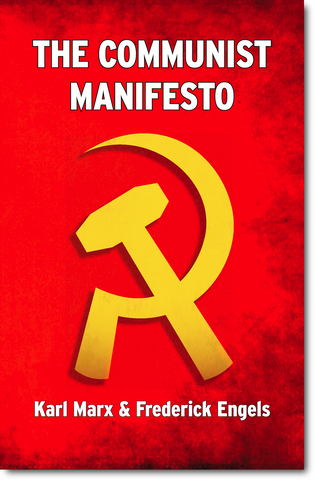
Two hundred and thirty-five years later, on the same date, a twenty-three-page pamphlet rolled off a press at 46 Liverpool Street in London. The Communist Manifesto, by Karl Marx and Friedrich Engels, was published on 21 February 1848. “A spectre is haunting Europe,” it began — “the spectre of communism.” The timing was almost theatrical. Within weeks, revolutions broke out across the continent: Paris, Berlin, Vienna, Budapest, Milan. The Manifesto had nothing to do with any of them. In 1848, nobody outside a small circle of German emigre radicals had read it. The print run was modest, the language was German, and the Communist League that commissioned it was a fringe organisation with no real power. As a practical contribution to the revolutions of 1848, the pamphlet was irrelevant.
As a contribution to the century that followed, it was something else. The Manifesto laid down a framework — history as class struggle, capitalism as a system that creates its own grave-diggers, the proletariat destined to sweep away the old order — that proved remarkably durable as a political programme. Marx spent the next decades expanding the argument into Das Kapital and a lifetime of polemics. By the 1870s, socialist parties were organising across Europe. By 1917, a group of revolutionaries who had studied Marx with the obsessive attention of medieval scholars seized power in — of all places — Russia. The dynasty that began on 21 February 1613 was destroyed by an ideology whose founding document was published on 21 February 1848. Nicholas II abdicated in March 1917. He and his family were shot in a basement in Yekaterinburg sixteen months later. The house of Romanov, born because the boyars wanted a tsar they could manage, ended because a different set of men decided they did not want a tsar at all.
The Soviet state that replaced the Romanovs lasted seventy-four years — a respectable run, but a fraction of the dynasty it destroyed. When it collapsed in 1991, it left behind fifteen successor states, several thousand nuclear warheads, and an enormous unresolved question: what would become of the territories that Moscow had ruled, under one flag or another, for centuries? Ukraine was the largest and most consequential of those territories. For twenty-three years after the Soviet collapse, a series of uneasy compromises kept Ukraine suspended between Russia and the West — not quite aligned with either, dependent on both, governed by men who navigated the space between Moscow and Brussels with varying degrees of cynicism. On 21 February 2014, those compromises ran out.
The Euromaidan protests had been building in Kyiv since November 2013, after President Viktor Yanukovych refused to sign an association agreement with the European Union and turned instead toward Moscow. What began as a student gathering on Independence Square grew, through three months of escalating repression, into the largest democratic mass movement in Europe since 1989. In January and February, the government sent riot police and snipers. Over 108 protesters were killed, most of them in the three days before the end. This galvanised the crowds and scared the rulers of the country. On 21 February, Yanukovych signed an agreement with opposition leaders, brokered by European foreign ministers, promising constitutional reform and early elections. It was already too late, power was slipping from his grasp. Police withdrew from central Kyiv that afternoon. Yanukovych fled the capital that evening. By the next morning, parliament had voted unanimously to remove him. Within days he was in Russia, and Ukraine had crossed a line from which there was no return.
What followed reshaped the map of Europe. Russia seized and annexed Crimea in March 2014 — the first forcible annexation of territory on the continent since 1945. Armed separatists, supplied and directed by Moscow, took control of parts of the Donbas. Eight years of frozen conflict followed, and then, in February 2022, a full-scale invasion that produced the largest war in Europe in eighty years. The war rages on even today. The line from Independence Square to the trenches outside Bakhmut runs through that agreement signed on 21 February 2014 — the day the post-Soviet settlement in Ukraine fell apart for good.
Three events. One date. The thread that connects them is Russia itself — the recurring, unresolved question of how that country should be governed and what it is entitled to rule. In 1613, the answer was: pick a tsar, any tsar, hold the state together. In 1848, a pamphlet proposed a radically different answer — no tsars, no classes, no property — and that answer, applied to Russia seven decades later, produced one of the most destructive political experiments in history. In 2014, the aftershocks of that experiment’s collapse reached Kyiv’s central square, and the consequences have not stopped rolling in since. The boy tsar, the revolutionary pamphlet, and the president’s flight — they do not explain each other in any simple, mechanical way. But they belong to the same long argument about power and legitimacy and empire, an argument that has been running through Russian history for four centuries without reaching a conclusion. That argument — its turns, its repetitions, its habit of producing consequences nobody intended — is one of the threads I follow in The Butterfly Effect. Not every date on the calendar carries this much weight. The twenty-first of February does.