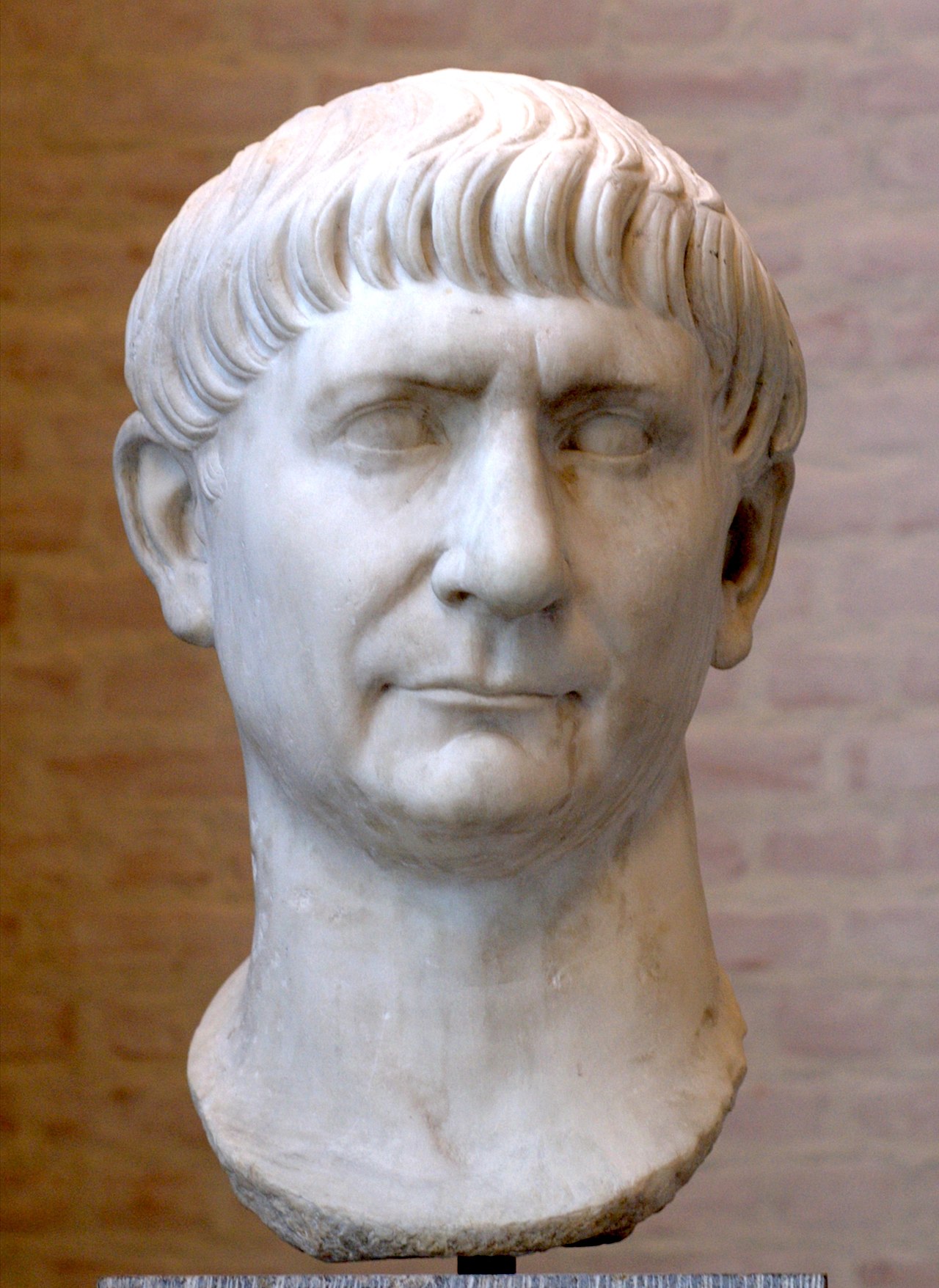
For several centuries after Trajan’s death, the Roman Senate greeted each new emperor with the same ritual phrase: felicior Augusto, melior Traiano - may you be luckier than Augustus and better than Trajan. Two names, two benchmarks. Augustus stood for fortune and dynastic survival; Trajan stood for conduct. That the Senate placed Trajan in this pair - above every other emperor in five generations of imperial rule - says something about what nineteen years of competent government looks like when it follows a long stretch of patchy alternatives.
Nerva died on 27 January 98. Trajan was in Germania Superior when the news reached him. He did not rush to Rome.
His predecessor had come to the throne in desperate circumstances. When the Praetorian Guard assassinated Domitian in September 96, the Senate produced Nerva - sixty-six years old, childless, no military experience - as a respectable caretaker. He lasted sixteen months before the Guard turned on him. They besieged the palace and forced the elderly emperor to surrender Domitian’s killers to them. It was an open humiliation, and it made Nerva’s position untenable without a credible heir. He found one in Trajan, commanding legions on the Rhine frontier. The adoption had the formal character of a free choice; its substance was closer to the Guard telling Nerva to choose someone the army respected, or face the consequences.
Before leaving Germania for Rome, Trajan summoned the Praetorian Prefect Casperius Aelianus - the man who had organised the coercion of Nerva - to Germany, where he was promptly executed. He then spent several weeks on a tour of inspection along the Rhine and Danube, assessing garrisons and frontier defences. He arrived in Rome in 99, a year after becoming emperor. The Senate, which had worried about a general with legions at his back, received instead a man who entered the city with conspicuous modesty and distributed money directly to the people rather than exclusively to the troops. He gave the soldiers half the usual accession donative. The message, delivered without a speech, was that the balance of power would not be what it had been under Domitian, or under the Guard’s short-lived arrangement with Nerva.
His military record was the foundation of everything else. The Dacian Wars - two campaigns against the organised kingdom north of the Danube - were the centrepiece. The Dacian king Decebalus had spent years extracting subsidies and technical experts from Rome under Domitian’s settlement, treating client status as an opportunity to rearm. Trajan crossed the Danube in May 101, won a hard battle at Tapae, and forced Decebalus to submit. The peace lasted until Decebalus resumed his usual behaviour. The second war, in 105-106, ended with Roman forces systematically reducing Dacian fortresses, Decebalus committing suicide rather than be captured, and his severed head carried back to Rome for display on the Capitoline. Trajan had raised two new legions for the second campaign. The Danube frontier permanently replaced the Rhine as the empire’s main military axis from that point forward. The treasure taken from Dacia - historians’ estimates vary but run to hundreds of thousands of pounds of gold and silver - went into stone.
Trajan’s Forum was the largest in Rome, carved out of the hillside between the Capitoline and Quirinal, financed from Dacian loot, completed in 112. Trajan’s Column, thirty metres of sculpted marble depicting both wars in a continuous frieze of 2,500 figures, still stands in the forum today. Roads extended across the empire - the Via Traiana running south to Brindisi, military roads into newly annexed Arabia and Syria. A stone bridge over the Danube, designed by Apollodorus of Damascus and stretching over a kilometre, allowed troop movements regardless of the river’s winter state. He formalised the alimenta, a welfare programme providing food and financial support to poor children across Italy, backed by mortgage agreements on agricultural land and funded partly from the same Dacian campaign. The Senate gave him the title optimus princeps - the best ruler - and had it stamped on coins from 105 onwards. No other emperor received it officially.
The Parthian campaign of 113-117 was his largest and most contested. He drove into Armenia, took Ctesiphon, and reached the Persian Gulf - the empire at its maximum extent, larger than it had been or would be again. Then Mesopotamia began to revolt. Jewish uprisings across Libya, Egypt, and Cyprus in 115 and 116 consumed significant forces; the suppression was thorough and brutal, effectively depopulating parts of Cyprus and Cyrene. In Mesopotamia, Trajan had taken more than he could hold, and his successor Hadrian handed the province back within a year of inheriting it. Whether Trajan, given more time, would have reached the same conclusion is genuinely unclear. He did not have more time.
He died in Selinus on the Cilician coast in August 117, on his way home, leaving behind a campaign that had not finished. Against that: two Dacian provinces, an annexed Nabataean kingdom, roads from Scotland to Mesopotamia, a forum that drew admiration when Constantius II visited Rome two and a half centuries later, and a welfare programme running on agricultural mortgages. He had governed for nineteen years, kept the Senate functional by the standards of the job, and spent his military capacity on wars that were mostly decisive. He devalued the currency in 107. He put 10,000 gladiators in the arena for 123 straight days of games after his Dacian triumph. He prosecuted Christians when identified, though he told Pliny not to hunt them out on anonymous denunciations. He ran an autocracy while affecting to consult the Senate, which is simply what the principate was. By the standards of the office, these were not exceptional faults.
The succession has a question mark over it. The Historia Augusta records that Hadrian was adopted as Trajan’s heir on 9 August 117; Trajan died on 11 August. The two days have attracted close attention, because Trajan’s wife Plotina was known to favour Hadrian and was present at the deathbed, while Trajan himself was in no condition to make public announcements. Whether the decision was genuinely his, was made on his behalf while he was still conscious, or was managed posthumously by a determined empress, is not firmly established. What is clear is that Hadrian ruled for twenty-one years and was himself considered, by most of those who followed, a reasonably capable emperor. He kept the peace and kept the structure intact. The chain held.
The formula felicior Augusto, melior Traiano was still in use in late antiquity, long after both men had become historical figures rather than memories. Augustus had built the system. Trajan had run it better than almost anyone else who tried. That the Senate placed them side by side as the two permanent standards - one for luck, one for quality - was not sentiment. It was the closest the Roman political tradition came to admitting that competent, restrained government was rarer than it should have been, and that when it appeared, it was worth naming.