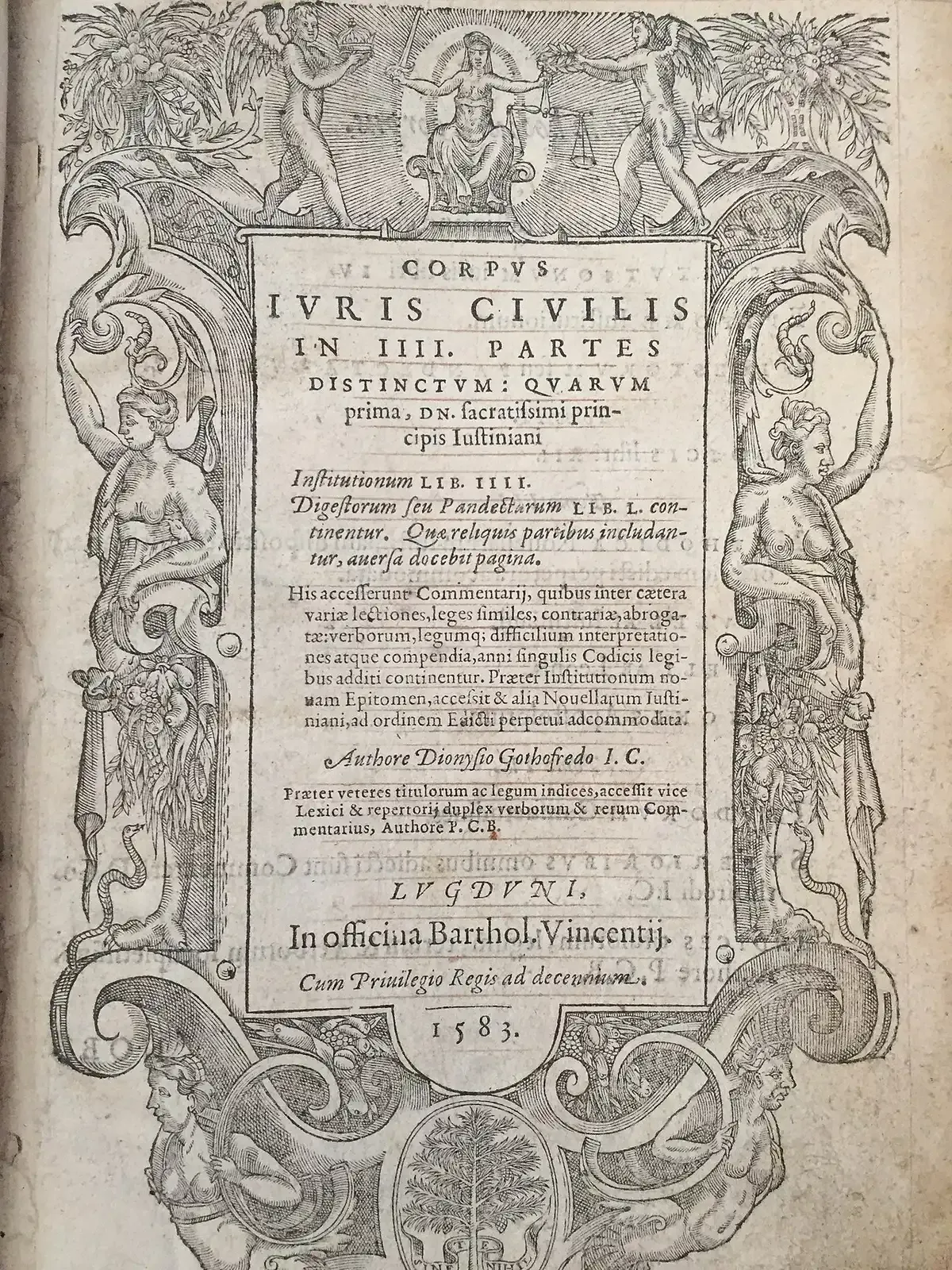
On 7 April 529, the Roman emperor Justinian I published a legal code. Nothing about that sentence sounds like the beginning of a story. It sounds like a footnote - the administrative byproduct of an empire that was, by that point, already half lost. But the code Justinian published that April is still in use, in modified form, in most of continental Europe, Latin America, and large parts of Africa and Asia. The empire that published it no longer exists. It fell in 1453. The law is still in the very fabric of many societies.
The problem Justinian had inherited was real and ungovernable. Roman law by 529 was nearly eight hundred years of accumulated legislation - imperial constitutions, decrees, rescripts - layered over six centuries of juristic commentary, much of it contradictory, almost none of it organised. The Codex Theodosianus, a collection of imperial edicts from Constantine onward, dated from 438 and was already eighty years out of date when Justinian took the throne in 527. Earlier compilations were unofficial and incomplete. Judges worked from multiple competing sources. Nobody could say with confidence what the law actually was.
Six months after Justinian acceded, he commissioned a new collection of imperial constitutions. The commission worked fast - the first Codex was complete by 7 April 529 - and was explicitly authorised to edit what it included: cut the contradictions, remove the obsolete, impose a single ordered text that would replace everything that had come before. The man Justinian put in charge was Tribonian, his quaestor, a legal scholar who combined formidable intellectual ability with a gift for extracting money from litigants that made him genuinely despised. In 533, Tribonian’s team completed the Digest: a fifty-volume compendium drawn from the works of thirty-eight classical jurists, converting centuries of private legal opinion into binding law. Alongside it came the Institutes, a student textbook given full force of law. Later, the Novellae - new legislation issued after 534 - rounded out what historians now call the Corpus Juris Civilis.
Tribonian was sacked in January 532. The Nika riots - when half of Constantinople burned and Justinian nearly fled to Thrace on whatever boat was available - produced demands from the crowd for the dismissal of two ministers, and Tribonian was one of them. Justinian reinstated him as soon as the Hippodrome was cleared of the dead. The Digest, the largest part of the project, was completed a year later. Whatever else the Nika riots were, they were not a stop order on Justinian’s legal programme.
What the Corpus tried to do was radical by the standards of any era. It did not merely collect old law. It proclaimed itself the sole source of law, prohibited citations to any original texts, and decreed that judges could not refuse to decide a case on grounds that the law was silent or unclear. They had to interpret. They could not legislate, but they could not abstain either. The code opened with an article requiring all subjects of the empire to hold the Christian faith - the Chalcedonian variant specifically, which excluded the Church of the East and most of the empire’s eastern provinces from the category of full citizens - and moved from there through property, contracts, inheritance, and the legal status of persons with a comprehensiveness that had no obvious precedent in the Western world. It was composed in Latin, which was still the language of government, even though most of the empire’s population had spoken Greek for generations.
The Eastern Roman Empire revised it into Greek as the administrative language shifted, and the Corpus - recast as the Basilika in the late ninth century - remained the foundation of Byzantine law until Constantinople fell to the Ottomans in 1453. In the Balkans it outlasted Byzantium itself, forming the basis of Serbian and Bulgarian legal codes, and it was the legal foundation of the newly independent Greek state in the 1820s, nine centuries after Justinian had first assembled it.
In Western Europe the story is more complicated. The Corpus was applied briefly in the territories Justinian reconquered - Italy, parts of North Africa, southern Spain - but after those territories were lost, it effectively disappeared from Western legal practice. Germanic customary law filled the gap. The recovery came around 1070, in Bologna, under circumstances historians still argue about. A scholar named Irnerius began teaching from a complete sixth-century manuscript of the Digest that had been preserved, improbably, in Amalfi. His method was to read the text aloud and then deliver commentary on what it meant. His students copied both. The tradition he started produced the University of Bologna - the oldest university in Europe - and a class of professional lawyers who staffed the new bureaucracies of European princes. The Catholic Church adopted it wholesale; the canon lawyers’ maxim was ecclesia vivit lege romana, “the church lives by Roman law.” Within two centuries of Irnerius, Justinian’s legal concepts had re-entered the intellectual foundations of European governance.
The Napoleon connection is not subtle. The Code civil des Français, signed into law in 1804, drew explicitly on Roman law principles recovered through this tradition: equality before the law, secular property rights, enforceable contracts, the prohibition on judges refusing to decide. Napoleon’s jurists were working from materials that traced directly back to Tribonian’s commission. The Napoleonic Code then spread to Belgium, the Netherlands, Italy, Spain, Louisiana, Quebec, and Egypt, and through those channels into the legal architecture of much of the modern world. The chain from Tribonian’s desk in Constantinople to the civil codes of France, Quebec, and Louisiana is not a metaphor. It is a transmission history.
7 April 529 is an administrative date: the day a commission delivered a finished codification to an emperor who had been on the throne for under two years, had not yet faced the riots that would nearly end his reign, and had no way of knowing whether the empire would last another decade or another millennium (it managed nine centuries). The code his commission had spent six months compiling was, from the outside, a bureaucratic housekeeping exercise - sorting through centuries of accumulated legal debris and producing something usable. What it turned out to be was the most durable thing he made. The Hagia Sophia is still standing. The law is still working.