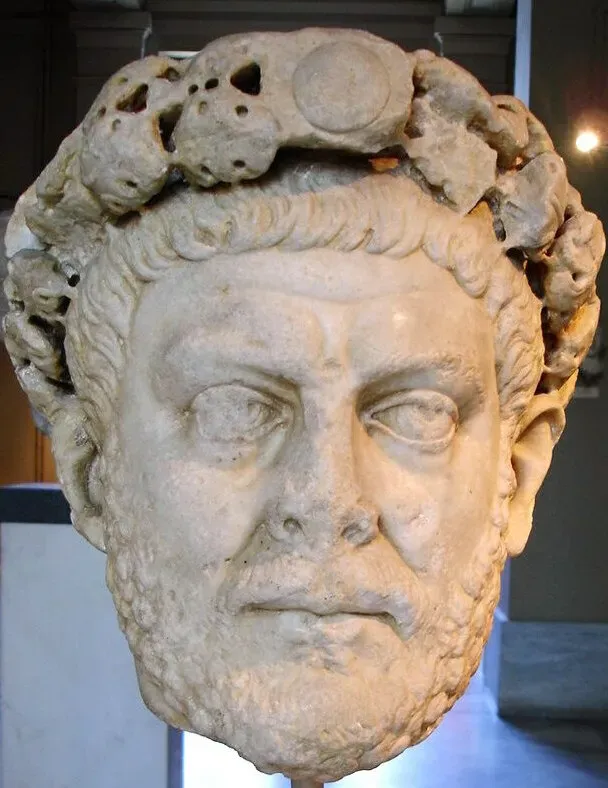
By 284 AD, the Roman Empire had worked through roughly twenty emperors in fifty years. Most of them died in the job - which is to say, most of them were killed by the soldiers who had put them there. The problem was not personal failure or moral weakness. There were many problems, but one of the largest one was, well, the geographical size of the state.
The empire covered roughly 5 million square kilometres and somewhere between 50 and 70 million people. It stretched from Hadrian’s Wall in northern Britain to the Euphrates in modern Iraq, from the Rhine delta to the Sahara. A general leading a campaign against Gothic raiders on the Danube could not simultaneously negotiate with Sassanid Persia or suppress a usurper in Gaul. The emperors of the third century kept dying not only because they were weak but because they were attempting to hold together something that one man, in one place, could not hold together. You can read more about how that crisis unravelled here.
Diocletian, who had seized power in 284 after the predictable assassination of his predecessor, understood this as a structural problem rather than a personal one. On 1 April 286, he appointed Maximian as co-Augustus - his equal in rank, his partner in authority, and the man responsible for the western half of the empire while Diocletian managed the east. This was the diarchy: rule by two.
The appointment was not a simple delegation of administrative duties. In Roman political tradition, the emperor was the single apex of legitimacy - the princeps, first citizen, the man through whom all authority flowed. Sharing that title was not a procedure anyone had worked out in advance; it was a deliberate break from a century of precedent. Augustus had dressed his autocracy in republican language, maintaining the fiction of restored governance while holding every lever that mattered. Diocletian went the other direction entirely. He adopted the title Dominus Noster - Our Lord - which Augustus would have found alarming. He required subjects to prostrate themselves in the Persian fashion, to kiss the hem of his robes. He wore a diadem. He replaced the old republican theatre with elaborate court ceremonial. Power no longer concealed itself. It announced itself.
Seven years later, in 293, Diocletian extended the system. He and Maximian each appointed a subordinate Caesar - junior emperors assigned to specific frontiers who would eventually succeed the senior Augusti. Diocletian took Galerius; Maximian took Constantius Chlorus. The result was the Tetrarchy: four rulers, four headquarters distributed across the empire’s most contested zones. Diocletian governed from Nicomedia in Asia Minor. Maximian from Milan. Constantius from Trier. Galerius from Sirmium. Rome itself - Rome, which had given the empire its name - became, for the first time, administratively marginal. The Senate still met. The city still had its bread dole and its chariot races. But the real business of empire happened wherever the armies were.
The administrative reforms that accompanied the Tetrarchy were equally sweeping. Diocletian divided the existing provinces into roughly a hundred smaller units and grouped them into twelve larger dioceses - a word the Catholic Church later borrowed for its own organisational purposes. He doubled the size of the army, paying for it with a revised tax system that assessed land and population directly, producing census records of the kind Rome had not attempted in generations. Civil and military careers, previously intertwined, were formally separated: governors no longer commanded troops; generals no longer governed civilians. The professional bureaucracy expanded to fill the gap.
The most remarkable act came last. In 305, Diocletian did something no Roman emperor had ever done: he resigned. Voluntarily, while still healthy enough to refuse to leave, he abdicated and retired to his palace at Split on the Dalmatian coast, where he ostensibly grew vegetables. When political allies later urged him to return to power, he reportedly told them he wished they could see the cabbages he had raised with his own hands, and they would not ask him again. He compelled Maximian to abdicate at the same time. The two Caesars became the new Augusti; two new Caesars were appointed beneath them. The system was designed to reproduce itself, peacefully, through merit rather than blood.
It did not. Within two years of Diocletian’s retirement, Maximian had reversed his abdication, Constantius had died and been succeeded by his son Constantine - the troops having proclaimed him on the spot, ignoring the succession mechanism entirely - and Maxentius, Maximian’s son, had been proclaimed emperor in Rome by the Praetorian Guard. By 310 there were six simultaneous claimants - a total mess in place of order. By 324, Constantine had eliminated all of them and ruled alone.
But the structural changes outlasted the Tetrarchy’s political failure. Constantine kept the divided provinces. He kept the separation of civil and military careers. He kept the bureaucratic apparatus and the Dominus Noster formula and the court ceremonial. He moved his capital to a new city on the Bosphorus, which he named after himself, and that city governed a Roman Empire for another eleven centuries after the western provinces had ceased to be Roman altogether.
The diarchy Diocletian established on 1 April 286 lasted, in its original form, less than twenty years. The logic behind it - that governing this much territory requires more than one centre of authority - outlasted the western empire by a millennium. That is a reasonable return on a decision that most of his predecessors, had they survived long enough to make it, would probably have reached themselves.