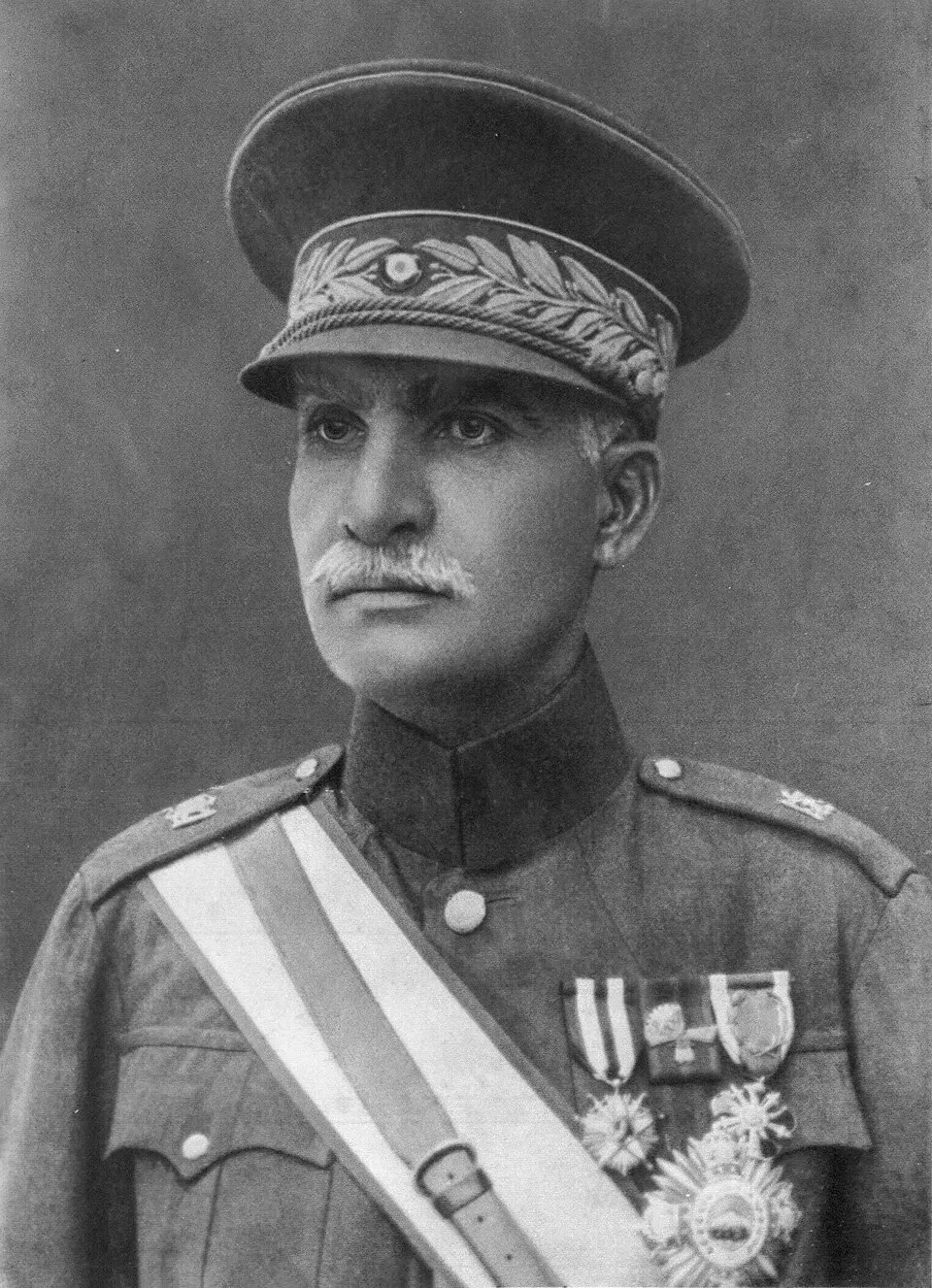
On 22 February 1921, a column of roughly three thousand soldiers marched into Tehran. Their commander was Reza Khan, a forty-two-year-old brigadier general of the Persian Cossack Brigade — a unit originally officered by Russians but recently purged of its foreign commanders at British insistence. His political partner was Seyyed Zia al-Din Tabatabaei, a journalist and political operator who would serve as the civilian front. The Qajar shah, Ahmad Shah, twenty-three years old and already exhausted by a throne he had never wanted, offered no resistance. There was nothing much to resist with. Persia in 1921 was a country in name only: its northern provinces under Soviet influence, its southern oil under British control, its central government bankrupt, its army a joke, and its dynasty — the Qajars, who had ruled since the late eighteenth century — too feeble to hold any of it together. Reza Khan took the ministry of war. Tabatabaei got the premiership. Within three months, Reza Khan had pushed Tabatabaei aside. The journalist went into exile. The soldier kept climbing.
The climb was fast and deliberate. Reza Khan made himself prime minister in 1923, pushed Ahmad Shah into a European exile from which he never returned, and on 15 December 1925 had the Majles depose the Qajar dynasty and hand him the crown. He took the name Pahlavi — borrowed from the pre-Islamic Middle Persian script, a signal of where he intended to look for legitimacy. Not to the Qajars, not to the clergy, but to Cyrus and Darius and the ancient empire that Persians still considered their civilisational core. What followed was a modernisation programme modelled explicitly on Atatürk’s Turkey: a new legal code replacing sharia courts, a national railway driven through mountains that engineers said could not be crossed, forced sedentarisation of nomadic tribes, a ban on the veil, compulsory Western dress, and in 1935 a formal request that foreign governments stop calling the country Persia and use its own name — Iran. The Trans-Iranian Railway alone was a monument to will: 1,394 kilometres from the Persian Gulf to the Caspian Sea, built without foreign loans, paid for by taxes on tea and sugar, completed in 1938 through some of the most difficult terrain in Asia. Reza Shah was building a nation-state from scratch, and he did not ask permission. He also did not tolerate dissent. Political opponents were imprisoned, exiled, or killed. The press was muzzled. Tribal leaders who resisted sedentarisation were crushed by the army. The clergy, whose courts and revenue streams the new legal code had dismantled, seethed quietly. He was an Iranian Atatürk in method and ambition — and, like Atatürk, the modernisation he imposed was real but brittle, because it depended entirely on one man’s energy and one man’s grip.
The energy ran out in August 1941, when forces Reza Shah could not intimidate arrived at his borders. Britain and the Soviet Union needed a supply corridor to move Allied materiel to the Eastern Front. Iran’s declared neutrality was irrelevant; its oil was not. On 25 August, British and Soviet troops invaded simultaneously from south and north. The Iranian army, which Reza Shah had spent two decades building, collapsed in under a week. The Allies gave him a choice: abdicate or be deposed. On 16 September he abdicated in favour of his twenty-one-year-old son, Mohammad Reza. The founder was shipped to Mauritius, then to Johannesburg, where he died on 26 July 1944 — alone, in exile, watching from a distance as the country he had assembled by force was occupied by the powers he had tried to outmanoeuvre. Not a heroic exit. But what he left behind — a centralised state, a professional army, a national identity stronger than any the Qajars had managed — survived him.
His son was a different kind of ruler. Where Reza Shah had been a soldier who made himself king, Mohammad Reza was a king who never quite believed it. The early years were precarious: foreign occupation, a weak throne, and a parliament that in 1951 handed the premiership to Mohammad Mossadegh, a nationalist lawyer who nationalised the Anglo-Iranian Oil Company and dared Britain to do something about it. Britain did — together with America. In August 1953, a CIA-MI6 operation (Ajax to Washington, Boot to London) organised street mobs, bribed army officers, and toppled Mossadegh after a chaotic few days during which the Shah fled to Baghdad and Rome. He came back to a throne secured by foreign intelligence services, and that origin stain never washed out. For the next twenty-six years, Mohammad Reza Shah ruled with expanding ambition and shrinking legitimacy. The White Revolution of 1963 redistributed land, gave women the vote, and industrialised at speed. SAVAK, the secret police built with CIA and Mossad assistance, imprisoned, tortured, and killed dissidents with the efficiency his father would have admired. Oil money — especially after the 1973 price shock — poured in, and the Shah spent accordingly: the Persepolis celebrations of October 1971, marking 2,500 years of the Persian monarchy, cost somewhere between $17 million and $100 million depending on who was counting, and featured a tent city in the desert, meals flown in from Maxim’s of Paris, and a guest list of kings, presidents, and dictators. The Iranian public, most of whom lived nowhere near the tent city, watched with the kind of resentment that accumulates interest.
The resentment came due in 1978. Protests erupted across Iranian cities — students, bazaar merchants, workers, and clerics united by little more than their hatred of the regime. The Shah, who had spent decades crushing opponents with a word to SAVAK, could not decide what to do. He oscillated between concessions and crackdowns, appointed and dismissed prime ministers, signalled to the army that force was authorised and then signalled that it was not. He was ill — lymphoma, diagnosed in 1974 and hidden from almost everyone — and the illness did not help. But the indecisiveness was constitutional, not medical. As much energy as his father had brought to seizing power, Mohammad Reza expended in failing to hold it. On 16 January 1979, he left Iran with his family. I covered what came next — Khomeini’s return, the revolution’s first days, the Republic it built — in The Homecoming. The Pahlavi dynasty, fifty-four years from coup to exile, was finished.
Or perhaps not entirely. Reza Pahlavi, Mohammad Reza Shah’s eldest son, was seventeen when his family left Iran. He trained as a fighter pilot in the United States, settled in the Virginia suburbs of Washington, and has spent four and a half decades as the exiled heir to a throne that no longer exists. For most of that time, the Iranian opposition — fragmented, ideologically incompatible, scattered across three continents — treated him as a curiosity at best: a man whose surname was as much a liability as an asset, given what SAVAK had done to the parents and siblings of the very people he hoped would rally behind him. In December 2025, when the rial collapsed and the streets filled again, Pahlavi issued a call from exile for unified demonstrations. Millions came out. The regime killed thousands and held on, as it has before. His chances of leading Iran — of reclaiming, in some form, the role his grandfather seized on a February morning in 1921 — look slim. The Islamic Republic has proven, repeatedly, that it can absorb protest through violence. But this century has a habit of overturning things that look permanent. The Soviet Union looked permanent. The Assad regime looked permanent. The Islamic Republic’s proxy network, dismantled in under two years, looked permanent. Reza Pahlavi is sixty-five — not quite the young pretender, though younger than Khomeini was when he boarded that Air France 747 — with no army, no party apparatus, and no guarantee of anything, betting that the Republic’s permanence is the next illusion to crack.
A dynasty founded by a Cossack officer who marched on a capital with three thousand men, expanded by a son who never matched his father’s nerve, and now carried forward by a grandson with a claim and a telephone. The Pahlavis have always been an unlikely house. That is not necessarily an argument against them. The unlikely is rather common in Iranian history — and in history generally. The twenty-second of February 1921 proved as much.