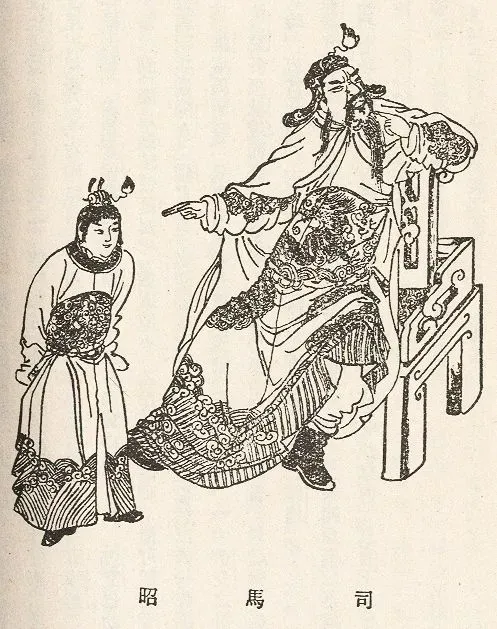
On 2 June 260, a twenty-year-old emperor decided he would rather die in the mud than live in a gilded cage. Sword in hand, Cao Mao, the nominal ruler of the state of Cao Wei, marched out of his palace in Luoyang. Behind him followed a pathetic, desperate army of palace eunuchs, cooks, and low-ranking guards, armed with whatever weapons they could scavenge. They were marching in the rain to attack the mansion of Sima Zhao, the all-powerful regent who held the imperial court in a stranglehold. It was a suicidal charge, and everyone in Luoyang knew it. But Cao Mao had reached his limit. By choosing a spectacular, public death over quiet submission, the young emperor forced his captors to drop their masks and expose the raw, bloody machinery of their power.
To understand this desperate march, one must look at the slow, systematic hollowing out of the Cao Wei dynasty. For over a decade, the Sima family had ruled in all but name. Sima Zhao, having inherited the regency from his father and brother, had reduced the emperor to a mere ceremonial prop. Cao Mao was intelligent, highly educated, and acutely aware of his humiliation. When Sima Zhao demanded the “nine bestowments” - the traditional precursor to formal usurpation - Cao Mao knew the end was near. He famously told his closest ministers: “Sima Zhao’s heart is known to every passerby on the street.” It is a phrase that has echoed through Chinese history for nearly two millennia, capturing the shameless transparency of the regent’s ambition. Rather than wait for the inevitable abdication ceremony, Cao Mao decided to force a confrontation.
The clash was brief and brutal. Sima Zhao’s forces, led by the ruthless minister Jia Chong, intercepted the imperial party just outside the palace gates. The regent’s soldiers hesitated. To strike the Son of Heaven was the ultimate sacrilege, a crime that carried the weight of cosmic damnation. Seeing his men waver, Jia Chong urged them on, demanding if they knew whose bread they ate. A low-ranking officer named Cheng Ji stepped forward and ran Cao Mao through with a spear. The emperor fell dead in the rain. In that single, shocking moment, the delicate fiction of the Han and Wei dynastic transitions - where puppet rulers politely stepped aside for their usurpers in a choreographed dance of pseudo-legitimacy - was shattered.
What followed was a masterclass in political damage control and profound hypocrisy. Sima Zhao, arriving at the scene, performed a grotesque display of public grief, throwing himself on the ground and weeping over the emperor’s corpse. He had to manage a severe legitimacy crisis. To appease public outrage, Sima Zhao posthumously demoted Cao Mao to a commoner, but later restored him as the “Duke of Gaogui Village” to allow for a modest burial. He executed the direct perpetrator, Cheng Ji, along with his entire clan, scapegoating the soldier who had merely carried out his faction’s wishes, while sparing Jia Chong, the man who had actually ordered the blow. I find this selective justice deeply revealing. It exposed a moral vacuum at the heart of the Sima regime, proving that in their world, loyalty to the faction trumped any notion of cosmic or legal justice.
The regicide was a turning point that paved the direct pathway to dynastic change, but it did so at a devastating cost to the Sima family’s moral authority. Sima Zhao consolidated absolute control, purging the remaining loyalists and installing the pliable Cao Huan as a final puppet. Within six years, Sima Zhao’s son, Sima Yan, would force Cao Huan to abdicate, establishing the Western Jin Dynasty and eventually reunifying China in 280. Yet, the Jin Dynasty was born with a terminal illness. By murdering an emperor in broad daylight, the Sima family had demonstrated that power belonged to whoever was ruthless enough to take it. They had destroyed the Confucian moral foundation of the state. To compensate for this legitimacy crisis, the Jin court later obsessed over “filial piety” as its primary governing principle, a desperate, ideological attempt to rehabilitate a reputation stained by regicide.
I look back at that rainy afternoon in Luoyang and see the tragic, enduring legacy of Cao Mao’s final act. He lost his life, his crown, and his dynasty. But in his suicidal charge, he won a different kind of victory. He denied Sima Zhao the comfortable lie of a peaceful transition. He forced the usurpers to write their dynasty’s foundation in the blood of their sovereign, leaving a stain that no amount of imperial propaganda could ever wash away. We still remember Cao Mao not because he was a successful ruler, but because he understood that when faced with absolute tyranny, even a hopeless rebellion is a form of truth-telling. He died in the mud, but he did so with his sword in his hand, proving that some crowns are too heavy to wear in silence.