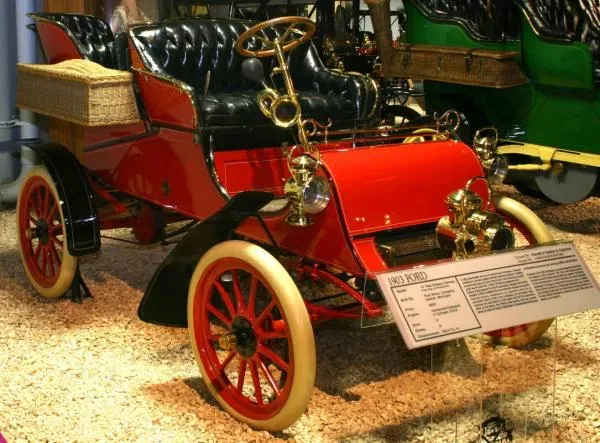
On 23 July 1903, a Chicago dentist named Ernest Pfennig took delivery of a two-cylinder Ford Model A with a tonneau, for which he had paid $850. It was the first car the newly formed Ford Motor Company had ever sold. By the time the cheque cleared, the company had $223.65 left in its account, against an initial investment of $28,000. Pfennig is the German word for a small copper coin, roughly equivalent to a penny. A man named after the smallest unit of currency arrived just in time to keep a car company from running out of money entirely. Henry Ford was not a man given to noticing irony, and there is no record he ever remarked on this one.
He had earned the second chance the hard way. Two previous attempts to build a car company - the Detroit Automobile Company and the Henry Ford Company - had already failed, the second partly because Ford quarrelled with his own investors and walked out. By June 1903, he had persuaded twelve stockholders, including the coal dealer Alexander Malcomson and the banker John S. Gray, to put up the money for a third try. Gray became president rather than Ford himself, specifically so the investors would have someone other than Ford to hold accountable if he walked out again. The company rented a modest wood-frame building on Mack Avenue in Detroit from one of its own shareholders, Albert Strelow, and set up an assembly room 250 feet long and 50 feet wide. Groups of two or three men built each car by hand from parts supplied by outside contractors. It was not yet a factory in any sense Ford would later make famous. It was a workshop that happened to be incorporated.
The order that saved it had come in eight days earlier, on 15 July, and it turned out not to be a one-off. Within two months the company had sold 215 cars. By the end of its first year, the Mack Avenue plant had turned out roughly a thousand of them, and the near-bankrupt venture of that July afternoon was, for the first time in Henry Ford’s career, an actual business. None of this yet resembled the company that would reshape the twentieth century. That took another decade, and it began with a single insight banal enough to sound obvious only after someone has proved it: standardise the product, break the labour into small repeatable steps, and bring the work to the worker instead of the other way round. The Model T arrived in 1908 and sold in the millions. The moving assembly line arrived at Highland Park in 1913, cutting the time to build a chassis from twelve hours to ninety minutes. By 1914 the whole approach had a name of its own - Fordism - and Ford had doubled the minimum wage on his own factory floor to five dollars a day, partly out of decency and partly because he needed workers who could stick around long enough to learn the line.
What happened next is the part of the story that matters more than the machine itself: everybody stole it. General Motors, watching Ford dominate the low end of the market with one unchanging model, built the opposite strategy under Alfred Sloan - a car for every purse and purpose, from Chevrolet up to Cadillac, refreshed annually so buyers traded in instead of driving the same Model T for fifteen years. Combined with GM’s own financing arm, it overtook Ford by the late 1920s and never fully surrendered the lead. Toyota studied the source material directly. In 1950, the Toyota executive Eiji Toyoda spent six weeks at Ford’s River Rouge complex, watching a plant that employed 70,000 people and turned out 7,000 vehicles a day. He went home unconvinced that bigger was automatically better, and the ideas he brought back - about flow, about waste, about not building a warehouse’s worth of inventory before you knew whether anyone wanted it - became the Toyota Production System, the ancestor of most of what the world now calls lean manufacturing.
Some of Ford’s rivals did not just study the method. They trained inside Ford’s own operations. From 1967 to 1974, Ford partnered with Hyundai to build the European Cortina at a new plant in Ulsan, South Korea. When that partnership ended, Hyundai used what it had absorbed to launch its own car, the Pony, in 1975 - the first mass-produced Korean vehicle, and the beginning of a company that now outsells Ford globally. Kia’s own history runs through a similar Ford-adjacent apprenticeship via Mazda, in which Ford held a stake from 1979. None of these companies would tell their own histories as footnotes to Ford’s. But the lineage is there in the paperwork, if you go looking for it.
The company that taught the world how to build cars has spent the last two decades finding that out the hard way. It avoided the federal bailout that General Motors and Chrysler needed during the 2008-2010 crisis, but not the damage: Jaguar and Land Rover were sold to Tata Motors in 2008, and record annual losses ran into the billions. It has since found new ways to lose money. In 2025, Ford posted a net loss of $8.2 billion on record revenue of $187.3 billion, including an $11.1 billion loss in the fourth quarter alone - the kind of number the company had not produced since the Great Recession. The cause this time was its electric vehicle division, which lost $4.8 billion on 178,000 vehicles sold, or roughly $27,000 for every EV that left the lot. Ford Pro, the commercial and fleet business, and Ford Blue, the traditional combustion side, are still profitable. The future the company bet on is not.
There is a detail in Ford’s response to that bet which I find hard to read as anything but symbolic. In August 2025, Ford announced it was retooling its Louisville plant to build a cheaper electric pickup, and doing it with what the company calls an “assembly tree”: three shorter subassembly lines converging together, instead of one long conveyor belt. The firm that invented the conveyor belt as the organising principle of modern industry is now quietly dismantling its own metaphor to survive. Ford’s competitors didn’t just copy the machine. They copied it well enough that Ford itself no longer trusts the original design.
None of that undoes what happened on 23 July 1903. The company had $223.65 to its name and a dentist named after a coin who wanted a car with a back seat. Everything that followed - the line, the wage, the word “Fordism” itself - escaped Ford’s ownership almost as soon as it existed, becoming the property of General Motors, Toyota, Hyundai, and half the manufacturing world besides. Ford today is a struggling company in an industry built entirely from a template it drew up and then watched everyone else improve on. That is not much of a consolation to Ford’s shareholders. But it is, in its own way, the largest compliment one company has ever paid another - it just happened to be paid by everybody at once, and mostly without credit.