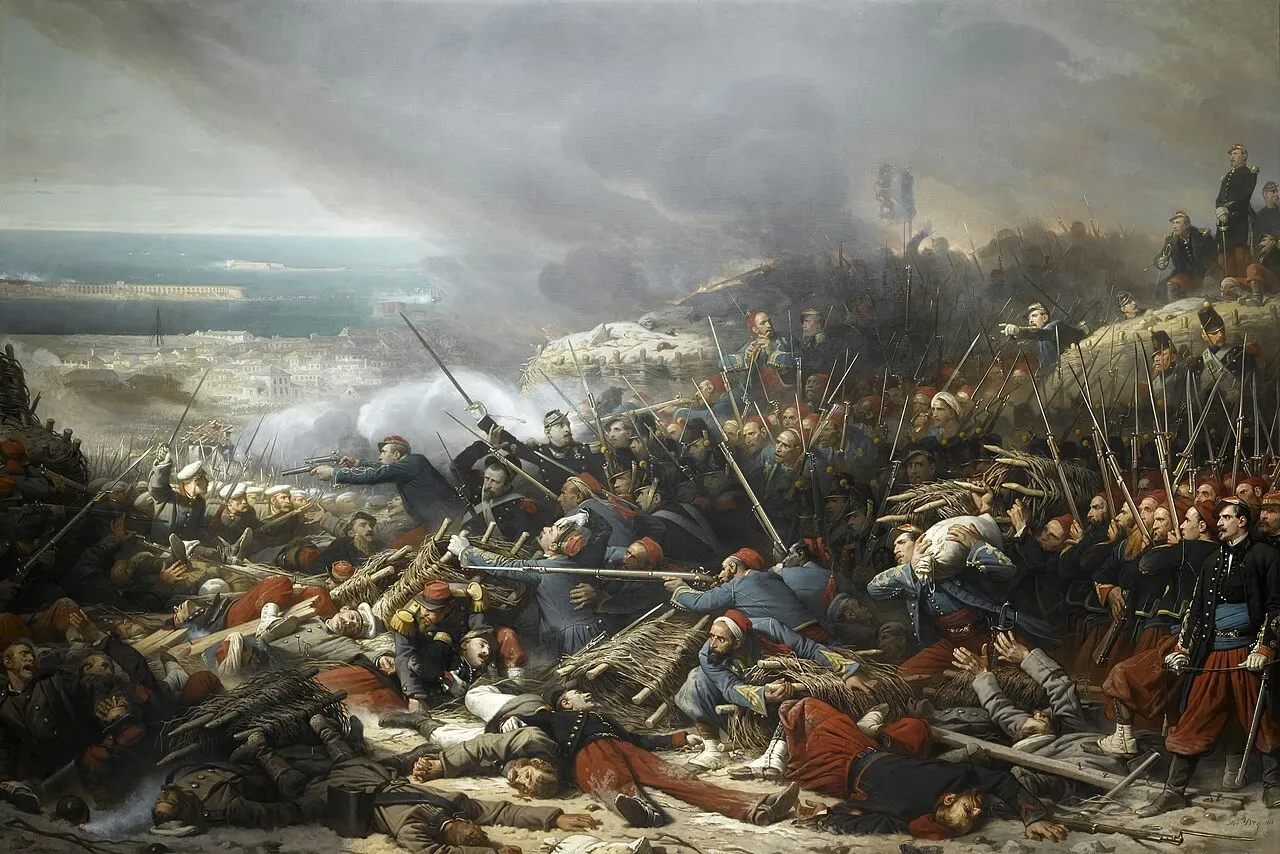
At twelve o’clock on 8 September 1855, French pocket watches clicked shut across the trenches outside Sevastopol. Within thirty minutes, an empire’s grandest illusion collapsed into a heap of shattered limestone. For 349 days, the Siege of Sevastopol had ground through tens of thousands of lives in the chalk and mud of Crimea. The entire southern fortress hinged on a single rounded knoll: the Malakhov Kurgan, crowned by the stone redoubt the French called the Malakoff. When General Patrice de MacMahon’s troops swarmed the ramparts and planted the Tricolour, the Crimean War was decided.
We tend to remember the Crimean War through Victorian incompetence: the blunder of the Light Brigade, the frozen shambles of Balaclava, and Florence Nightingale battling typhus at Scutari. Yet behind the bungling lay the mother of all modern wars. Crimea was the first conflict of the industrial era. Steamships delivered armies with timetabled precision; telegraph lines carried tactical updates straight to cabinets in London and Paris; and William Howard Russell’s dispatches in The Times gave the public their first taste of uncensored war reporting. In the trenches, rifled muskets tore through flesh at five times the range of Napoleonic smoothbores, while primitive ironclads traded fire with granite forts. Mechanised slaughter had arrived.
At the centre sat Tsar Nicholas I’s imperial hubris. For generations, the Romanov dynasty had eyed the weakening Ottoman Empire with predatory longing. St Petersburg did not just want border provinces; it wanted Tsargrad. The dream was the reconquest of Constantinople, the cross restored atop the Hagia Sophia, and absolute naval mastery over the Bosporus. Nicholas had branded the sultan “the sick man of Europe,” assuming the great powers would look away while Russia carved up the estate. He miscalculated. Neither Britain nor France would allow the Black Sea to become a Russian lake, or see the route to India menaced by a hostile fleet operating out of the Golden Horn. When Nicholas marched into the Danubian Principalities, London and Paris allied with Istanbul to strike back.
The Allies landed in Crimea in September 1854 expecting a brisk campaign. Instead, they walked into an eleven-month siege that prefigured the Western Front. Sevastopol was protected by nature and by engineering genius. Eduard Totleben, the twenty-six-year-old Russian chief engineer, transformed a dusty port into an interlocking maze of earthworks and timber-reinforced trenches. At the summit of the eastern line stood the Malakoff. Originally a two-storey white stone tower built by local merchants, Totleben had enveloped it in massive bastions, packing the ramparts with heavy naval guns stripped from warships scuttled in the harbour mouth.
Holding that hill was an abattoir. Russian soldiers endured suffocating casemates under ceaseless artillery fire. An ambitious young officer named Leo Tolstoy, stationed nearby, watched men torn apart by mortar splinters while waiting for an assault that seemed perpetually delayed. By the summer of 1855, the garrison was losing upwards of two hundred and fifty men every day merely repairing parapets. Russia was fighting on its own soil, yet its supply lines were broken. Without railways south of Moscow, it took three months to haul ammunition and conscripts by ox-cart across the steppe. Thousands of men and horses died of cholera before sighting the sea. Western steamships delivered supplies from Portsmouth faster than the Tsar could feed troops from his own heartland.
By September, the position was unendurable. Marshal Aimable Pélissier, the French commander, unleashed an overwhelming three-day bombardment. Over eight hundred guns hammered the works, smothering Sevastopol in a permanent pall of sulphur and pulverised stone. The final assault was timed for midday on 8 September. French planners knew that at noon the defenders rotated watches and retreated into bombproofs to eat soup.
When the bugles sounded, surprise was total. French sappers had driven trenches to within twenty-five metres of the ditch. MacMahon’s 1st Division surged out of the earth. Algerian Tirailleurs and Zouaves - in billowing red trousers and short jackets - vaulted the ditch and clawed up the revetments. The fighting inside was savage: clubbed rifles, entrenching spades, and bayonets among dismounted cannon. Zouave Eugène Libaut scrambled up the stone tower and secured the French Tricolour. When aides warned MacMahon that wires led to Russian powder mines beneath his feet and urged him to withdraw, he delivered the retort that would define his life: “J’y suis, j’y reste!” - “Here I am, and here I stay!”
He stayed. While a simultaneous British attack on the Great Redan collapsed under murderous canister fire, the French held the Malakoff against desperate counterattacks. The loss of the Kurgan was fatal. From its crest, French gunners could pour enfilading fire into every surrounding work and sweep the city below. Prince Mikhail Gorchakov saw that Sevastopol was lost. That night, Russian sappers laid fuses to their magazines, torched the barracks, and withdrew fifty thousand men across a swaying pontoon bridge to the north side of the bay. By morning, the Allies walked into a smoking ruin.
The fall of Sevastopol ended the war. The 1856 Treaty of Paris brought humiliating terms: the Black Sea was demilitarised, Russia was barred from keeping warships on its own coast, and dreams of carving up the Ottomans were buried. Nicholas I did not live to sign the peace; he had died months earlier, broken by defeat. His successor, Alexander II, drew the obvious conclusion. Serfdom was not merely a moral failure; it was an economic ruin that produced primitive logistics, an illiterate peasantry, and an army incapable of facing modern industrial states. The shock of the Malakoff forced Alexander to liberate twenty-three million serfs in 1861, setting in motion the turbulent modernisation that culminated in 1917.
The defeat also redrew the map of Europe. Realising it could never defend Pacific outposts against British sea power, Russia sold Alaska to the United States for pocket change in 1867. More crucially, the war destroyed the Holy Alliance between Russia and Austria. When Vienna refused to back St Petersburg, the conservative pact that had policed Europe since Waterloo dissolved. An alienated Russia stood aside a decade later while Prussia crushed Austria and forged the German Empire. The path toward the crises of 1914 began on the slopes of the Malakhov Kurgan.
I often wonder how different Europe would look if that limestone redoubt had held. Had the French assault broken on that September afternoon, an exhausted Allied coalition, bleeding from disease and facing domestic fury, might have abandoned the siege. Without that barrier, the Romanovs would have continued dismantling the Ottoman realm. Tsargrad would have ceased to be a mystical slogan. Russian ironclads would have sailed the Bosporus, the double-headed eagle would have flown over Constantinople, and the Eastern Mediterranean would have become a Russian preserve. The twentieth century would have unfolded on a fundamentally different axis.
Instead, Russian expansion stalled on a chalk hill outside Sevastopol. The Crimean peninsula remains one of the world’s most violently contested landscapes - a place where lines drawn on maps still trigger international conflict, as seen in the Soviet transfer of 1954 and its modern fallout. But the turning point was 8 September 1855. When MacMahon held his ground amid the smoke of the Malakoff, he did not just take a fortress. He slammed the door on Russian Constantinople and ensured the modern world arrived in fire and steel.