Rome’s birthday is 21 April 753 BC. We know this because a Roman scholar named Marcus Terentius Varro, writing in the first century BC, did the arithmetic — back through king-lists, consular fasti, and an astrological calculation he commissioned from his friend Lucius Tarutius — and arrived at that precise date. Before Varro, Rome had no agreed year of foundation. Greek chronographers had been producing guesses for a century, most of them in the ninth or eighth century BC, none of them matching. Varro’s reconstruction happened to win. From then on, Roman historians dated their world ab urbe condita, from the founding of the city, using a birthday a grammarian had calculated while Julius Caesar was still a teenager.
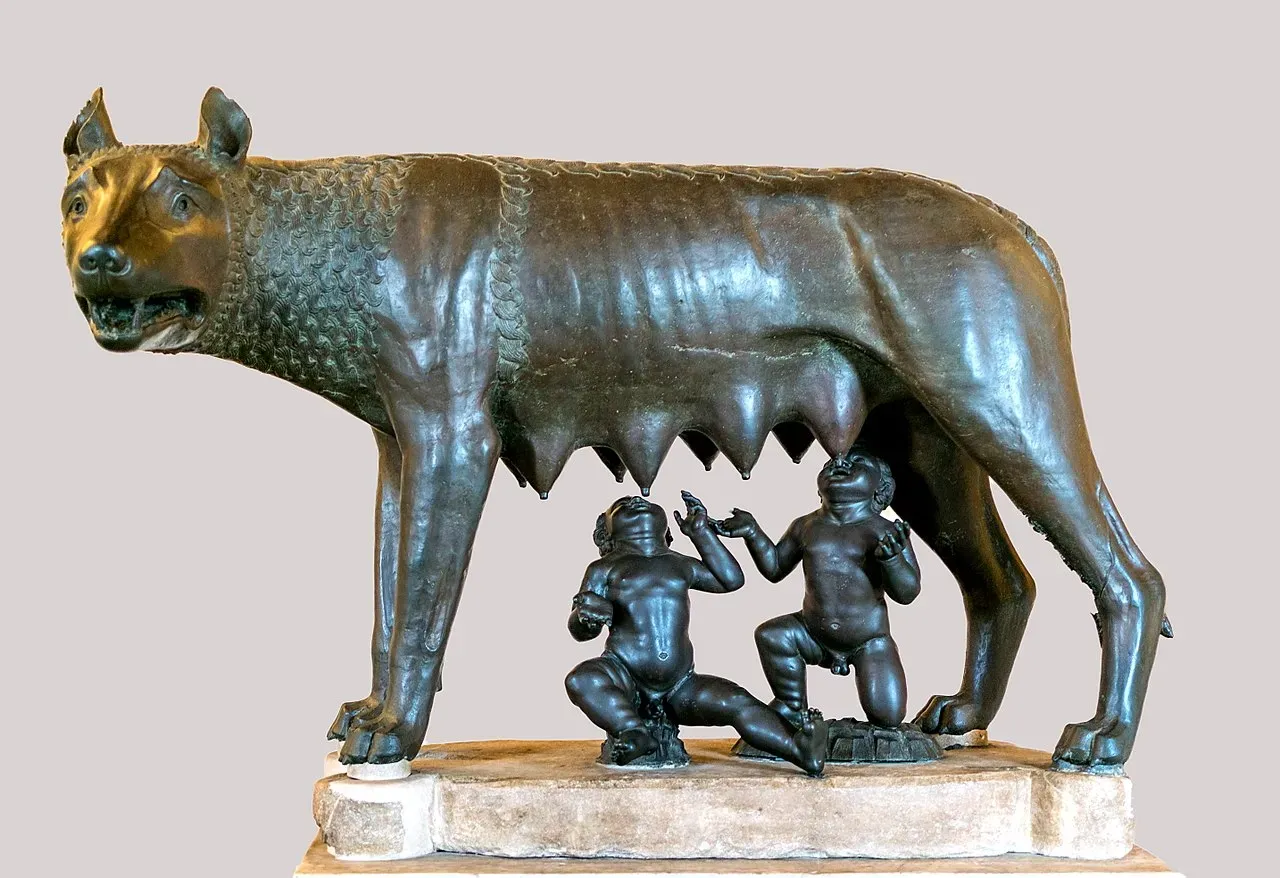
The occasion it commemorates is a story about brothers. Romulus and Remus, the twin sons of the god Mars and the Vestal Virgin Rhea Silvia, were exposed at birth on the banks of the Tiber by a wicked great-uncle. A she-wolf suckled them. A shepherd raised them. They grew up, killed the great-uncle, decided to found a city, quarrelled over which hill to build it on, and took the auspices. Romulus saw twelve vultures, Remus saw six. Romulus began to build a wall on the Palatine. Remus jumped over it in mockery. Romulus killed him. The city was named after the survivor. This was, unusually for a founding myth, a story the Romans themselves treated as embarrassingly violent. Livy records it without apology and without relish. The fratricide was part of the inheritance. Better to acknowledge it.
The archaeology tells a smaller, duller story. The hills between the Tiber and the Alban Mount were occupied from at least the tenth century BC by Iron Age villages of mud-walled, thatched huts. Dozens of such settlements existed across Latium, and the one on the Palatine was not obviously more important than its neighbours on the Aventine, Esquiline, or Caelian. What happened around the eighth century was that the separate villages began to coalesce, to drain the swampy ground of the Forum and pave it, to construct communal walls, to share a marketplace. The process produced something recognisably urban by the late seventh century. No wolves, no twins, no birthday. Just villages that decided to pool their resources and hire a king.
What the myth gets more or less right, and what the birthday obscures, is how unremarkable this beginning was. Rome in 753 BC, or whenever you prefer to date its actual emergence as a town, was a minor Latin settlement among dozens of Latin settlements, overshadowed by their more civilised northern neighbours the Etruscans and their more sophisticated southern cousins the Greek colonists of Cumae and Neapolis. Nothing on the Palatine suggested the city would matter. For four centuries, it largely didn’t. Rome became a regional power in central Italy by the fourth century BC, a serious one by the early third, the master of the peninsula by 270, and the master of the western Mediterranean by 241, after defeating Carthage in the first of the three wars it would fight with that city. In 146 BC it destroyed Carthage outright and in the same year sacked Corinth, the richest Greek city in the world. Two of the three great mercantile civilisations of the Mediterranean ended in the same consular year. The third, Ptolemaic Egypt, lasted another century and collapsed into Octavian’s lap in 30 BC.
By the time Augustus died in AD 14, Rome controlled everything worth controlling around the Mediterranean basin, from Portugal to Syria, from the Rhine to the Sahara. At its maximum under Trajan, a century later, the empire ran from the English border to the Persian Gulf. Then it split into two. The western half of Diocletian’s administrative division kept functioning, in progressively reduced form, until 476, when a Germanic general named Odoacer deposed a teenage emperor and wrote to Constantinople to say the western court was no longer required. The eastern half — the continuation we now call Byzantine, though its inhabitants kept calling themselves Romans right up until the end — lasted another thousand years, until Mehmed II’s cannon breached the walls of Constantinople on 29 May 1453. From Varro’s notional birthday to the fall of the City on the Bosphorus is 2,206 years. No other political entity in Western history has come close.
The sum total of what Rome did to the world outside its shifting borders, and to the world inside them, cannot be summarised honestly in a paragraph. Consider only the most obvious. Every Romance language descends directly from the Latin spoken on the streets of the imperial city: French, Spanish, Portuguese, Italian, Romanian, Catalan, and their branches are, structurally, Latin that kept drifting after the empire’s postal service collapsed. English is not Romance, but up to 3/4 of its vocabulary is Latin, inherited through French after 1066 and through direct scholarly borrowing ever since. The alphabet you are reading these letters in is Roman, adapted from the Etruscan adaptation of the Greek. The calendar by which this post is dated is Roman in structure, reformed by Julius Caesar in 46 BC, refined by Pope Gregory XIII in 1582, but Julian at the bones. The months of July and August bear the names of the two men who between them finished off the Republic.
Roman law is the harder inheritance to trace and the more consequential. Justinian’s Corpus Juris Civilis, compiled in Constantinople in the 530s from a thousand years of legal tradition, was rediscovered in the West in the eleventh century and became the basis of every continental European civil code that followed. French, German, Italian, Spanish codes; by onward borrowing, most of Latin America, parts of Africa, the civil law countries of Asia. English common law is not Roman in its formal structure, but the Roman concepts of property, contract, delict, and legal personality run through it regardless. The words with which I wrote the last sentence — contract, property, justice, republic, senate, constitution, citizen — are all Latin, most of them carrying the technical meaning the Romans gave them.
The Catholic Church inherited rather more directly. Its administrative units — dioceses — are literally the provinces Diocletian drew. Bishops descend from provincial officials. The Pope occupies the old capital and carries the title pontifex maximus, stripped from the state religion of Rome in AD 382 and reused. The Latin liturgy ran for a millennium and a half and still does, in places. The Orthodox church inherits the eastern continuation more plainly. Christianity as an institution is Rome with a different theology layered on top.
None of this was an unalloyed gift. Rome invented nothing about imperialism, but it perfected several techniques the later European empires would borrow wholesale: the civilising mission as justification, the client-king arrangement, the extractive province, the triumphal parade of captives, the industrial-scale slavery that kept its agricultural economy running. Plutarch estimated that Caesar’s Gallic wars alone killed a million Celts and enslaved another million. The figures are contested. The order of magnitude is not. When the British and French empires of the nineteenth century reached for a model, they reached for Rome, and the models they picked up were the uglier ones as often as the more palatable. The American founders modelled their Senate and their republic on the Roman ones, but the Roman Senate happily presided over the slow conversion of a citizen republic into an autocratic empire, and the American one has not been immune from the same temptation.
The vocabulary itself is a confession. The word “empire” is Roman. So is “dictator” — a magistracy Cincinnatus resigned from in sixteen days and Sulla kept for years and Caesar turned permanent. So is “republic”, res publica, the public thing, the concept that a state can exist without a personal ruler on top. The argument between Cicero and Caesar about what to do with a political system that has outgrown its original institutions is an argument we have not finished having. The decisions Augustus made about how to run an empire that could not admit it was one shape how modern executive power relates to its legislatures today, in ways the founders of those legislatures would have recognised.
Whether any of this justifies celebrating a birthday that Varro calculated from horoscopes, I leave to the individual reader. What stands out is that the only reason the birthday exists is that the Romans cared about chronology enough to construct one retroactively, from fragments, with more confidence than the evidence warranted. That habit — of giving history a precise date and a named protagonist when a fuzzy century and a collective process would do — is itself Roman. Every schoolbook’s list of founding dates, every nationalist parade on an invented anniversary, every breathless countdown to a centennial, descends from the same scholarly impulse Varro had in the first century BC, when he decided a city that had existed for around seven hundred years needed, finally, a birthday.
It is Rome’s birthday on 21 April. The date is made up. The empire is gone. Its shadow is longer than any other in the Western world, and we keep living in it.